Trending Topics

 Trending
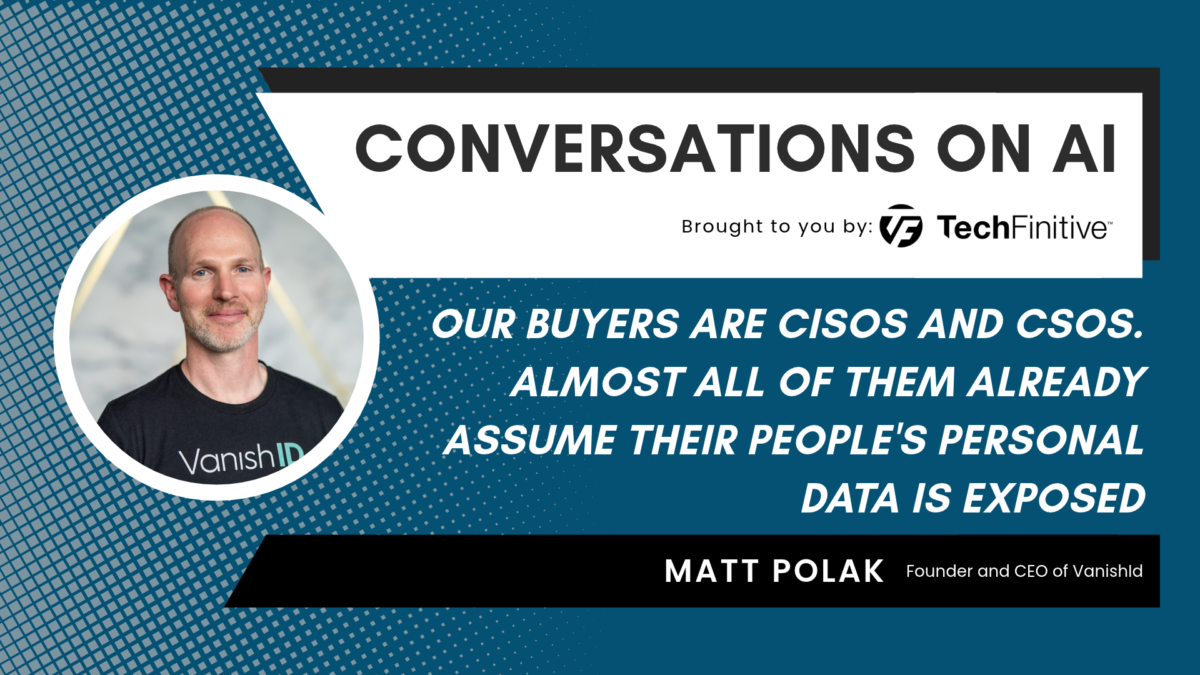
Matt Polak, Founder and CEO of VanishId: “Our buyers are CISOs and CSOs. Almost all of them already assume their people’s personal data is exposed.”

Verifying identity is perhaps one of the biggest challenges AI creates – and it goes to the core of Matt Polak’s agenda as CEO of VanishID. With a focus on External Identity Security, the company aims to stop bad actors from hacking individuals outside the company’s network and accessing sensitive company information.
With AI reducing the manual labour it takes to target individuals, all employees now have a target on their back. “The number that matters isn’t what AI does for defenders, but instead what AI does to the cost of reconnaissance,” Matt told us. “When reconnaissance gets cheap, the target set expands from twelve executives to the whole employee directory.”
The required shift is from collecting information to turning it into action.
Beyond Detection: How can we turn detection into actionable defence?
Many AI models focus on detection and reporting but stop there. What’s needed are products that can take analysis and compare it to something ‘outside’ the model – something checkable – and that’s the focus for VanishID. Matt said: “Compare these types of outcomes to a model that generates a paragraph of analysis. Nobody can tell you whether the paragraph is right or wrong, and the vendor can’t either. That’s where most ‘AI-powered’ claims live.”
With the middle of the org chart increasingly a target, what matters to CISOs – VanishID’s customers – is knowing where to prioritise. “The job is deciding which exposure matters and what to do about it,” Matt explained. “The work we replace is collection. Stitching one person’s addresses, relatives, breach records, voice samples, writing samples and reporting line into a single view took an analyst days. Advancing AI models have made this process faster. Now it runs on a loop.”
And that demands turning noise into something that’s actionable. “It’s trivial to generate a finding for an exposure that 99% of adults have. That isn’t a detection; it’s a fact about the world.” “Signal comes from context. Is it recent, is it removable, does it sit next to three other things that complete an attack?” Matt said.
With over twenty-five years of experience spanning intelligence, strategy, investing, and entrepreneurship, Matt balances innovation and responsible AI. As he explains, VanishID’s approach combines hunting for exposed personal data, analysing the information against data sets and remediating threats in a way that sends an easy, actionable signal to the CISO.
Where is the industry overestimating AI’s impact, and where is it underestimating it?
There are two overestimates: autonomy and the interface. Every demo shows an agent running a program end to end. In practice, most organisations let agents handle collection and correlation, and then a person still decides. On the interface, many teams build a chat window on top of a database and call it transformation, but security leaders don’t want another window. They want the problem solved. They don’t need more information; they need fewer problems.
Where the industry badly underestimates AI is the attacker’s economics. Targeting a person used to be manual labour. One operator, a few targets, hours or days per attack. Trend Micro showed in February 2026 that public LinkedIn data turns into a tailored attack in about thirty minutes. CrowdStrike’s 2026 Global Threat Report put AI-enabled adversary operations up 89% year over year, with eCrime breakout time at 29 minutes. Verizon’s 2026 DBIR found 65% of AI-assisted attacks target people.
So, the number that matters isn’t what AI does for defenders, but instead what AI does to the cost of reconnaissance. When reconnaissance gets cheap, the target set expands from twelve executives to the whole employee directory.
What separates real customer value from companies simply adding AI features?
Two tests. Is the output checkable, and does it end in an action?
Checkable means there’s a right answer somewhere outside the model. Our highest volume AI workloads take actions like stepping up risk-based authentication, enriching an identity inside a customer’s SIEM [Security Information and Event Management], or submitting a removal request to an external site. These workflows check themselves: an MFA request was verified, a profile record was updated, an external identity record was removed.
Compare these types of outcomes to a model that generates a paragraph of analysis. Nobody can tell you whether the paragraph is right or wrong, and the vendor can’t either. That’s where most “AI-powered” claims live.
We got this wrong internally before we got it right. Detection alone is a demo. Detection stitched to a countermeasure the customer already owns is a product. And if a vendor can’t name the control their output drives, the AI is decorative.
How is AI changing the role of your customers?
Our buyers are CISOs and CSOs. Almost all of them already assume their people’s personal data is exposed. Many assume nothing can be done about it, because you can’t unpublish the internet. So, the job was never “find exposure.” The job is deciding which exposure matters and what to do about it, and that used to be impossible at scale because assembling the picture was manual labour.
The work we replace is collection. Stitching one person’s addresses, relatives, breach records, voice samples, writing samples and reporting line into a single view took an analyst days. Advancing AI models have made this process faster. Now it runs on a loop.
The work we augment is judgment. Which attack does this exposure enable? Which control you already own breaks the chain?
What genuinely changes is scope. When reconnaissance was expensive, protection was an executive program. Twelve people, a vendor, an annual report. Now that it’s cheap, the middle of the org chart is a viable entry point, and the program has to cover thousands.
What has been the hardest challenge in bringing AI into your products?
The hardest thing has been data quality, specifically identity resolution. Before you can say anything intelligent about a person’s exposure, you have to know which records are actually theirs. Plenty of people share a name. Get that wrong, and every downstream conclusion is wrong, which is worse than saying nothing.
Right behind it is noise. It’s trivial to generate a finding for an exposure that 99% of adults have. That isn’t a detection; it’s a fact about the world. Signal comes from context. Is it recent, is it removable, does it sit next to three other things that complete an attack?
Are applications becoming collections of agents, or will conventional interfaces stay central?
Our product runs three layers. Recon agents hunt for exposed personal data across brokers, public records, breach repositories and social sources. Analyst agents map what was found onto specific attack recipes. Remediation agents run the takedowns, and they have to work through opt-out flows that change without notice, which is exactly the messy unstructured task agents are good at.
We deliberately didn’t build an AI agent that sits in the SOC and tries to be the analyst. That space is crowded and it would pull us off what we’re actually good at. Instead, we provide inference-time identity intelligence to agentic platforms our customers are already using.
Agents are taking over the work. Interfaces aren’t going away; they’re getting thinner and moving. The security leader doesn’t want to visit our dashboard. They want a signal in Okta or Entra that triggers a step-up, or an enrichment in the SIEM that makes an alert make sense.
So, the interface stops being where the work happens and becomes where you verify it happened. Audit, override, disable. That’s a smaller surface than today’s dashboards, and a more important one.
How do you balance innovation with responsible AI?
We sort data by source before any model sees it. Public records and operational context can go to frontier models. Dark web and breach repository content, which can carry passwords, Social Security numbers and payment cards, only ever touches a privately deployed open-weights model running inside our own environment. No customer data trains anything.
We also think people are important to these types of systems. Human analysts review and approve key decisions that have downstream implications. That gate can slow us down, but we feel it’s appropriate at this stage.
We have built instrumentation into our systems that lets us provide verifiable outcomes to customers, not marketing fluff and bold claims that can’t be substantiated.
You might also be interested
- Kenny Johnston, Chief Product Officer, Azul: “Runtimes could become a catch-all barrier for security exploits that don’t require code changes.”
- Staffan Ever, CEO of Pure Battery Technologies (PBT): “I think one of Europe’s biggest challenges is converting strategic plans and desire into bankable demand”
- Michael Curry, President of Data Modernisation at Rocket Software: “Ultimately, trust is what determines whether AI initiatives succeed”
- Geoff Thomas, Senior Vice President, Asia Pacific and Japan, Infor: “The most meaningful change is in how people spend their time”
About The Author

Sarah Kidner
NEXT UP