Trending Topics

 Trending
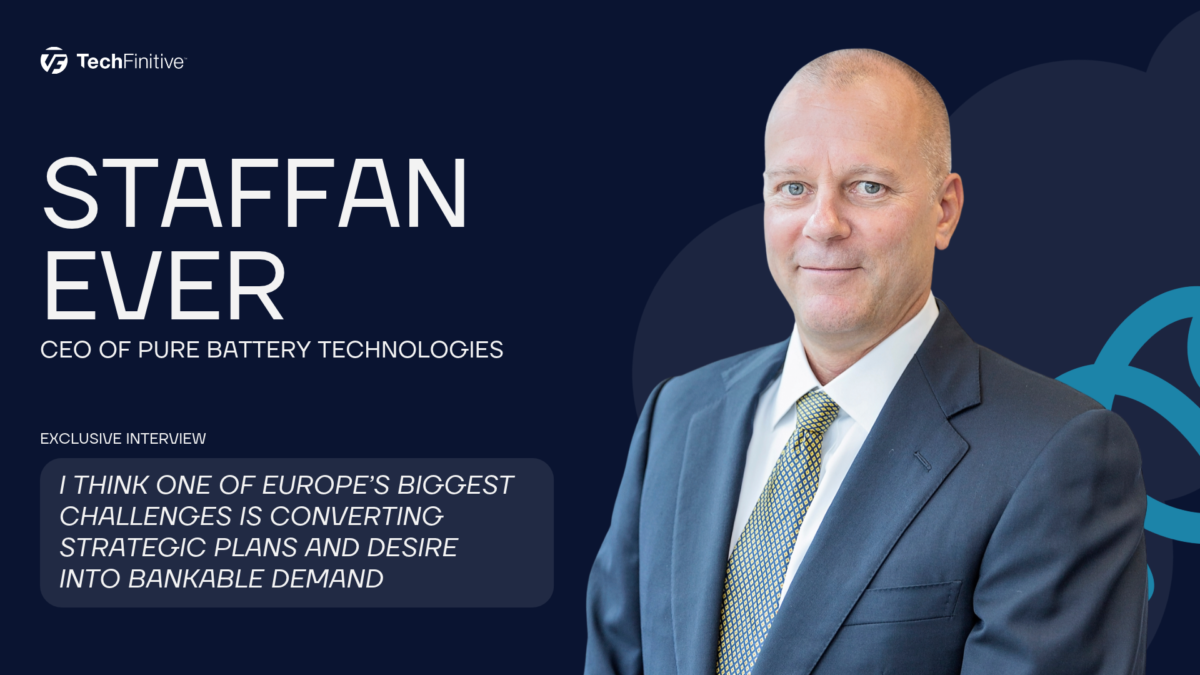
Staffan Ever, CEO of Pure Battery Technologies (PBT): “I think one of Europe’s biggest challenges is converting strategic plans and desire into bankable demand”

Europe’s ambitions to build a domestic battery supply chain face a familiar problem: securing the raw materials is only part of the challenge. Turning those materials into battery-grade products at a commercially competitive price is another matter entirely. For European refiners, high energy and labour costs, fragmented supply chains and competition from established overseas producers all make the economics difficult.
Staffan Ever, CEO of Pure Battery Technologies (PBT), believes Europe needs to rethink how it processes battery materials if it is to compete. The company has developed a refining process that takes nickel intermediates from either mined material or recycled batteries directly to precursor cathode active material (pCAM), avoiding several stages used in conventional production. PBT says this reduces equipment requirements, energy consumption and operating costs, with capital costs 40-50% lower than those of a conventional plant on a like-for-like basis.
The company’s German refinery in Hagen has been named a Strategic Project under the EU Critical Raw Materials Act, one of only five selected for integrated processing and recycling. The designation provides additional support as PBT works to secure the financing and customer commitments needed to expand production capacity to 15,000 tonnes of pCAM a year. But, as Ever makes clear, recognition and public funding alone will not get a refinery built. Long-term offtake agreements remain essential to making the project commercially viable.
There is also the question of how quickly battery chemistry will evolve. While nickel manganese cobalt (NMC) remains an important chemistry, manufacturers are exploring alternatives including lithium manganese-rich (LMR) and lithium manganese nickel oxide (LMNO). PBT says its process can accommodate these emerging materials, giving it flexibility as demand changes.
In this interview, Ever discusses the economics of European battery materials production, the obstacles to securing investment and customer commitments, and why technological innovation – rather than policy support alone – will determine whether Europe’s refining industry can become commercially sustainable.
PBT’s German refinery has been named a Strategic Project under the EU Critical Raw Materials Act, with only five of the 46 selected projects recognised for integrated processing and recycling. What does this designation change in practical terms for PBT, beyond the recognition itself?
The practical value is that it helps reduce two of the biggest risks facing new critical-mineral processing projects in Europe: access to capital and certainty of demand.
Hagen is already permitted, so for us this is less about accelerating approvals and more about getting our commercially viable project into production. Strategic Project status gives us access to coordinated support around financing and, importantly, the mechanisms Europe is putting in place to connect strategic projects with potential customers.
It is also meaningful independent validation. The Commission has assessed whether these projects genuinely contribute to European supply-chain resilience, whether they are technically feasible and whether they can be delivered sustainably. As you point out, we are one of only five that were selected for integrated processing. This endorsement is particularly helpful as we seek to finalise funding and offtake.
You’ve said that “a refinery without customers does not get built”. Why has securing long-term offtake agreements been such a significant obstacle for Europe’s emerging critical minerals refining industry, and how could the Strategic Project designation help turn interest from manufacturers into firm commitments?
I think one of Europe’s biggest challenges is converting strategic plans and desire into bankable demand.
There is broad agreement that Europe needs a more resilient critical-minerals supply chain. Manufacturers want greater diversification and governments want more processing in Europe.
Two structural issues make offtake difficult. First, a qualification deadlock: lenders need long-term offtake to finance a plant, but manufacturers can only commit once a material is qualified, and that requires product from the commercial plant itself. A refinery without customers does not get built.
Second, Europe’s midstream is fragmented. Sulfates, pCAM, cathode material and cells are separate steps, each dependent on the next.
The Commission can help break that cycle by bringing strategic projects, manufacturers and finance together across the value chain, and by providing greater confidence that selected projects form part of Europe’s long-term industrial strategy.
European manufacturers want to diversify their battery materials supply chains, but they must remain competitive with imported materials. How does PBT’s refining technology enable you to compete on cost, and where are the biggest cost pressures when refining battery metals in Europe?
This is really the central issue for European critical-mineral processing.
Europe can identify strategic projects and support construction, but if the material coming out of those facilities is fundamentally uncompetitive, you haven’t solved the long-term supply-chain problem.
The conventional route for nickel-based battery materials relies on technologies such as solvent extraction and salt crystallisation. They are proven, but they are decades old and were developed for a different industry. They are cost-, reagent- and energy-intensive, and every additional stage means more equipment, labour and capital. They work well at very large scale, where energy and labour are cheaper, which is how established overseas producers have built their position.
Europe has a different cost base. European processors cannot compete by taking the same process and simply building it here. The cost base is different, so the process has to be different. That is where innovation is key.
PBT’s process takes nickel intermediates, either MHP from mines or black mass from recycled batteries, directly to pCAM. It avoids organic solvents and skips the sulphate crystallisation step the conventional route depends on. Fewer process steps means less equipment, fewer reagents and less energy per tonne, and a smaller, less complex plant needs fewer people to run it. On a like-for-like basis, our capital cost is 40-50% lower than a conventional plant. In Europe the biggest cost pressures are power and labour, and that is exactly where a shorter flowsheet pays off.
PBT’s Hagen refinery is permitted to expand production to 15,000 tonnes per year of precursor cathode active material (pCAM), with support including a €36.7 million European Investment Bank loan and a €23 million conditional German government grant. What still needs to happen to finance and deliver the expansion, and what role will customer commitments play in unlocking the next stage?
We have already de-risked a significant part of the project. We have an operating industrial site, the permits, the technology, an experienced team and substantial institutional support.
The remaining pieces are the equity component of the financing package and customer commitments, and the two close together. Capital providers quite reasonably want to understand who will buy the material and at what scale. Customers, meanwhile, want confidence around financing, construction, qualification and delivery. Once both are in place, we take a final investment decision and move into delivery of the expansion.
That is why I keep coming back to offtake. It isn’t simply a sales agreement at the end of project development; it is part of what makes a processing project financeable in the first place.
For Europe more broadly, this is an important lesson. We have spent a lot of time talking about how to fund new critical-mineral projects. We also need to focus on creating enough long-term demand certainty for those projects to attract capital.
The European Commission is considering stronger sourcing requirements if incentives alone fail to diversify supply chains. Would binding obligations give European refiners the certainty they need to invest, or risk making battery production more expensive for manufacturers? Where should policymakers draw the line between supply-chain resilience and commercial competitiveness?
I don’t think resilience and competitiveness can be treated as opposing objectives. Europe ultimately needs both.
There is a genuine market problem at the moment. Europe is asking companies to invest significant capital in new processing capacity, but those projects are then expected to compete immediately against established supply chains that have scale, infrastructure and decades of investment behind them.
Policy also needs to level the playing field. European producers operate under high environmental, labour and safety standards, and those standards should be respected. Imported material often comes from highly integrated supply chains, where costs can be spread across several steps. European new entrants operate in a siloed supply chain, where each step must stand on its own economics, and they face prices they struggle to match before they reach scale.
But scale is only part of the problem. A European refiner using the same technology as China, with much higher power and labour costs, cannot compete, whatever the policy support.
Binding requirements can help new producers through the start-up phase and give investors confidence that there will be a market for European production. Without technology improvements, though, they only defer the problem. To be competitive in the long term, policy also has to support the innovation that brings the cost of production down.
Obligations also need to reach the midstream. Requirements set at vehicle or cell level do not automatically pull through to pCAM, and Europe today has very limited, if any, commercially viable pCAM production.
If stronger sourcing requirements are introduced, their purpose should be to create diversification and resilience while the industry develops scale, not to institutionalise a permanent price premium. The end point has to be a European critical-minerals industry that can stand on its own commercially.
PBT’s process can produce materials for emerging lithium manganese-rich (LMR) and lithium manganese nickel oxide (LMNO) battery chemistries, as well as conventional battery applications. How important is this flexibility as battery technology evolves, and what will determine whether European refiners can build a sustainable business rather than depend on policy support?
This is another area where processing technology has to stay ahead of the curve. The battery industry is evolving rapidly, and the chemistry that dominates one part of the market today may not be the chemistry customers want in five or ten years.
NMC has been a major chemistry for higher-energy EV applications, but manufacturers are now exploring a much broader range of technologies as they balance cost, energy density, safety, performance and access to critical minerals. Manganese-rich chemistries such as LMR and LMNO are attracting increasing attention, and our R&D team has been working to make sure PBT can respond as that market develops.
For PBT, that flexibility matters commercially. To be viable over the long term we have to meet the market where it is going, not just where it is today. Our process can be adapted to produce LMNO or LMR pCAM as well as conventional NMC precursor.
Policy support can help establish capacity, but it cannot make a processor competitive. Input costs in Europe are higher, so we believe a European refiner has to use new, improved technology and protect that advantage through patents and IP. Black mass from domestic recycling will be part of the solution as well, giving European refiners feedstock that doesn’t depend on imports. The businesses that succeed will be those that can adapt their feedstocks, products and processes as the market evolves, while producing at a cost customers can support.
You might also be interested
- Behind the scenes of the HPE Technology Renewal Centre in Erskine… and why it’s such an important part of HPE’s strategy
- The real message behind Schneider Electric and Nvidia’s new blueprint for the AI data centre
- UK’s sovereign AI investment raises questions over control, governance and security
- Intel doubles down on European manufacturing with €5 billion investment in Ireland fab
About The Author