Trending Topics

 Trending
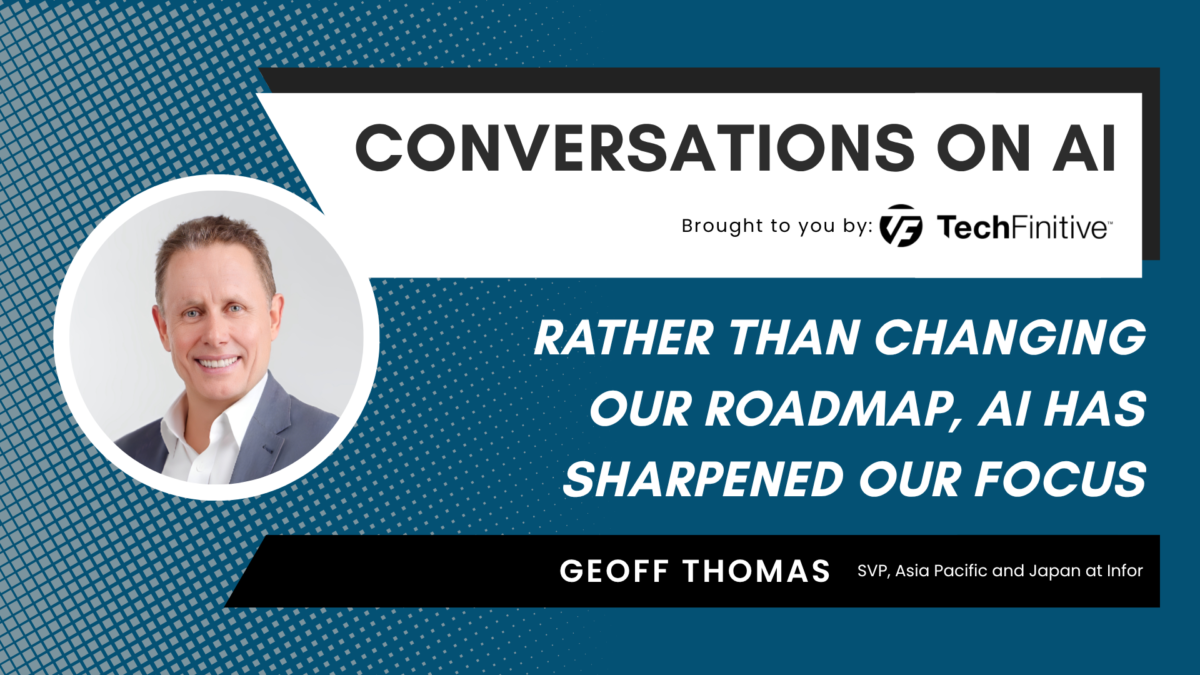
Geoff Thomas, Senior Vice President, Asia Pacific and Japan, Infor: “The most meaningful change is in how people spend their time”

Infor describes itself as the Industry Cloud Complete company, providing crucial services to over 65,000 organisations worldwide. In February, it appointed Geoff Thomas as Senior Vice President and General Manager for Asia Pacific and Japan (APJ), and we’re delighted to interview him as part of our Conversations on AI series. We suspected he would have a lot to say on the subject, having held senior positions at Qlik, Microsoft, Juniper Networks, Polycom and OneLogin, and we weren’t disappointed.
Let’s start with the fact that he’s a fan of efficiency, and he’s not seeing enough of that right now. “Using the most expensive [AI] model for easy tasks is like driving an F1 car to the grocery store,” he said. “So, enterprises must ensure they architect AI the right way to avoid unnecessary costs.”
Geoff also has insight on how ERP is shifting “to enterprise resource execution (ERX) – from a system of record to a system of execution. For years, the job of enterprise software was merely to record. But expectations are changing fast.”
In practice, that means an expectation that we can delegate tasks to AI in the knowledge that it understands how our business works. And to do so in an integrated manner. “For example,” said Geoff, “while a system of record can tell a manufacturer that the line went down last week, a system of execution sees the shortage coming. It can secure a supplier who still meets the deadline and keeps the line running.”
This doesn’t mean that ERP as a sector is going to disappear (we’re seeing “disruption, not complete annihilation”, says Geoff) but will instead transform into something new… but highly related. “. AI is not removing the need for enterprise systems but is changing what those systems must become. “Industry-specific SaaS will be essential to the reliability of autonomous AI, not bolt-on industry add-ons,” he emphasised.
Read on to discover Geoff’s taking on everything from the impact of AI in the tech industry as a whole and on Infor itself.
Everyone says AI is transforming software, but where do you believe the industry is still overestimating its impact, and where is it underestimating it?
We continue to be surprised by how quickly things are advancing in 90-day increments. We’re shocked that what wasn’t possible 98 days ago is now possible, and it doesn’t look like that’s going to slow down. As AI becomes more efficient and more capable, I think usage will expand, so I’m optimistic that things will stay up and to the right for quite some time.
What’s really making headlines is token consumption and spending, driven by several factors. One is the shift towards agentic AI. If we look back a couple of years ago – or even to last year – most AI interactions were through chatbots, such as email, which is not very token-intensive.
On the other hand, using agents is incredibly token-intensive because multiple steps and automations are required. Consider processing an invoice, something every company does. The invoice has to be pulled, scanned and matched to a purchase order. If it doesn’t align, it must go through a series of approvals within the company. Then it has to be sent and paid. Each of these steps consumes tokens and chaining them together is hugely token-intensive.
Token spend is down 90% but usage is up 510 times, and that’s a function of all the new agentic capabilities on the market. Inefficient use of agentic AI models is also increasing: using the most expensive model for easy tasks is like driving an F1 car to the grocery store. So, enterprises must ensure they architect AI the right way to avoid unnecessary costs.
How has AI changed your company’s product roadmap over the past 18 months? Were there projects you accelerated, delayed or abandoned altogether?
Rather than changing our roadmap, AI has sharpened our focus. We’re seeing a shift from ERP to enterprise resource execution (ERX) – from a system of record to a system of execution. For years, the job of enterprise software was merely to record. But expectations are changing fast.
With AI, a core system can not only remember but also act on what is happening. For example, while a system of record can tell a manufacturer that the line went down last week, a system of execution sees the shortage coming. It can secure a supplier who still meets the deadline and keeps the line running.
ERX isn’t exactly a pivot for us or a rebrand. It’s more of a validation of what we have already built – our existing roadmap – and the journey our customers are now on, so it’s an acceleration of that strategy.
It’s important to bear in mind that language models like Claude, Gemini, and ChatGPT are, in their base form, industry-agnostic. A general model can reason about your industry, but it cannot run it, because it does not know your processes, data, or rules. With our products, we take that industry knowledge, context and expertise and turn it into a capable agent that can act.
Many SaaS vendors now describe themselves as “AI-powered”. What actually separates companies creating real customer value from those simply adding AI features?
Real customer value happens when organisations aren’t just implementing AI to tick a box. They understand their industry and constraints, and they choose a software partner that shares this understanding and offers a vertical solution tailored to their industry.
One of the biggest lessons we’ve learnt is that AI should no longer be viewed as another software product, but as a service that must continually evolve alongside the business. You need a deep understanding of the customer and their sector first. Our forward-deployed engineers work with customers to develop solutions in real time.
Every industry has its own risks. A hospital weighs regulatory compliance and supply continuity for clinical care differently than a manufacturer weighs supplier performance against just-in-time schedules. A food producer must factor in perishability and seasonal demand, while a distributor must balance inventory across multiple channels.
This is why AI agents are only as good as the industry context behind them. To build a truly agentic enterprise, you need AI built for your industry and deeply embedded in your business processes.
Vertical ERP systems are built around the operational realities of specific industries, where workflows, compliance requirements and production logic vary enormously.
SaaS vendors who take a more general, horizontal approach won’t be able to deliver this level of operational specificity and the value that really drives growth. They may have impressive demonstrations, but they lack the domain expertise needed to drive meaningful transformation.
What is the biggest misconception enterprise customers still have about adopting AI within business-critical software?
AI is advancing too quickly for rigid strategies and for the traditional enterprise software model, in which a vendor builds, tests, implements and supports a product in a relatively linear fashion.
Instead, organisations need an approach that enables them to continually identify opportunities, deploy new capabilities, measure results and refine processes over time.
According to our research, 80% of enterprise decision-makers believe their organisations have the internal capability to manage AI implementations. However, nearly half remain stuck in the earliest stages of adoption, whether running limited pilots, pausing initiatives, or not yet deploying AI into production.
That confidence gap shows up at the individual level too. A recent Prosper Insights & Analytics survey found that 53% of executives and business owners say they already use generative AI, compared with just 38% of employees. This suggests the disconnect between belief and execution runs through the entire organisational chart, not simply the boardroom.
More than one-quarter of respondents also said they were unsure or disagreed that their organisation’s data was mature and well-governed enough to support reliable AI. That is significant because even the most sophisticated foundation models depend on high-quality enterprise data to generate trustworthy outcomes, and nearly half of AI-generated outputs still require manual review before organisations trust them in regulated or mission-critical environments.
How is AI changing the role of your customers? Are you replacing repetitive work, augmenting decision-making, or fundamentally changing how people do their jobs?
We’re seeing all three across multiple verticals. In many organisations, there remains an over-reliance on spreadsheets, emails and manual processes, with staff focused on transactional rather than analytical activities. AI addresses all of this: automating intensive manual processes and delivering insights. We’ve now reached the agentic phase, where it will also execute.
For example, we recently worked with Nutreco, a leader in animal nutrition and aquafeed, to strengthen its forecasting capabilities. Nutreco had a forecasting tool in place, but adoption varied widely across countries and teams, and a significant portion of the planning process still depended on manual steps and spreadsheets running in parallel.
By switching to a platform with an AI-driven statistical forecasting engine, large, diverse datasets across product categories and markets could be analysed while maintaining local relevance. This has greatly improved Nutreco’s forecast accuracy across the 35 countries it operates in and reduced manual effort.
Some of the other examples we’ve seen among our enterprise AI customers include accelerating pricing decisions across their supply chains, optimising inventory management in real time, and enabling new product development through AI-driven insights. Another Infor customer can now manage complexity across 90 countries using precision pricing logic tailored to distribution constraints.
There’s growing discussion around AI agents replacing traditional software workflows. Do you see the future as applications becoming collections of intelligent agents, or will conventional interfaces remain central?
We see it as orchestration, with AI becoming “invisible” and embedded in platforms and workflows. When someone buys a product online, they only see the website and a ‘checkout’ button, not the dozens of systems coordinating inventory, payments, warehousing, fulfillment and customer communications in the background.
AI is following a similar trajectory. While the first phase of generative AI focused on helping individuals complete tasks, the next phase focuses on orchestration. Instead of individual productivity tools, AI will coordinate activity across people, systems and processes. In doing so, it will fade from view.
This shift will be a fundamental change in how organisations approach AI. It’s about organisation-wide coordination, rather than individual productivity gains.
This means connecting workflows across departments and business functions. Information will move automatically between systems, enabling routine decisions to be made in real time. Processes that previously required manual coordination will be managed dynamically in response to changing business conditions.
This also has huge benefits for sectors with high churn, such as hospitality, where staff turnover is near constant. When employees leave, they take specialist knowledge with them. New employees typically start with little to no training or knowledge of the systems and processes used by their predecessors.
This is where AI can act as an “institutional brain” that retains knowledge across staff changes and connects and distills complex performance metrics into plain-language briefings. Embedded across the organisation and working in the background, it means staff don’t have to be trained on multiple tools or spreadsheets – they can interact with it through natural language.
How do you balance innovation with responsible AI? Where do you draw the line between moving quickly and ensuring customers can trust the outputs?
Strong governance is the foundation of our long-term sustainability and business integrity. Growth must not compromise our customers, employees, partners or communities. To do this, we maintain robust risk management frameworks that guide operational, financial, regulatory, and reputational oversight, protecting stakeholders and ensuring sustainable business continuity.
For example, we ensure that proprietary enterprise data is neither stored nor repurposed to train public or shared large language models. Our products run on Amazon Web Services (AWS), which uses enterprise security tools such as KMS, IAM and WAF to keep tenant data fully partitioned and encrypted. We also use monitoring solutions such as LangSmith and AWS CloudWatch to audit accuracy, trace system reasoning, track error rates and maintain governance of multi-agent workflows.
This is all the more critical as we move into the agentic era. As organisations progress from simple single agents to sophisticated multi-agent orchestration, success depends on maintaining a careful balance between scalable autonomy and transparent control. Agents must remain trustworthy partners in enterprise operations.
The adoption of generative AI is nuanced and requires careful consideration. Infor GenAI features are designed with a ‘human-in-the-loop’ approach. A business user must review any AI-generated text or responses before use. Business users gain productivity benefits while retaining full control over whether to apply the outputs.
Guiding our business, we have a Global Code of Ethics & Compliance that outlines clear expectations for ethical conduct, integrity and responsible business practices. All leaders are fully accountable for upholding our values, and all employees receive training and resources to understand and uphold them. For us, governance is not simply a policy, but a shared responsibility embedded in our culture and decision-making.
Beyond productivity gains, what business outcome are your customers most excited about when they invest in AI?
Productivity is often the starting point, with benefits including greater efficiency, reduced manual labour, and better oversight of operations. But there’s an increasing focus on better decision-making and on how AI can ultimately drive sustainable business growth and expansion into new products and markets.
Our customers are excited about this potential. Team Air Distributing, a US-based heating, ventilation, and air conditioning (HVAC) provider, has used our platform to create an agentic enterprise where AI agents, automation, and employees work together across daily distribution workflows. Inventory sourcing search time has been cut by up to 90%, and the company is targeting 95% automation of advance invoice processing.
Looking ahead three to five years, what part of today’s SaaS experience do you think will disappear because AI makes it obsolete?
What we are seeing is disruption, not complete annihilation. AI is not removing the need for enterprise systems but is changing what those systems must become. Industry-specific SaaS will be essential to the reliability of autonomous AI, not bolt-on industry add-ons.
AI agents are only as useful as their foundations: data and context. Vertical SaaS injects years of operational history, enabling an agent to make precise, reliable decisions. In enterprise environments, organisations cannot afford the mistakes that arise when AI operates without deep domain knowledge.
For example, a generic horizontal AI system might identify that a manufacturer is carrying excess inventory and recommend reducing stock levels to improve cash flow. On paper, this may appear rational. But a vertical industry system can account for a particular component’s long lead times, strict regulatory certification requirements, or seasonal supply constraints. Cutting inventory in that environment could halt production for weeks or create compliance risks.
As such, horizontal systems are likely to become less useful than vertical, industry-specific SaaS.
Vertical SaaS brings years of operational history, enabling an agent to make precise, reliable decisions. In enterprise environments, organisations cannot afford the mistakes that arise when AI operates without deep domain knowledge.
If you could give one piece of advice to another SaaS executive planning their AI strategy today, what would it be?
My advice is to start by identifying the pain points they want AI to solve and the outcomes they want to achieve. Looking closely at their core operational workflows will help find the right answers, as the organisations that see the greatest value from AI are those that embed it into the processes that power their operations, rather than treating it as a standalone productivity tool.
Some more great reads
- Laura Hertz, CEO and Co-Founder of Gifts for Good: “We wanted it to feel like a modern consumer app, even though our target market is more corporate-gifting”
- Sunil Wahi, VP, APAC Solution Engineering, Oracle: “The most meaningful change is in how people spend their time”
- Rex Young, CIO at Spinnaker Support: “You modernise when you’re ready, not when someone else’s sales cycle says so.”
- Amit Bendov, CEO and Co-Founder of Gong: “As organisations deploy more agents, I think the bigger challenge will be making them work together”
About The Author