Trending Topics

 Trending
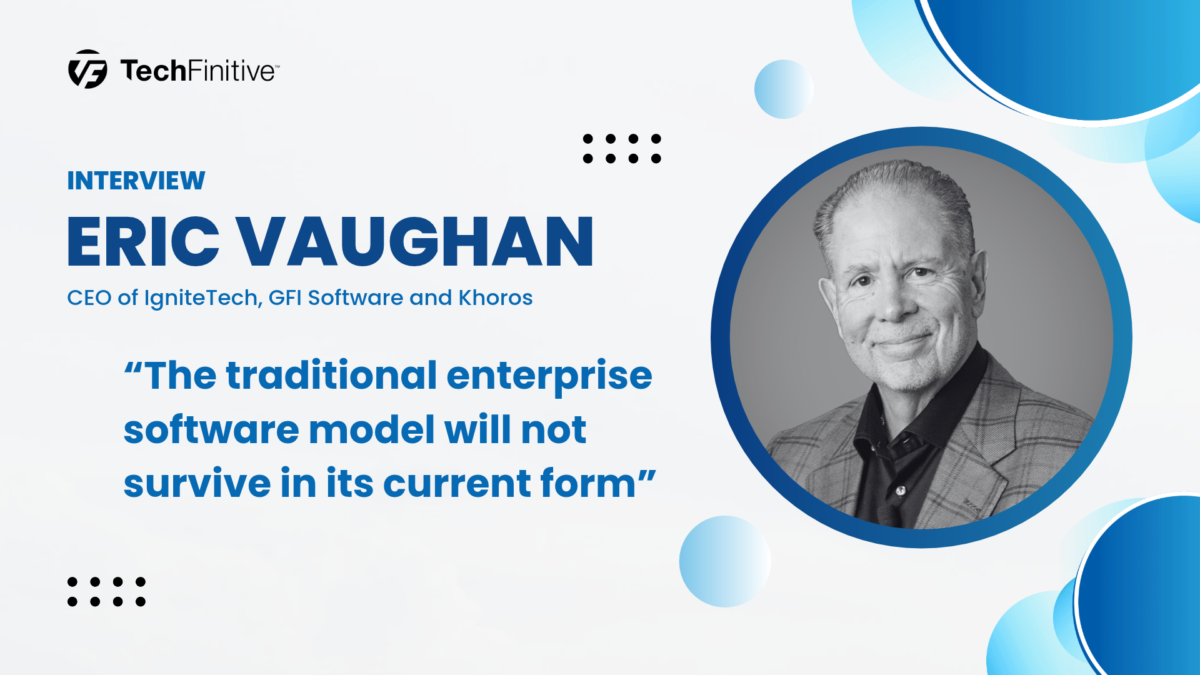
Eric Vaughan, CEO of IgniteTech, GFI Software and Khoros: “The traditional enterprise software model will not survive in its current form”

In 2023, Eric Vaughan made a decision that would fundamentally change the way his enterprise software businesses operated. As CEO of IgniteTech, he gave employees a year to embrace AI, providing training, tools, financial incentives and dedicated time to experiment. The outcome was dramatic: over five quarters, the company replaced nearly 80% of its workforce, hiring people who already believed in AI and were prepared to build their working lives around it.
Vaughan’s argument is that the transformation was never really about technology. It was about culture. He believes businesses cannot simply give employees access to AI tools and expect meaningful change; they need people who are willing to rethink how work gets done. At IgniteTech, that philosophy now extends across every department, with the company reporting that 95% of employees rate their AI proficiency as advanced or expert.
The changes are also beginning to reshape software development itself. Vaughan describes internal systems that can receive requests, reproduce bugs, write fixes, test changes and release updates with limited human intervention. During four days of jury service, one such system reportedly delivered four releases and 17 changes without his involvement. The company is now looking to bring similar capabilities into its enterprise products.
But Vaughan’s views on AI extend beyond productivity. He argues that critical infrastructure such as power grids, water supplies and air traffic control should be disconnected entirely from the public internet, warning that AI gives attackers the ability to search for weaknesses at a scale and persistence that traditional security models were not designed to handle.
As CEO of IgniteTech, GFI Software and Khoros, Vaughan is also challenging the traditional enterprise software business model. He believes customers will increasingly expect bugs to be fixed overnight and new requirements delivered in days or weeks, rather than waiting for quarterly product roadmaps.
In this interview, Vaughan discusses the realities of rebuilding a business around AI, why he believes workforce transformation starts with belief rather than training, and how autonomous software development could change what enterprise technology companies deliver to customers.
In 2023, you made the decision to transform IgniteTech into an AI-first company, giving employees a year to embrace the technology and providing financial incentives, training and dedicated time to experiment. Despite those efforts, around 80% of the workforce was eventually replaced. What led you to take such a dramatic approach, and what did the experience teach you about the challenges of changing an established organisation’s culture?
Early in 2023, I saw AI as an existential threat, quite literally. An enterprise software company that kept working the old way would go out of business if it didn’t act quickly and decisively. It was an existential problem for our customers too, and we couldn’t lead them through a change we hadn’t made ourselves.
So, we gave everyone a year and removed every excuse we could think of. We paid up to $1,200 per person for AI education with no pre-approval, licensed the pro version of AI tools and declared AI Monday, a day each week for learning and building with AI instead of scheduled customer calls and ordinary work. Some people who had worked with me for years told me they didn’t believe in AI. What astonished me was who resisted most: our software engineers, people with my own background, who said there was no way AI could learn to write code.
Over five quarters we replaced nearly 80% of our people. We didn’t replace them with AI. We hired people who already worked with it and believed in where we were going, and we rebuilt the company around them.
The lesson is that this was never a technology change. It was a culture change. Money, tools and time remove excuses, but they don’t create belief; without belief, the change has no chance. That’s why belief is now the first thing we look for when we hire.
There’s an important distinction between AI replacing employees and an organisation replacing employees who aren’t willing or able to adapt to an AI-first way of working. How do you think business leaders should approach this transition? Is it realistic to expect existing employees to fundamentally change how they work, and what responsibility do employers have to help them make that adjustment?
Leaders should be honest about both halves: the opportunity has to be real, and the transition is not optional. It is realistic for many existing employees, but not for everyone, and not on a timeline set by the person least willing to move. Belief comes before skill: someone who believes AI will change their work learns quickly, and someone who doesn’t keeps finding reasons the tools fall short.
The employer owes people more than a training budget and a login. People change when AI is part of their actual job, with real projects, real deadlines, protected time to learn and managers who expect results. What the employer doesn’t owe is an indefinite waiting period, because if the company falls behind, everyone loses, including the people who adapted.
That was the bargain we made. Nearly four years after we started, we have built a company where everybody is dispatching AI in their daily workflow. We’ve also redefined how we write software. As we recently announced, AI now does the development on two of our internal systems, rather than assisting a developer, inside guardrails built on decades of building enterprise software.
To show our people what that change looks like in practice, I used AI to build both systems myself: a knowledge base and an account management system. Proving the approach in real production software lets us build the harness of checks and rules that makes it repeatable for everyone else. We’re now bringing that way of building into our enterprise products.
Three years into the transformation, you report that 95% of employees rate their AI proficiency as advanced or expert, while the time required for new hires to become proficient in their roles has fallen from around 18 months to six. How has embedding AI into everyday workflows changed the way you recruit, develop and measure the performance of employees?
We recruit for what we call AI DNA: people who reach for AI before anyone asks them to, in every function from finance to engineering. Candidates complete an AI screening and a real assignment, such as designing an AI feature for one of our products and walking us through how they built it, before they meet me. The process tells me more than the result, and I also ask how they prepared for our conversation, because people who work this way can’t help showing it.
Development happens in the work. We once had a single head of AI, and every idea had to go through one person. Now every department owns AI in its own area, and our all-hands meetings are live demonstrations of what teams have built. In our anonymous employee survey this year, 72% of respondents said they were beginners or intermediates with AI when they joined the company. Today, just 4% rate themselves at those levels, while 95% now consider themselves advanced or expert. We didn’t buy ready-made experts. People became experts here by doing the work.
Performance comes down to the work people deliver and the judgment behind it, not prompt counts or how fluent they say they are. Getting AI to produce something is now a basic skill. The harder one is recognizing when a convincing answer is wrong and taking responsibility for the decision. So, our managers spend less time teaching people how to do the work and more time developing that judgment.
You’ve described an internal system in which AI agents can receive software requests, reproduce bugs, develop fixes, test changes and release updates with limited human intervention. During your jury service, the system reportedly handled five requests and delivered four software releases without your direct involvement. How close are we to a world in which AI can independently manage much of the software development lifecycle, and where should human oversight remain non-negotiable?
In the two internal systems I mentioned, KnowledgeWell, our knowledge base, and Anvil, our account management system, that world is already here. AI does the development itself, around the clock. In early September, I spent four days on a Texas jury with my phone off. While I was out, Anvil kept fixing and improving itself, shipping four releases and 17 changes requested by five colleagues.
Every step is checked. The system interviews the person who reported a problem until it understands it, then reproduces the problem before writing a fix. Separate AI roles plan, specify, review, build and test each change. A fix goes live only after passing automated tests. The system then repeats the person’s original steps on the live product before notifying them that the issue is resolved. Every request is checked against a blueprint of what the product is for, so each product stays one product for every customer. Khoros is bringing this approach to its Aurora AI and Iris AI platforms first.
Human oversight belongs where judgment and consequences sit, not in a ritual sign-off on every safe change. People decide what each product is for, rule on requests that don’t fit and control logins and access, secrets, payments, deleting data and any communication outside the company beyond the automatic notice that a fix is live. Anyone can let AI write code. The hard part is the harness that decides what gets built, proves it works and keeps the product true to its purpose.
Your position on AI and critical infrastructure is particularly interesting: you believe that systems capable of endangering human lives, including power grids, water supplies and air traffic control, should be disconnected from the public internet. As AI systems become more capable of identifying vulnerabilities and exploiting connected environments, are traditional approaches to cybersecurity becoming insufficient? What should organisations be doing differently to protect their most critical systems?
For a short list of critical systems, traditional cybersecurity is no longer enough. For decades, the standard for important systems has been “mostly isolated”: behind a firewall, on a VPN, with a policy that keeps the control network separate from the office network. Those defenses also benefited from something no policy mentioned: finding the one misconfigured machine took a skilled attacker, and skilled attackers were scarce. AI removes that constraint. It can keep searching for weaknesses without getting tired.
My test is simple. If a stranger taking control of a system could kill people at scale, it doesn’t belong on the internet. That means the controls for the power grid, water and wastewater, national payment settlement, air traffic control, emergency dispatch and weapons command and control. They should be off it entirely, not behind a firewall or on a VPN, while the systems themselves keep running. Where two sites need to talk, give them a private, dedicated line that carries nothing else. The second rule is the one people miss: don’t bring AI inside those controls. Send the data out to AI if you want analysis. Don’t give it hands on the valves.
This isn’t a rejection of the internet. Almost everything connected should stay connected, and I spent my career helping connect it. Isolation won’t stop an intelligence service with someone on the inside. It removes the public-internet route an automated attacker could use to reach those controls, or that a machine could stumble into by accident.
You are leading three enterprise software businesses – IgniteTech, GFI Software and Khoros – at a time when AI is fundamentally changing how software is developed, delivered and supported. Looking ahead, do you believe the traditional enterprise software business model will survive the AI transition in its current form? What will distinguish the software companies that thrive from those that struggle to adapt?
The companies that thrive will fix what a customer reports by the next morning and build what the customer needs in days or weeks. The ones that struggle will keep asking customers to wait for a roadmap measured in quarters while their bugs sit in a backlog. The traditional enterprise software model will not survive in its current form. Customers accepted long waits because building software was slow and expensive. AI is taking away that excuse.
That changes what a vendor owes a customer. At Khoros, we killed the roadmap, so a customer’s requirement no longer waits in line behind a quarterly plan. If the requirement fits what the product is for, we prototype against it, refine it with the customer’s team and ship it in days or weeks into the one shared product every customer uses. Pricing will change too. Charging by the seat assumes value tracks the number of people logging in, and that assumption weakens as the software does more of the work itself.
Access to AI won’t separate the winners, because competitors can buy the models too. What they can’t buy is what you build around the models: a harness shaped by decades of knowing how enterprise software fails, deep knowledge of what customers actually do with the product and people who work this way every day without being told. Each of those takes years to build, and nobody can license them.
You might also be interested
- Kelly Fitzpatrick, CFP®, Vice President of Product at Advyzon: “AI can expand what advisors accomplish, but it does not remove their responsibility or decision-making authority”
- What regulated industries already understand about AI risk and what they don’t
- Can we trust AI without losing innovation?
- Time to stop treating every new AI model as an upgrade
About The Author

Ricardo Oliveira
NEXT UP