Trending Topics

 Trending
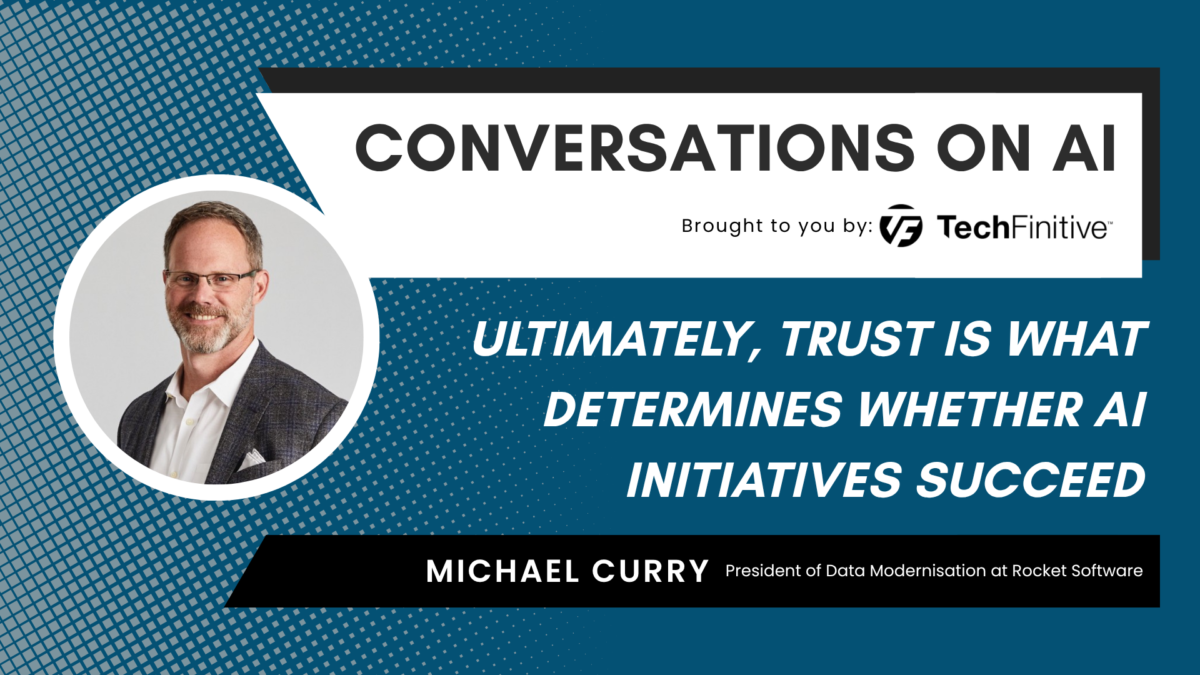
Michael Curry, President of Data Modernisation at Rocket Software: “Ultimately, trust is what determines whether AI initiatives succeed”

What a job title: President of Data Modernisation. And by the end of this interview with Michael Curry, who performs that role for Rocket Software, you may well be thinking that data modernisation is exactly what your organisation needs.
Before we dive in, it’s useful to know two things. First, that Rocket Software helps global enterprises modernise and manage their IT infrastructure, including core, legacy systems, without causing disruption. Second, that Michael has a killer CV that includes 17 years at IBM, where he held VP positions across Big Blue’s diverse portfolio – covering everything from AI to data governance.
No surprise, then, that Michael has strong views on where organisations are getting things wrong – and right – when it comes to enterprise AI. For one, don’t rush in and simply use AI to code things faster. “The opportunity goes beyond simply generating more code,” he told us. “AI can help teams understand, assess, document, transform, validate and maintain the applications and data that already run their businesses.”
Get it right, says Michael, and you can give your teams advanced decision-making abilities “by bringing superhuman powers of recall and assimilation”. And who doesn’t want superhuman powers?
But thinking about AI’s impact on people alone is another mistake. “Organisations should… not isolate AI within a single team or project – instead, they should build AI skills, governance and operating models into every function of the business,” he explained.
Nor is it about individual AI tools. The real advantage comes from creating “conditions that allow AI to operate effectively”. This means “improving access to trusted data, establishing clear governance and ensuring AI initiatives are aligned with broader business and technology goals,” said Michael.
And the key word there is “trust”. “Organisations that build trust into their data foundations, governance models and operational processes will be in a much stronger position to realise long-term value from AI than those focused solely on the speed of deployment,” is arguably the core conclusion to take away from this thought-provoking interview.
Everyone says AI is transforming software, but where do you believe the industry is still overestimating its impact and where is it underestimating it?
I think many organisations are overestimating what AI can currently do. One example is software modernisation. AI has made remarkable progress in its ability to understand, write and transform code, leading some organisations to assume they can quickly refactor complex, business-critical applications.
The reality is that code is only one part of the story. Enterprise applications have often evolved over decades and contain layers of business rules, operational processes, integrations and institutional knowledge that are not immediately visible from the code itself. While AI can accelerate parts of the process, successful modernisation still requires application understanding, engineering discipline and validation. In many cases, AI exposes complexity rather than eliminating it.
At the same time, organisations are underestimating where AI can create the greatest value. The opportunity goes beyond simply generating more code – AI can help teams understand, assess, document, transform, validate and maintain the applications and data that already run their businesses.
As AI becomes more deeply embedded across the enterprise, the organisations that realise the greatest value not necessarily be those generating code the fastest. They will be the ones that can combine AI with trusted data, application context and governance to modernise with confidence while continuing to support the systems their businesses depend on. The real opportunity lies in using AI to reduce uncertainty, improve visibility and help organisations make better decisions about how they evolve their technology estates.
What is the biggest misconception enterprise customers still have about adopting AI within business-critical software?
One of the biggest misconceptions is treating AI as a standalone initiative rather than as part of a broader modernisation strategy.
Over the next few years, AI will become embedded in virtually every application, workflow and business process. Organisations should therefore not isolate AI within a single team or project – instead, they should build AI skills, governance and operating models into every function of the business.
This is especially important when it comes to data. Many organisations assume AI success starts with selecting the right model. In reality, it starts with making trusted data available to that model. AI is only as effective as the information it can access. When data is fragmented across systems, duplicated, poorly governed or difficult to understand, AI exposes those challenges faster than ever.
That is why AI readiness is fundamentally a data readiness challenge. Organisations need a foundation that makes enterprise data accessible, current and governed across mainframe, cloud and distributed environments. Data quality and governance cannot be treated as one-off clean-up projects. They need to become ongoing disciplines that support AI at enterprise scale.
To achieve genuine success with these initiatives, organisations need to focus less on individual AI tools and more on creating the conditions that allow AI to operate effectively across the business. That means improving access to trusted data, establishing clear governance and ensuring AI initiatives are aligned with broader business and technology goals.
How do you balance innovation with responsible AI? Where do you draw the line between moving quickly and ensuring customers can trust the outputs?
Governance and innovation should not be viewed as competing priorities. In fact, effective governance is what allows innovation to scale.
As enterprises accelerate AI adoption, the quality, security and accessibility of data become even more important. AI systems are highly dependent on the information they consume. If the underlying data is incomplete, poorly governed or out of date, organisations risk generating inaccurate outputs and undermining trust in the technology.
The challenge is that many governance frameworks were designed for environments where humans remained at the centre of every decision. As AI assistants and agents become more autonomous, governance needs to evolve alongside them. Organisations need controls that are embedded directly into data pipelines, workflows and AI interactions rather than applied after the fact.
When enterprises have trusted data, clear governance and strong operational discipline, they can scale AI while maintaining the security, compliance and reliability their businesses depend on.
Ultimately, trust is what determines whether AI initiatives succeed. Organisations that build trust into their data foundations, governance models and operational processes will be in a much stronger position to realise long-term value from AI than those focused solely on the speed of deployment.
Beyond productivity gains, what business outcome are your customers most excited about when they invest in AI?
I think there is an enormous promise of having better information at your fingertips at all times. Human decision-making can be advanced incredibly by AI bringing superhuman powers of recall and assimilation. Combining such a huge corpus of external inputs with a business’s private internal data can lead to better, more informed decisions and faster execution. Even if you just consider the vast amounts of internal data: transaction histories, customer interaction data, and especially unstructured data like specific customer claims documents, regulatory guidance, or detailed market reports, the opportunities are enormous to improve the way we work and make decisions.
More great interviews
- Sharryn Napier, VP APAC at GitHub: “AI is changing not only how people work, but who can create value with technology”
- Simon Ernst-Sunne, CEO at ScraperAPI: “The fundamental change is that AI agents consume web data directly and act on it, often without a human checking it first”
- 4 things customers asked Panasonic to bring to the rugged Toughbook 34 tablet… and one surprising thing they didn’t want at all
About The Author