Trending Topics

 Trending
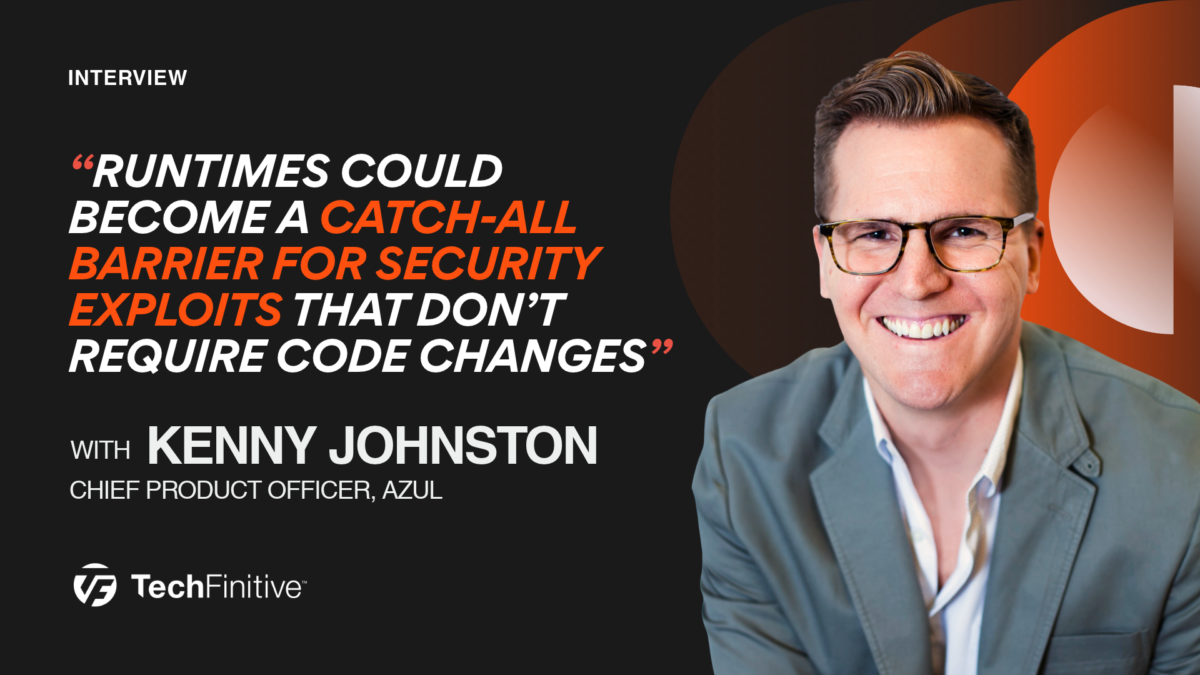
Kenny Johnston, Chief Product Officer, Azul: “Runtimes could become a catch-all barrier for security exploits that don’t require code changes.”

The growing use of AI in cyberattacks is putting pressure on a part of enterprise security that has traditionally moved at a much slower pace: software patching. Organisations are now facing a widening gap between how quickly attackers can identify and exploit vulnerabilities and how quickly IT teams can test and deploy fixes. For businesses running Java applications, that gap is becoming particularly difficult to ignore.
Azul’s 2026 AI Vulnerability Gap Report highlights the scale of the problem. It found that 85% of organisations running Java had experienced a security incident, suspected incident or near miss attributable to slow patching. Meanwhile, 69% of security leaders believe AI-equipped attackers can build a working exploit within three days or less, but only 56% say their organisations can deploy a critical patch within that timeframe.
For Kenny Johnston, Chief Product Officer at Azul, closing that gap requires more than asking IT teams to work faster. He argues that organisations need to rethink the mechanics of patch management, moving away from manual approval processes towards automated, fleet-wide updates. But that creates another challenge: applying security fixes quickly without introducing regressions that could disrupt business-critical applications. His case for security-only updates is built around minimising the changes made during patching, reducing the risk of destabilising systems while addressing vulnerabilities.
The report also points to a visibility problem. More than half of security leaders surveyed said they had only partial or limited visibility into their critical Java runtime instances. As estates become more fragmented across legacy applications, containers and cloud environments, unmanaged or outdated runtimes can leave organisations exposed without their security teams even knowing where the risks lie.
In this interview, Kenny discusses how AI is changing the vulnerability landscape, why traditional patching strategies are struggling to keep pace, and what enterprises need to do to secure their Java environments without compromising application stability.
Azul’s 2026 AI Vulnerability Gap Report found that 85% of organisations running Java have experienced a security incident, suspected incident or near miss attributable to slow patching. What does this tell us about the state of enterprise vulnerability management, and why are organisations continuing to struggle with something as fundamental as keeping software up to date?
That 85% figure tells us the old approach to patching is breaking down. The problem is twofold. It’s not just the speed of exploits, it’s also the breadth of exploits that organisations are struggling to keep up with. We’re ending the world of security through obscurity. No one is immune, because bad actors can now attack on a very broad basis, and at a speed that is orders of magnitude faster than before. Everybody’s patch management system has needed to change radically in just the last six months. So this is not as simple as keeping up with software. The rules of the game have changed quickly underneath everybody’s feet.
One of the report’s more striking findings is that 69% of security leaders believe AI-equipped attackers can build a working exploit within three days or less, yet only 56% say their organisations can deploy a critical patch within that timeframe. How is AI changing the balance between attackers and defenders, and what needs to change in the way businesses approach vulnerability management?
Closing that gap means changing how patching works, not just how fast people work. I’ve heard directly from customers that they need to move from a ‘requesting updates’ mentality to an ‘explaining that updates happened’ mentality. They no longer go to application owners and say, ‘We have a new version of this critical software, please update it sometime.’ Instead, they have entire automated systems that do it for them. The only way to do that is to trust that the changes won’t break anything. That’s the trade-off. They’re prioritising security, but they’re taking on the risk that an automated update could break something. Azul’s Security-only, Stability-first™ updates, for example, are built for exactly that purpose. Sophisticated organisations are changing how they patch, moving from an ask-for-permission approach to an ask-for-forgiveness mentality.
The report identifies extensive pre-deployment testing as one of the biggest barriers to faster patching. This creates an interesting dilemma: organisations need to address vulnerabilities quickly, but they also cannot afford to introduce changes that destabilise mission-critical applications. How can IT and security teams reconcile these competing priorities, and what role should security-only updates play?
I think you are looking for something that is as low friction as possible because it is important that you can patch quickly, without having to worry about it causing unforeseen errors or that the patch that you release has a critical regression that you can’t come back from. Because remember, if you deploy a security patch that has a regression, and that regression is business-impacting, you’re then left with a choice between continuing to have your business hurt or being left in a very insecure position. Minimising the footprint of those updates so that they only focus on the security components and no non-security-related updates is the only path forward.
Another finding suggests that many organisations don’t have a complete picture of their Java environments, with 51% of security leaders admitting they have only partial or limited visibility into their critical Java runtime instances. Why has Java estate management become such a challenge, particularly across legacy applications, containers and cloud environments, and what are the risks of overlooking runtimes that may not be actively managed?
I would argue that some organisations have taken a ‘let a thousand flowers bloom’ mentality, letting developers choose whatever Java version they want, and that can come back to bite them. While you’re giving developers choice, you don’t have uniformity, and therefore you have a complete lack of visibility. That’s starting to change, because organisations are realising that central teams can only manage so much heterogeneity. They need some standards in order to operate IT organisations at the new AI pace. I think the why is that previously it wasn’t as important to operate uniformly and at speed. Now that’s changed. What are the risks? You may be using a version of Java, or a build, from a vendor that doesn’t even provide regular updates, which means there’s no new patch version to upgrade to. So it’s critical to have complete visibility over your estate, and to make sure that at least the runtimes you know about come from a vendor that publishes, or has a history of publishing, updates in response to security threats.
As AI agents become increasingly capable of identifying and chaining together vulnerabilities, the traditional distinction between vulnerability discovery and active exploitation may become less meaningful. Do you believe organisations need to fundamentally rethink their approach to patching SLAs and vulnerability prioritisation? What would a more realistic model look like when the window between disclosure and exploitation is potentially measured in hours rather than days?
I think there are two parts to this question. The first is whether we need to rethink the old approach of ‘if it’s not a really critical vulnerability, I won’t do it.’ What chaining changes is that even low-severity vulnerabilities can be chained together to form an exploit, and AI is now very capable of finding those chains. So you can’t say, ‘There was a Java update, but it didn’t have any critical CVEs, so I’m not going to take this one.’ All vulnerable surface area adds to an exponential number of possible chained exploits, which means that you can no longer be selective. If a patch is available, you need to deploy it, and you can no longer debate whether it’s severe enough. The second part is how you patch rapidly. It can’t mean going to your application owners and telling them to perform the update. You need a fleet-wide, homogeneous approach to patching something as critical as your Java runtime or any other critical infrastructure. That approach should carry the least likelihood of regression, which means patches with the smallest possible impact, focused only on security coverage.
Looking ahead, how do you see the relationship between Java, AI and enterprise security evolving over the next few years? As organisations increasingly deploy AI-driven applications and autonomous agents, what innovations or changes in the Java ecosystem will be most important in helping businesses maintain security without compromising performance, stability or developer productivity?
I would argue that Java is the best place to run mission-critical applications because it’s the most secure. It’s a hardened language that the industry has built an entire ecosystem around, with players who can provide the tools you need to keep your environment secure. Nobody else has that. There’s no Python equivalent of security-only, stability-first updates, or of the patch velocity we’ve been talking about in Java. If you’re a serious enterprise operator who cares about security, Java is the place to run your operations. Looking ahead, you can imagine that as a runtime language, some of the vulnerabilities or exploits that are found might be patchable by the runtime itself. We’re hearing a lot more about agentic operations that can perform security improvements without code changes, and that would be unique to Java as a just-in-time language. Runtimes could become a catch-all barrier for security exploits that don’t require code changes. At the same time, Java is rapidly evolving to meet the demands of the AI world. Maybe someday soon Java will do inference the way Python does, and Java is the place to run agentic workloads because it has LangChain4j and other tools. Java isn’t a laggard or yesterday’s technology. It’s actively evolving to meet the needs of AI workloads.
More from our cybersecurity section
About The Author