Trending Topics

 Trending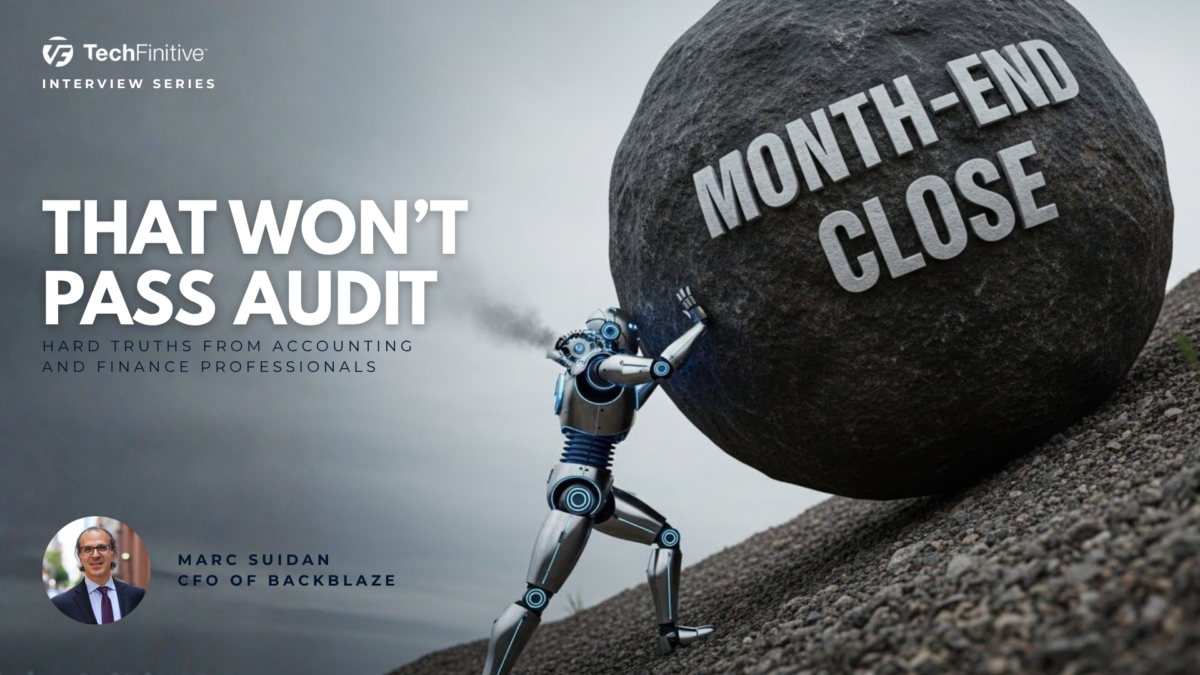
Marc Suidan, CFO of Backblaze: “There’s no digital transformation without cultural transformation”

You can’t hide from tech if you work at Backblaze. As the name of the company suggests, it’s been at the cutting edge of technology since it was founded in 2007, quickly becoming one of the most trusted companies for cloud storage and backup. As CFO of Backblaze, Marc Suidan has also been equally quick to embrace new technologies that help to improve the efficiency – and expand the scope – of his team. Something that permeates our whole interview.
“[AI] is driving speed, new insights and lots of new analytics,” he told us, but Backblaze isn’t merely buying in tools. “We’re also building internal tools with AI on our own, a lot of our accountants have developed templates where the AI project extracts key terms from contracts and populates templates and summaries.”
It’s a far cry from when Marc began building his experience in this sector, with a storied career that included 17 years at PricewaterhouseCoopers. He has an enviable record of driving growth and innovation at technology companies, leading over $250 billion in tech deals throughout his career.
All of which means he’s extremely well placed to answer our questions on the impact of AI on the finance sector – starting with increased collaboration with other areas of the business.
How is finance collaborating with other parts of the business – such as IT, operations, or marketing – and where does friction still exist?
Collaboration starts with building a strong bond with the rest of the business unit leaders. Our executive team is dispersed across different US cities, and we have many new faces. This means that scheduling time for team building and getting to know each other is crucial as we can’t rely on the day-to-day touchpoints of a centralized organization. A strong bond between executives maintains alignment, helps push thinking faster, and solidifies the attributes of a great team to work through all challenges.
Our collaboration covers the entire organization, but the ones most key to finance’s success are IT, marketing, sales and operations. IT supports our automation, maintains SOX IT controls to maintain the integrity, security, and accuracy of our financial data and provides insights into the business.
We help marketing with measuring the crucial ratio: lifetime value (LTV) of a customer and cost to acquire them (CAC) to help ensure our profitability and sustainable growth, as well as programmatic deployment decisions.
My team reviews and approves sales’ deals and co-design the sales compensation plan for account executives to keep them motivated and sufficiently rewarded for their efforts.
We partner with operations on demand and supply planning to ensure we can maintain our data center capacity and can scale with our customer growth without over committing capital. As AI is growing as our most promising customer segment, ensuring that balance is vital (and our work together makes that a reality.
What impact has AI had on your finance or accounting workflows so far and where do you see the most realistic near-term value?
It is driving speed, new insights and lots of new analytics. First of all, we have invested in several financial technology solutions like Ramp and Stripe to embed AI capabilities for invoice recognition or fraud detection.
It’s great having tools like that to speed up manual workflows and they’ve already produced ROI. But we’re also building internal tools with AI on our own, a lot of our accountants have developed templates where the AI project extracts key terms from contracts and populates templates and summaries. And in other cases, we have accountants using ChatGPT to write Visual Basic and Sequel code.
Of course, we always make sure to have a human in the loop to review and ensure the accuracy of what these projects and applications produce. AI still isn’t 100% accurate, and finance can’t have any room for error.
AI has driven a tremendous amount of productivity and it is also helping with new analytics and use cases we didn’t previously think would happen. If you had told me in the pre-AI era that I’d have accounts working for me that were coding, I’d thought it would have meant they were trying to train themselves for a new job!
How are you currently using data and analytics to support decision-making beyond compliance and reporting?
We use data and analytics extensively, but we are also expanding how we use this to improve decision making. It’s key that decision be backed by thoughtful analysis, but sometimes there are limitations in access to good signals or data logs.
This is especially true if there’s not enough historical data compiled and saved in your organizations, or if it’s not organized and cleaned properly to remove duplicates or erroneous files.
I recommend ensuring that your department has its historical data organized properly and with sufficient records for analysis to make sense. This is an area where collaboration makes sense, as IT teams can help with ensuring your team has data compiled in the best way possible.
It can take up to a decade of solid data to enable sound financial decision making in some cases as you may need to account for economic swings, seasonal changes and other variables that won’t be accounted for if your data is relatively new.
Thinking ahead of such needs, and putting sensors/monitoring solutions to log the data in an organized fashion, enables future analysis. Outside of that, lots of data can be sourced from benchmarks and third party reports. It’s critical not to be insular and just look internally for data.
How has the role of the finance function changed in the last three to five years, and what do you think most organisations still underestimate about that shift?
The classic metaphor for finance is that its role is in “shedding sunlight.” In recent years, that’s been accelerated to every corner of the business. It’s now a presumption for any modern finance team to have full visibility and transparency into accuracy, compliance, operations, staffing and other high-touch segments of the business. Now teams need to take it a step further and determine every key lever and indicator.
In the modern macroeconomic climate, organizations need to get lean. With this finance shouldn’t pat themselves on the back for meeting basic activities but start looking into every nook and cranny of their organization to determine where inefficiencies and warning signs exist that have been previously ignored.
For example, moving from monthly reporting to real-time reporting platforms where authorized users can view transactions immediately will reduce the need for retroactive auditing and creating reports for less busywork and a faster path to transparency.
Finance’s call to action is not necessarily to audit every other department but to work together with other team leaders on how to best uncover poor-performing practices, potential threats to revenue, unnecessary expenditures and other opportunities to boost the company’s overall bottom line.
Ultimately, you will build an organization that’s highly transparent, more productive and more appealing to prospective investors, customers and employees.
What advice would you give to finance leaders who are under pressure to ‘digitise’ but lack internal buy-in or technical resources?
Digitizing is crucial for every organization to stay competitive, but there’s no digital transformation without cultural transformation. Too many companies have failed to evolve because their digital transformation investments weren’t met with buy-in from team members. You need to start with the cultural changes that will pave the way for technical changes that succeed.
There’s a few cultural shake-ups that can be most effective. Start with injecting new talent into your team – the right additions can bring new energy, ideas and perspectives that convert into new business practices.
You must also lead by example and drive top-down changes within leadership first to show team members that this is serious and that you’re making an effort to evolve as well.
Finally, you can also encourage junior members to adapt to new practices by ensuring they have access to training and enablement, as well as using competitive/incentivized programs to add additional value.
By showing how capable you are at driving change, it can either encourage the C-suite and the board that it’s worth providing the technical resources you’d need to evolve your department or create room in the budget for additional tech expenditures.
About The Author

Rowan Campbell
NEXT UP


