Trending Topics

 Trending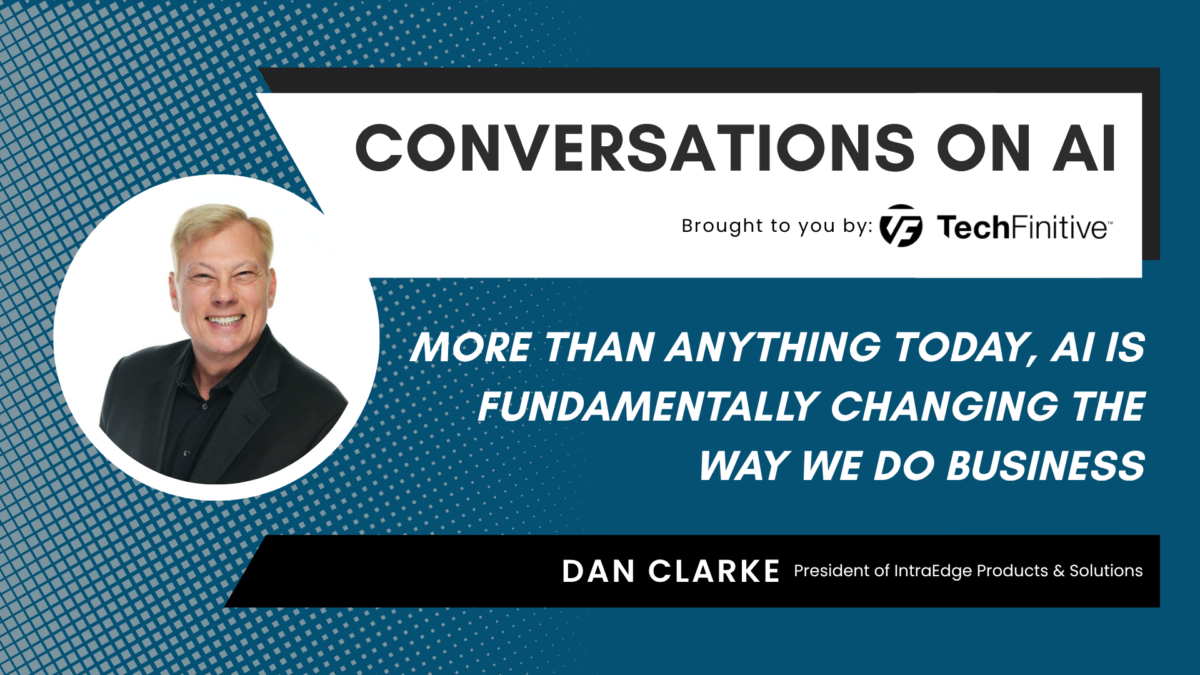
Dan Clarke, President of IntraEdge Products & Solutions: “More than anything today, AI is fundamentally changing the way we do business”

Dan Clarke has spent much of the past 30 years at the cutting edge of a technology industry that constantly reinvents itself. First when he was working at Intel as it brought laptops to market, most recently with the rise of AI. Today, as President of IntraEdge Products & Solutions, Dan is focused on enabling enterprises to embrace the new era that AI is rapidly bringing. He also leads the strategy behind Truyo, a Gartner Magic Quadrant Leader for AI Governance Platforms.
For Dan, one of the advantages that comes with his experience is being able to see beyond the hype to the core product. When it comes to AI, Dan sees both overconfidence and underestimation. While Dan says that “there are people who don’t really understand how much it can change the software development process,” there are those who believe, erroneously, that just because AI can write basic code “somehow you don’t really need programmers anymore”.
The reality, he argues in this interview, lies somewhere more interesting. AI can drastically alter how software is developed, but certain principles remain irreplaceable, such as the role of properly planned architecture managed by an architect. These architects, Dan points out, are now “far more valuable than they were in the past” as they’re the only ones who truly “understand how you take a business idea, understand it, and turn it into software”.
That same pragmatic approach shapes much of his beliefs around responsible AI usage. AI governance and security shouldn’t be patched on after an incident. Rather, they should be considered within the software design from day one: the later you think about it, the harder it is to design in. “If you think about security and guardrails up front, you can just build it into the process,” Dan explains, warning that “if you don’t think about that, people run into walls all the time”.
With Dan’s pragmatic approach now detailed, it seems natural to ask him to evaluate where he sees AI genuinely changing software development, and where people may still be falling victim to overestimating the technology.
Everyone says AI is transforming software, but where do you believe the industry is still overestimating its impact and where is it underestimating it?
When it comes specifically to software, I think there are people at both ends of the spectrum. There are people who don’t really understand how much it can change the software development process. And there are people who think it’s because I can create an agent that does something simple, which is software programming, that somehow you don’t really need programmers anymore. We see both ends of the spectrum.
What we see in our industry the most is how executives overestimate what it can do for software. It doesn’t replace a good approach to software development methodology. You still need an architect and someone to define the requirements of the functionality of the software itself. This needs to be defined to a degree that is specific enough that you can create programming around it, and you need a methodology around that.
We find that architects now are far more valuable than they were in the past because they’re the ones who really understand how you take a business idea, understand it, and turn it into software.
It’s not nirvana that allows you to take a business person who has no experience in software who’s now able to then write a bunch of software. Because if you do that, you’ll get a product. It will produce software, produce code, but it won’t produce useful code that you can put into production. Prototyping, on the other hand, is now within the reach of really anybody. Anyone with an ability to describe what they want can now create prototypes. I find that to be a very effective way to communicate with customers about what they really mean and what they want at the end of the day.
How is AI changing the role of your customers? Are you replacing repetitive work, augmenting decision-making, or fundamentally changing how people do their jobs?
It depends on the role, but we see repetitive-task roles are getting replaced. For example, when you send out a response to a privacy request or a public information request, you have to remove or redact certain information. It’s a very repetitive process. So it’s relatively easy to automate much of that work. On the other hand, for most of the cases, AI is really just changing how employees are doing their job. They can do tasks a lot more efficiently and effectively.
More than anything today, AI is fundamentally changing the way we do business and then the way we perform our jobs, rather than replacing them for 80% of the workforce. One of our city government customers told us that they see AI as a way to reduce job openings. As you can imagine, they have a huge number of openings in the city, and most of the jobs that are open are not the most fun jobs. If you think about redacting public access request information, this is not a fun thing to do day in and day out, and it’s hard to find those people. So for them, they would never replace a person. They have rules against that, but they can close out openings and scale much more effectively.
What is the biggest misconception enterprise customers still have about adopting AI within business-critical software?
As a business, you can think about guardrails, and safety, and governance after the fact. There’s so much of that in the industry. But if you think about it later, then it’s really hard to design that stuff in.
One of my clients told me that he’s building a house. If he wants to add a water line to his refrigerator from the sink, it’s like 10 minutes of work and it costs $20 if you’re still in the planning stages. If you do it after the house is built and done, it’s like a $1,000 project that you have to rip up the walls for, and it’s a lot harder to add.
It’s one of these things where if you think about security and guardrails up front, you can just build it into the process. It’s really not that difficult. It doesn’t add a lot of steps or a lot of complexity. If you don’t think about that, people run into walls all the time.
I had an urgent call this morning from a big tech company. They had an incident and were worried about management just shutting down AI usage in the company. You don’t want to be in that position, especially as a technical leader, because that’s who management will blame. They’re going to blame the CISO and the CIO. Why didn’t you protect us against this? So I think that’s often the biggest misconception.
If you were launching your company today with AI available from day one, what would you build differently?
If I were starting a company today, I would design AI inside from the beginning. At Truyo, we’ve designed automation into our platforms since the very beginning. Automation is not an afterthought for us, it’s intrinsic in how we approach solving these problems. And in our industry, because we’re governing AI, the majority of our clients don’t want us to use AI. But you should think about how AI fits into this from the very beginning, and you should also think about where the competitive barriers are different.
Building software used to be an enormous undertaking. Today, that’s much less of the challenge. The real differentiators are understanding the market, the customer, the ecosystem, and the relationships you bring. Those are much harder to replicate with AI. At the same time, you have to design governance into your AI from day one and ask yourself, ‘Where could this bite me?’ Whether it’s hallucinations, bias, legal issues, or data consent, you need to think about those risks upfront.
The biggest mistake is assuming you’re safe because you’re using a third-party or off-the-shelf AI tool. We saw that with the Anthropic jailbreak. People assumed the guardrails would protect them, and they didn’t. Those tools are still subject to the same AI risks. Simply taking the time to identify where AI can fail is one of the best forms of risk protection.
What has been the hardest challenge in bringing AI capabilities into your products? Technology, data quality, customer trust, regulation, pricing or something else?
We talk about data quality a lot because if you don’t have the right data to start with, you can’t really leverage it effectively. But for us, the biggest challenge is all about attitude. It’s that developer who goes, ‘I don’t really need this. I’ve been doing this right. And maybe I’ll use it a little bit here and there.’ You need to embrace it at your core. It needs to just fundamentally change the way you approach doing your job.
Now, in our particular case as an AI governance company, a lot of times our customers don’t want to use AI to govern AI. So, when we’re governing an agent, we can use deterministic rules like, no credit card numbers, no PII. We have a very rigorous list of what PII is, and what you can’t use. Now, you have almost no false positives when you use a deterministic approach. Do you want to use AI to govern AI? I tend to approach it from: let’s use everything we can, let’s use the deterministic pieces and AI. But I get people’s point on this by saying you cannot use AI. So everything is opt-in for us with AI. But again, that’s an attitude, right? That’s an idea that I think stands in the way much more so than anything else.
How do you balance innovation with responsible AI? Where do you draw the line between moving quickly and ensuring customers can trust the outputs?
You don’t really have to do much of a balancing act if you think about it from the beginning. It’s understanding, what data am I leveraging? What decisions am I making? How does that map against our policies? And really identifying the risk against your own policies. It’s a huge problem when companies miscategorize the risk. And it’s almost always because of third-party developers. It’s because they’re like, ‘I’m just using a third-party resume screener from this giant company. It must be good, right? It must be safe. I don’t have to worry about that, do I?’ And that’s the one that will get you.
As another example, one of my friends runs a giant fund, and he was telling me that when cell phones came out, companies were like, ‘no cell phones in the workplace.’ He told me that all that did was take them out of the conversation because everybody was going to use it anyway. And he goes, we’re not making that mistake with AI. We’re telling everybody, ‘use AI, use AI, just do it safely. Think about the guardrails, think about the risks.’ Role model it, but role model it in a way that has an eye towards understanding the potential risks. So that you don’t get in trouble and so that you can scale and take advantage of this profound new technology.
If you could give one piece of advice to another SaaS executive planning their AI strategy today, what would it be?
Embrace AI from the top. Role model using it safely and securely. And think about the risks and the benefits. Gartner says that 50% of AI pilots fail. Why is that? The number one reason is that nobody really thought about what AI would do. People were like, ‘let’s make an AI!’ And they didn’t think about how that fits into the flow of the company? How do they actually leverage this? The pilots failed because they didn’t think, what’s the real benefit at the end of the day? So, executives, you want to role model using it, you want to role model thinking about safety and governance right from the beginning, and you want to role model thinking through why this is going to benefit us.
If you’re planning your AI strategy, you need to think about the cost. We just launched our cost analysis add-on for Truyo. That allows you to analyze the cost of agents and tokens and how those are trade-offs, and all of the details. We had a client that told us: “We finally got people to start using AI, and they used their entire budget the first month.” Are the employees using it efficiently? Maybe they don’t know how to write the prompts properly. They can get into these infinite loops that blow through tokens. As an executive, you have to think about the costs because it can get out of control really quickly without a lot of benefits.
More interviews
- Johannes Rittershausen, Co-CEO of Convergent Energy and Power: “We’re definitely seeing a shift from exploratory conversations to real, near-term projects”
- Maksym Sakharov, CEO & Co-Founder of WeFi: “A stablecoin on its own does not change global finance”
- Darren Anstee, CTO for Security, NETSCOUT: “DDoS attacks have become a pervasive threat to every organisation that participates in the Internet’s digital ecosystem”
About The Author

Rowan Campbell
NEXT UP


