Trending Topics

 Trending
Inside the modern CFO’s tech stack: why ERP still matters

Today’s CFOs rely on connected systems to balance stability with speed and to build a foundation for smarter scaling.
On any given day, a CFO’s to-do list can span predictive analytics, ESG reporting, compliance audits and real-time forecasting. On a tight budget and with a small team, these tasks can eat into time better spent meeting core business goals of growth and long-term resilience.
According to research from spend-management platform Pleo, more than half of organizations say their finance teams spend so much time on manual reporting that they struggle to focus on more impactful work.
As financial leaders face pressure to deliver deeper insights and faster decisions in less time, the demand to transform finance functions within organizations has grown louder. The new mandate is to scale smarter: automate where it counts, streamline where possible, and ensure human insight remains central to every decision.
Balancing growth and stability
With a global economy plagued by inflation, supply chain volatility and talent shortages, companies have been forced to rethink what growth means.
In Deloitte’s most recent CFO Signals survey, half of large-company finance leaders cited employee engagement as a major concern, while 45% pointed to the ongoing talent shortfall as a primary constraint to growth. For CFOs looking to find balance between innovation and control, the message is clear: maintaining momentum requires as much focus on people and prices as on profit.
Efficiency then becomes the solution as a new growth lever. With 69% of CFOs seeing cost optimization and efficiency as their top priorities for 2025, the next step is to deliver on those goals by designing systems that, in addition to recording transactions, can also quickly adapt to changing business conditions.
Finance leaders are now rethinking how teams are structured, blending technical expertise with data fluency and change management skills. Upskilling is becoming central to the modern finance agenda, with CFOs prioritizing digital literacy alongside traditional accounting competence. The shift from manual reporting to automated analysis demands new tools and new mindsets.
Automation as strategy
Today’s automated financial systems are no longer confined to simple macros or batch uploads. They use intelligent process automation to eliminate repetitive manual work across reconciliation, expense reporting and monthly close. Connected directly to enterprise resource planning (ERP) platforms, these workflows automatically match transactions, code expenses, and update ledgers in real time, subsequently reducing the hours finance teams spend chasing receipts or correcting data.
The new wave of automation centers is equipping people to make faster, better-informed decisions. AI-supported tools now help detect anomalies, forecast trends and highlight areas of overspend, giving CFOs a clearer view of financial health. When automation flows through the ERP rather than around it, the result is more reliable data, cleaner reporting, and a finance function capable of responding to change with speed and accuracy.
Viewed this way, automation becomes a foundation of strategy and a mechanism that allows finance to shift from reaction to prediction.
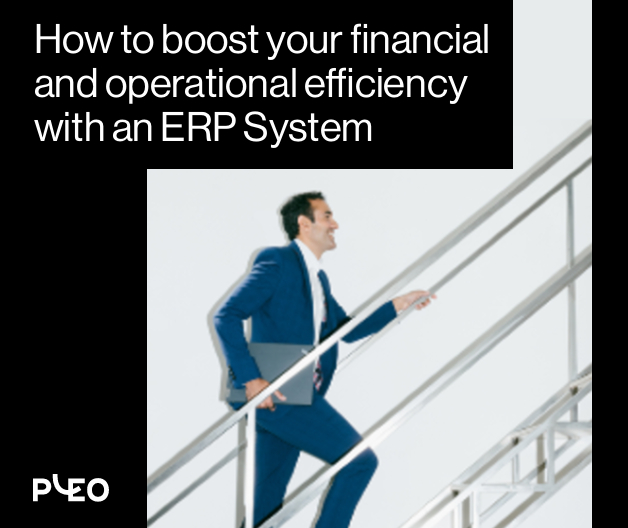
Smarter Scaling: How To Boost Your Financial and Operational Efficiency With An ERP System
Organisations are under pressure to grow sustainably while managing rising costs, evolving customer expectations, and constant market shifts. Success now depends on having the right systems to stay agile, efficient, and data-driven. This whitepaper shows how modern ERP solutions help businesses streamline operations, enhance visibility, and scale with confidence.
ERP as an agility engine
Behind every agile finance team is an infrastructure that can flex with the business. For many organizations, that foundation is a modern cloud-based ERP system that unifies finance, procurement, HR and operations.
According to Statista, global ERP software spending is projected to continue rising steadily through 2026 as companies modernize their finance stacks to gain visibility and control across departments. These systems have become central to managing growth efficiently by offering a single source of truth, automating core processes, and supporting real-time data flows between teams.
When paired with connected tools for expense and spend management, a well-integrated ERP helps finance leaders move from traditional financial reporting to forward-looking analysis. This results in faster closes, cleaner data and more informed decision-making. By connecting performance data across operations, finance teams can anticipate bottlenecks before they arise. This predictive insight gives leadership a stronger foundation for planning and risk management, turning the ERP from an accounting tool into a strategic command center for the business.
Just as the tools are getting smarter, financial leaders too are stepping up their game. As automation removes repetitive work, CFOs are moving from controllers to strategic leaders who move the needle by interpreting data rather than merely reporting it.
As automation takes over routine finance tasks, the CFO is emerging as a catalyst for change. Rather than focusing on transaction management, today’s finance leaders drive transformation by interpreting data, identifying risks and shaping strategy. With connected systems providing near real-time insight into spending and performance, decisions happen faster and with greater accuracy.
Smarter scaling in practice
When businesses connect automation, data and people they create the framework for sustainable scaling. Modern ERP systems give companies an integrated view of business performance through a shared platform while allowing them to expand capabilities gradually and on their own terms.
The result is a finance function that’s both efficient and adaptive: closing books faster, uncovering insights sooner, and supporting the business in near real-time. Smart scaling requires integrating the right tools that empower financial leaders to design for, rather than chase, growth.
In this context, the agile CFO is a strategist first and a scorekeeper second and is steering transformation through insight, structure, and with a clear view of what the business needs next.
Related finance articles
About The Author

Llanor Alleyne
NEXT UP