Trending Topics

 Trending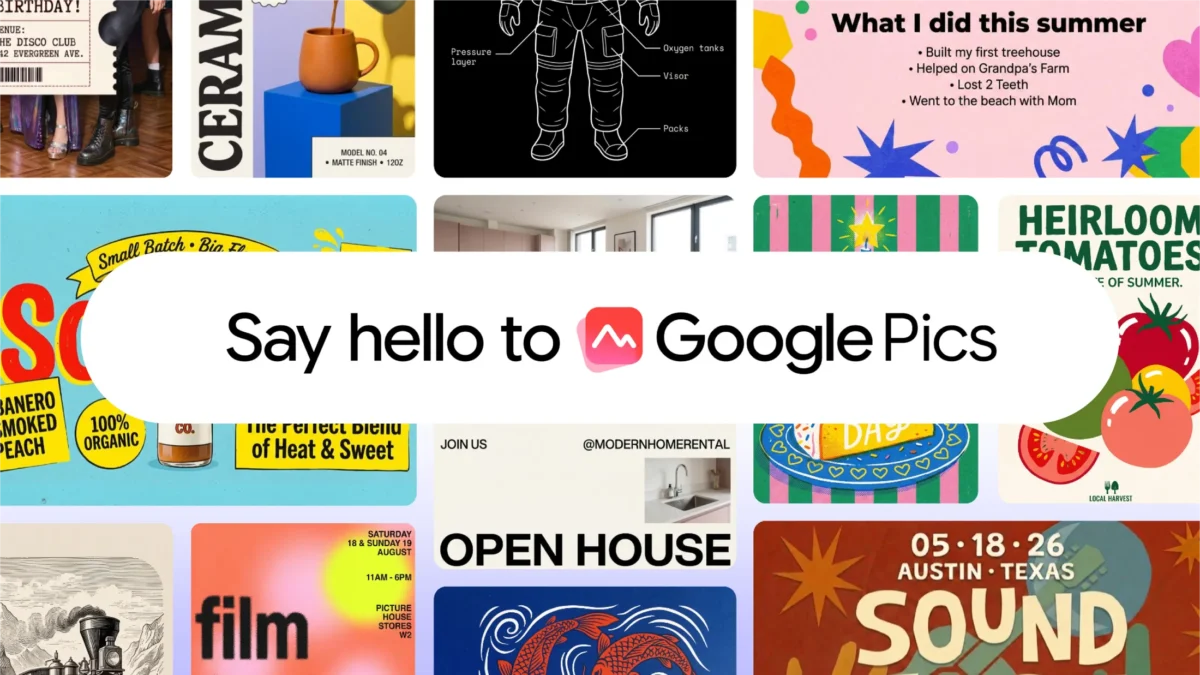
AI is awful at creating marketing content… surely Google Pics can’t make it worse

Breakfast burritos that appear filled with bugs. Fun fair posts with inhuman attendees and curse words. Cafés advertising products they don’t actually have. But the worst is perhaps the proliferation of nearly identical posters for community events, all using the same fonts, design and colours.
Little wonder people aren’t keen on the flood of AI posters being shared online and in the real world. They’re a mix of grotesque, uncanny valley and just plain boring. And it’s sparking a real-life backlash, with companies using hand-written signs in social media posts rather than turn to tech.
Into this world, Google has launched Google Pics, an image creation and editing tool for Workspace subscribers.
Google Pics takes on Canva
Google Pics is the tech giant’s answer to Canva for professional users.
“Built on our Nano Banana image generation and editing model, Pics gives you the control you need to create whatever you’re imagining, whether you’re designing a poster, producing social media posts, or editing digital illustrations,” writes Meg Whittenberger, Google Pics Product Manager, in a blog post. “Google Pics will be both a standalone product and integrated into Workspace apps, starting with Slides, Docs, and Drive, so you’ll be able to edit images where you’re already working.”
The examples on display thankfully steer clear of the “made by AI” vibes already flooding social media and sandwich boards outside of cafés and pubs. However, it remains to be seen whether using dedicated tools powered by AI is enough to avoid such issues for Google Pics users.
We can learn a lesson from content tool Canva. This sparked greater professionalism in social media posts, but it also led to phrases such as “Canva core” or “Canva vibes”, referring to the aesthetic popularised by that app. This wasn’t a compliment: it meant flat, generic or clearly template based. But still miles above the AI examples referenced above.
Of course, Canva has jumped fully into AI with its own features as well as integrating ChatGPT and Claude. The trick for Canva and Google Pics is to embed these tools without it being obvious in the creative output.
What do we want?
Research by Kantar found that four in ten consumers say AI-generated ads are annoying, while a separate study suggests a third of people like a brand less for using AI in advertising.
But it turns out we don’t mind AI marketing – as long as it doesn’t look like AI. That’s according to research released this week from Columbia Business School, which ran a massive online experiment over two days with 7,000 advertisers and 16 billion ad impressions.
“We do not find a detectable average click-through-rate disadvantage for AI-generated images relative to their human-made siblings,” the researchers found. “However, this average masks an important boundary condition: ads with AI-generated images outperform human-made ads when the AI images do not ‘look like AI’.”
According to the paper, consumers see sharp images of large faces as likely to be made by humans, even though AI tends to generate that aesthetic. However, people actually spot lower warmth in colours and intense colour saturation as signs of AI generation.
Some would-be customers will always be put off by AI, in particular when it comes to small businesses, ethical or sustainable companies, or those working in culture. Indeed, music venues in Canada are starting to ban AI artwork in event promotion in support of artists.
But others simply don’t want bad marketing. It remains to be seen whether generative AI can make high-quality campaigns that will convince consumers, but if tools like Google Pics can halt the flood of identical posters or food that looks like bugs, that’s a good start.
If not, maybe just go back to chalk on a board written by hand.
More by Nicole Kobie
About The Author

Nicole Kobie
NEXT UP


