Trending Topics

 Trending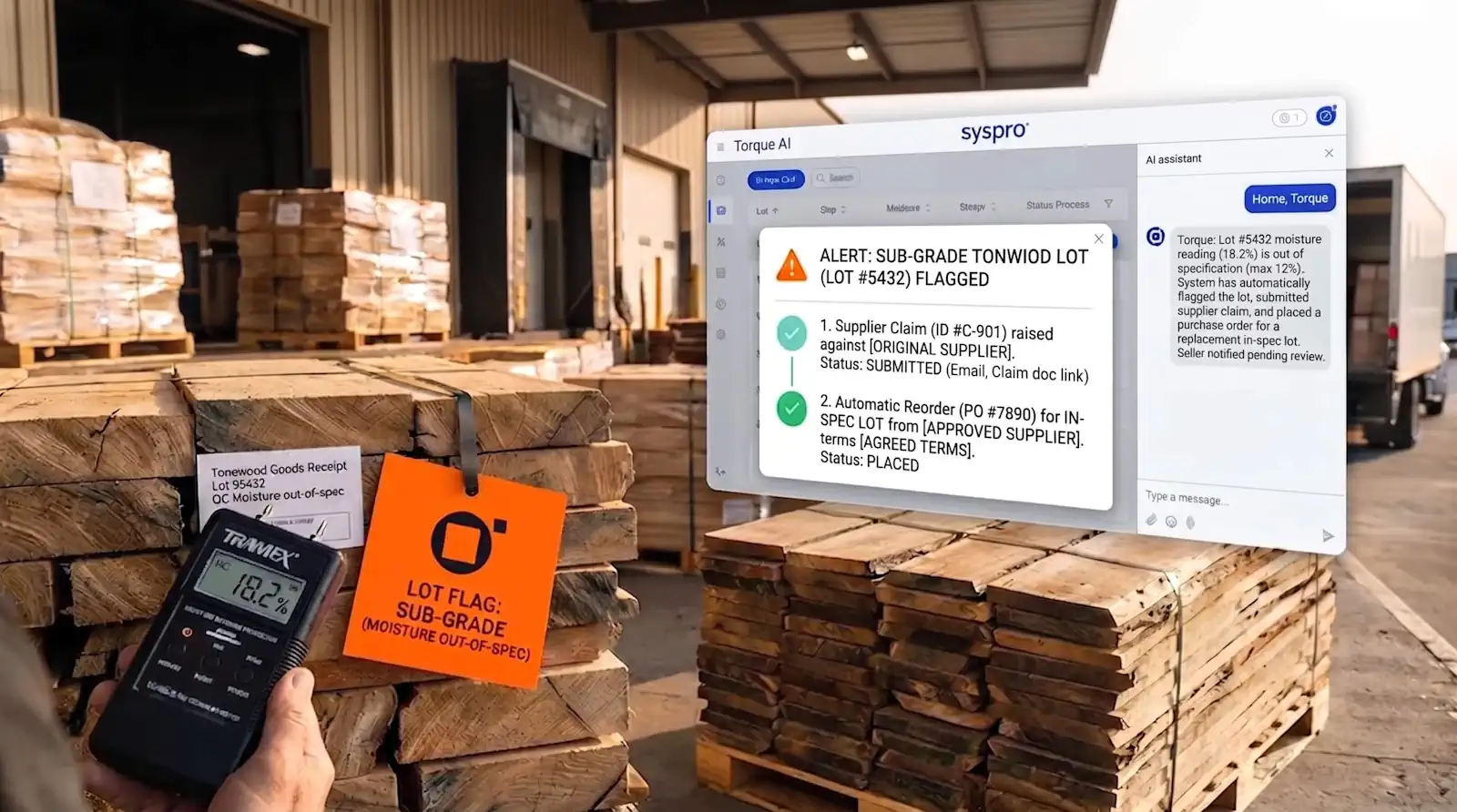
Syspro Torque puts industrial AI to the test: Can auditable agents finally earn manufacturers’ trust?

Syspro has just launched an industrial AI platform called Syspro Torque. It is entering a factory environment that has little patience for black-box technology – giving the user an answer without clearly showing how it arrived at the answer. More on this later.
Torque identifies operational problems, recommends responses, and takes approved actions across systems manufacturers already use. That includes ERP, manufacturing execution systems, SCADA platforms, and warehouse technology.
It’s an ambitious proposition.
However, the greater significance of Syspro Torque is its attempt to make governance part of the product.
It is rare for manufacturing decisions to happen in isolation. A delayed order can have a domino effect on several operational issues such as production schedules, material availability, supplier commitments, product quality, margins, and delivery dates all at once. Generic AI may be good at producing answers but is less equipped to understand the messy web of rules, constraints, and consequences sitting behind a factory-floor decision.
This is the gap Torque is seeking to fill.
The black box problem
Unlike the traditional black box approach, where you can see what goes in and what comes out, but the thinking in the middle is hidden or too complicated to understand, Syspro has adopted what they call the ‘Glass House” Principle – the idea is that an AI agent should not be allowed to quietly make factory decisions behind a locked door. Its decisions should be visible to the people responsible for the factory.
Syspro says every action taken by Syspro Torque is logged with the rule applied, data used, and the reasoning behind the recommendation. Consequently, the operator sees how the agent reached a decision rather than simply accepting its output.
This auditability is not only a useful feature for compliance teams but may be essential for adoption.
The Black Box approach is one of the reasons that many manufacturers distrust AI. Few manufacturers would agree to hand over operational control to an AI system if it cannot explain why it chose a supplier, changed a schedule, or released an order. The cost of being wrong runs the gamut from poor customer interactions and awkward chatbot responses to production downtime, wasted material, missed delivery windows, and safety issues.
The solution that Syspro Torque offers manufacturers is a sliding scale of autonomy. Operators can approve every action or allow the platform to run trusted, repeatable workflows automatically. That approach reflects the crawl-walk-run path explored in our industrial AI framework: trust has to be earned through controlled use cases before automation expands.
Industrial context matters
According to the company, Torque is built on Syspro’s knowledge graph that draws on nearly five years of industry logic. It can work with any ERP, though the company says the richest operational context is derived when used with its own ERP platform.
It also uses Model Context Protocol (MCP) connectors to integrate with legacy and modern factory systems without bespoke middleware. This is a crucial feature because industrial AI cannot live only in a clean cloud-data environment. It has to cope with ageing shop-floor systems, fragmented data, and processes that have evolved over decades.
This is the same strategic shift behind Syspro’s Industry 4.0 pivot. ERP is no longer just a record of what happened yesterday. It is becoming the operational context layer from which AI agents can identify what should happen next.
Trust is the product
The platform entered controlled availability in August, partnering with food and beverage, industrial machinery, and fabricated metal operations. Its public debut is slated for the International Manufacturing Technology Show (IMTS) in Chicago this September, as detailed by Syspro.
The true test will be pragmatic: can the solution curb exceptions, streamline decision-making, and safeguard profitability without creating unforeseen liabilities?
Industrial leaders have little use for speed without substance. They demand systems that demonstrate clear reasoning. In factory automation, transparency is not a bottleneck; it is the prerequisite for real-world deployment.
About The Author

Kihara Kimachia
NEXT UP


