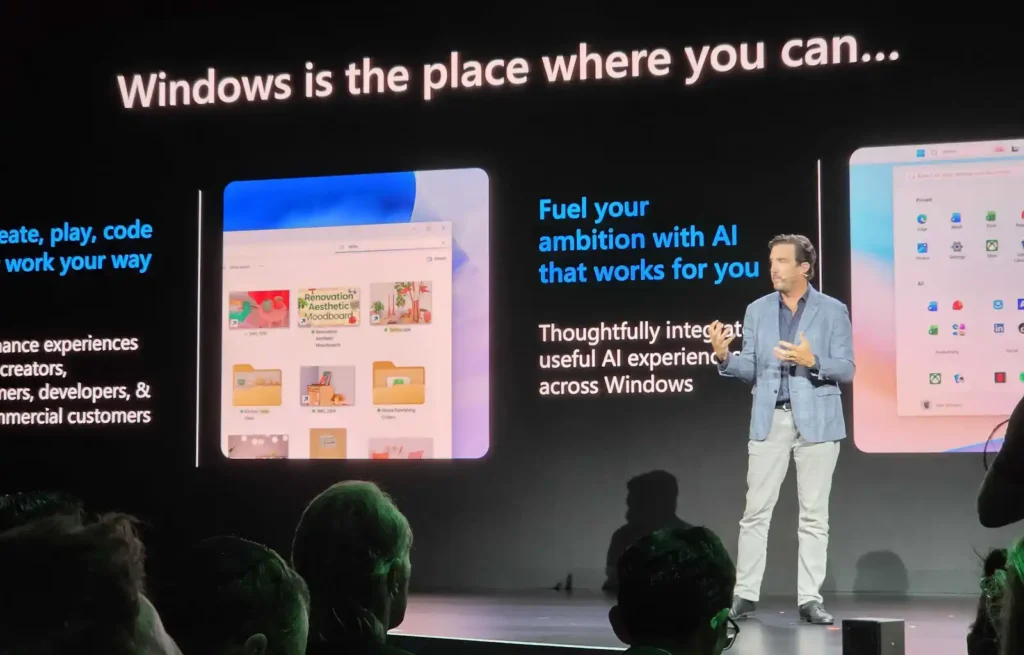
We’re now several months into the rejuvenation of Windows 11, with Microsoft promising an overhaul of the OS to make it run faster on older hardware and become better suited for this AI age. As part of the Acer keynote, Mark Linton from Microsoft took to the stage and gave an insight into the latest Windows 11 K2 developments.
The first thing he talked about was the idea of “unmetered intelligence”. The idea that where Bill Gates talked about having a PC on every desk, people will now have access to limitless intelligence wherever they are.
“Unmetered intelligence, that’s how we think about it,” said Linton. “These powerful PCs can do so much, why not offload to the PC for your AI workloads and create workloads?” So future versions of Windows 11 will weave “AI into not only the user experience but also the platform”.
But most people still care about smooth day-to-day performance more than anything else. Good news, then, that Microsoft is “continuing to improve on the fundamentals” said Linton. “We made significant gains on things like boot time, Windows Hello responsiveness, working on 8GB of memory. We’re optimising so that programs run great on 8GB machines as well”.
He added that users would also be able to customise Windows more, although that was mentioned many months ago.
The different ways we’ll be able to stack the taskbar (image: Microsoft)
Windows 11: Weaving in AI for unmetered intelligence
What does Microsoft mean by unmetered intelligence? Over to Linton. “We mean that these powerful PCs can complement what you do in the cloud, but you shouldn’t have to go to the cloud for models that you can use every day. What if your PC were powerful enough, and essentially you can change your token economics by running it locally on your PC?”
He went on to focus on three areas, the first being “a streamlined experience to help builders build faster and create”. This builds upon the existing Windows Developer Mode. “Everything’s optimised for terminals and command line interfaces. We’ve improved Windows subsystem for Linux. There’s so many things that we’re doing there to make Windows a great home for developers to develop.”
Mark Linton on stage at IFA 2026 as part of Acer’s press conference (image: TechFinitive)
The second one centres around data privacy. “Our customers are very clear: I don’t want to let agents just run loose across my corporate network. I need security and manageability because I want to use the power of these… agents, but I don’t want to let go of my policies.”
So Microsoft is going to make it possible to “isolate and containerize the agents through MFC [Microsoft Foundation Classes], through new technology for containerization. You’ll be able to match and apply policies, and then event and audit and log what those agents do all within Windows as a security construct.” He added that Microsoft worked with partners, including Nvidia, to ensure it works smoothly and securely.
“The final one, of course, is about the AI platform itself,” Linton concluded. “You can choose models through Windows Foundry. We have inbox models that we include as part of Windows, but then also you can run Windows AI subsystems to make sure that you’ve got the harnesses and orchestration that you need as well.
“And then again all wrapped around with security data to make sure that your AI workloads are known, are secured under policy, and how you want them to run as well.”
When will we hear more about Windows 11 K2?
So there isn’t much hard information in there, and I sensed a certain frustration from the system builders I spoke with at IFA that the big benefits of Windows 11 K2 hadn’t yet been seen. After all, we’ve seen the return to 8GB of memory in laptops as companies struggle with the rising cost of RAM.
That said, there is also anticipation – I wouldn’t go so far as to say excitement – about the speed and responsiveness of Windows builds that haven’t yet landed.
When will we know more? Linton said that Microsoft would reveal more in October and that it would also be covered in its Ignite conference in November.
About The Author
Tim Danton
Tim has worked in IT publishing since the days when all PCs were beige, and is editor-in-chief of the UK's PC Pro magazine. He has been writing about hardware for TechFinitive since 2023.
To provide the best experiences, we and our partners use technologies like cookies to store and/or access device information. Consenting to these technologies will allow us and our partners to process personal data such as browsing behavior or unique IDs on this site and show (non-) personalized ads. Not consenting or withdrawing consent, may adversely affect certain features and functions.
Click below to consent to the above or make granular choices. Your choices will be applied to this site only. You can change your settings at any time, including withdrawing your consent, by using the toggles on the Cookie Policy, or by clicking on the manage consent button at the bottom of the screen.
Functional
Always active
The technical storage or access is strictly necessary for the legitimate purpose of enabling the use of a specific service explicitly requested by the subscriber or user, or for the sole purpose of carrying out the transmission of a communication over an electronic communications network.
Preferences
The technical storage or access is necessary for the legitimate purpose of storing preferences that are not requested by the subscriber or user.
Statistics
The technical storage or access that is used exclusively for statistical purposes.The technical storage or access that is used exclusively for anonymous statistical purposes. Without a subpoena, voluntary compliance on the part of your Internet Service Provider, or additional records from a third party, information stored or retrieved for this purpose alone cannot usually be used to identify you.
Marketing
The technical storage or access is required to create user profiles to send advertising, or to track the user on a website or across several websites for similar marketing purposes.
To provide the best experiences, we use technologies like cookies to store and/or access device information. Consenting to these technologies will allow us to process data such as browsing behaviour or unique IDs on this site. Not consenting or withdrawing consent, may adversely affect certain features and functions.
Functional
Always active
The technical storage or access is strictly necessary for the legitimate purpose of enabling the use of a specific service explicitly requested by the subscriber or user, or for the sole purpose of carrying out the transmission of a communication over an electronic communications network.
Preferences
The technical storage or access is necessary for the legitimate purpose of storing preferences that are not requested by the subscriber or user.
Statistics
The technical storage or access that is used exclusively for statistical purposes.The technical storage or access that is used exclusively for anonymous statistical purposes. Without a subpoena, voluntary compliance on the part of your Internet Service Provider, or additional records from a third party, information stored or retrieved for this purpose alone cannot usually be used to identify you.
Marketing
The technical storage or access is required to create user profiles to send advertising, or to track the user on a website or across several websites for similar marketing purposes.

 Trending