Trending Topics

 Trending
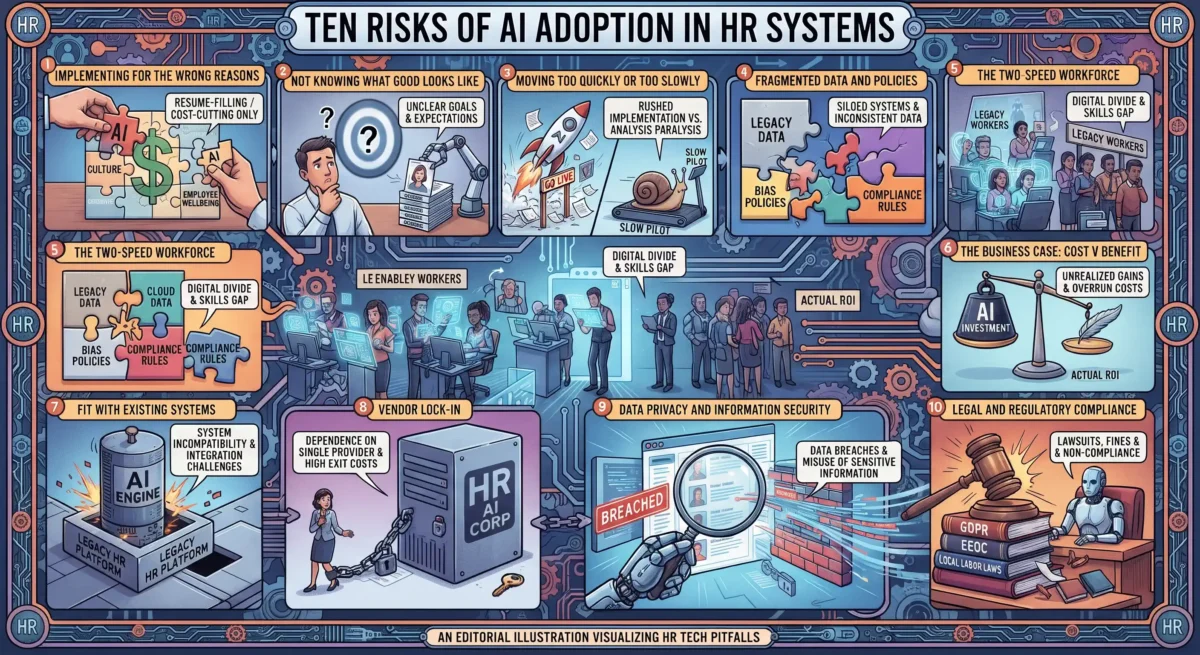
The ten risks of adopting AI in HR systems…and the five you can solve yourself

Worries about the risks of AI adoption are felt sharply in HR. You’re not only responsible for your own team, and their experience of work; but HR is at the very heart of your organisation, so have a duty of care to all colleagues.
This is a sponsored article brought to you by NTT DATA Business Solutions UK&I. It was written by Chris Gabriel, Executive Head of Marketing & Innovation.

AI adoption still feels like a business decision fraught with complexity and risk. But when it comes to using it in HR, it’s worth considering that not all AI is equal.
There’s the ‘superintelligent’ kind that’s grabbing headlines around the world, and then there’s the kind that can answer questions your colleagues have about your company’s processes and policies, helps an employee complete an end of year review, or provides support to managers to assess their team’s performance.
As a hot spot for AI value, and one of the few departments every employee engages with on a regular basis, HR teams could have a unique perspective on AI in the workplace. And UK research on the questions people are asking of their personal AI relate closely to the cases your typical HR function deals with everyday. At home, we are planning our finances, asking legal questions, and using AI to monitor our health. Does that sound familiar to the questions your HR team deals with everyday; payroll, pensions, policy, and health cover?
This level of comfort with personal use of AI suggests that employees could be just as comfortable interacting with an AI deployed by your HR team, allowing the system to take more of the day to day load, not your people, and providing every employee with tangible AI value and giving your HR team room to get on with the valuable human interactions in those moments that matter.
But AI deployments come with risks; and in that same research, people voice the same concerns in their personal use of AI as you are probably asking as an HR leader.
If you’re considering implementing AI within your HR systems, those risks need answering. Let’s look at ten of them.
Five of them are in your hands: adopting AI for the wrong reasons, not knowing what good looks like, moving too fast or too slowly, fragmented HRM systems and data, and the experiences of a 2-speed workforce.
Five more are for IT to lead, with you in the room: cost, fit with existing systems, technology lock-in, privacy and security, and compliance.
| HR resolves | IT leads, HR supports |
| Implementing for the wrong reasons | The business case: cost v benefit |
| Not knowing what good looks like | Fit with existing systems |
| Moving too quickly or too slowly | Vendor lock-in |
| Fragmented data and policies | Data privacy and information security |
| The two-speed workforce | Legal and regulatory compliance |
Let’s take them one by one.
Implementing AI for the wrong reasons
Corporate FOMO, the board is asking why you haven’t done it yet, or yielding to sales pressure from your existing vendors and partners all count as the wrong reasons for implementing AI.
The right reason starts with figuring out if you need it, and defining your goal.
What, exactly, do you want to use AI for in your organisation. Ask yourself:
- What internal HR practices are overly complex and time-consuming?
- What processes are painstakingly repetitive for managers or employees?
- Where is your team not able to deliver that impacts function or business?
Because there’s a really good reason to implement AI, and that’s to eliminate “bad work” inside your HR team, managers or employees. By that I mean work that’s repetitive, unnecessarily complicated or frustrating.
7 in 10 workers report they’ve experienced bad work (source: NTT DATA Business Solutions, Good Work, Bad Work Survey 2026; base 1,657 UK working adults). More than a third say working with broken processes is bad work; around a quarter highlight work that’s high effort for low value.
Not knowing what good looks like
It can be hard to know what a good HR AI looks like, but it’s possible to find out what your people would want it to do, and build a strategy that addresses real pain points. We asked workers what they thought good looked like, and heard that 65% of workers wanted AI to “guide me through tasks or processes I don’t do very often”, with similarly strong support for “making communication more effective” and “providing fast, accurate responses to workplace policy questions” (source: Good Work, Bad Work Survey 2026).
What’s the most unfamiliar thing to an employee? Your new starter on-boarding process?
What’s a process most managers and employees don’t do very often. Annual review or KPI setting discussion?
What are the fast and accurate responses your employees want from HR? I have just had a hospital appointment, does my health insurance cover my treatment?
The research shows that organisations without their own AI almost certainly have shadow AI running in the background already; where people bring their own AI tools to use for work without their organisations knowing or approving it. How many of your managers are already using their own AI to form annual review questions? How many employees have their employment contracts already in their own ChatGPT?
And this is where one of the biggest risks lies, not just in terms of security, accuracy and your employees experience of work. It’s clearly safer to implement your own AI, with guardrails, based on accurate data housed in your own HR system. But, if people are already using their own AI, getting their own benefit, any official AI you launch after a 12-month program is going to feel meh!
Because shadow AI practice is already widespread, and growing. 53% of UK workers have used their own AI tools or workarounds at work, 21% regularly (Good Work, Bad Work Survey 2026).
Understanding what your good looks like by asking your people what they want from HR AI, what off the shelf AI use cases already exist, makes sure any AI program is solving a real problem and delivering real value.
Moving too quickly or too slowly
This follows on from the point above. You must spend time doing your homework and getting your first AI fit for purpose, but don’t assume your employees are more worried about AI taking their jobs than it is taking away the bits of their jobs they don’t enjoy doing.
In many of our home lives, AI is firmly embedded in the way we live. Let’s get back to those use cases we may want to implement in HR.
The Good Work Bad Work survey found that 42% of UK workers already trust AI with financial planning, and 40% with health or personal legal advice. So that means for HR, if your teams are not getting quick answers from you on, say, maternity leave or performance reviews, they’re asking ChatGPT or Gemini. And it might well be better if they were getting their answers from your system instead.
We know that some industries and professions are being fundamentally remapped by AI right now, while others still feel relatively immune from AI’s clutches.
But, if we dig into organisations whose business model or industry isn’t yet seeing a huge AI disruption, that doesn’t mean individual business functions can ignore that they may need to embrace AI at a faster pace than they currently are.
You should choose a pace that matches your situation. IT industry analyst Gartner’s advice consistently leans towards achieving value, rather than velocity, but that’s not a reason to delay understanding how your HR team, managers or employees are already using AI, and where they could benefit from a system designed to help them.
Fragmented HRM systems
94% of HR teams in higher education reported that their HR systems, and therefore their data, were either unintegrated or partly integrated (NTT DATA Business Solutions and UHR, HR Transformation and the Role of AI in Higher Education 2025). If that statistic maps even loosely to other industries and professions, if it applies to you, your simpler route to scalable AI could be through a platform that unites your data and processes together under one AI system. The same goes for the AI you put on top.
But your employee data isn’t the only challenge when thinking about AI in an HR context. How many different employment contracts do you have? Is your expense policy clear enough for AI to interpret it? Do you have varying health cover for levels within your organisations, and are those levels clearly indicated in your current system?
AI inside your HR system will only learn from and use the data you give it, so it won’t create an hallucinated policy, but if it cannot learn that a Level 9 executive receives more health cover than a Level 3 junior, the AI will struggle to provide the clarity of answer that makes it a useful tool.
The two-speed workforce at work: But consistent at home
All age groups are AI-curious at home, but the under-45s are more comfortable using AI for health, finance and legal advice (50%) than 45-64 year olds (28%). And in the workplace, 69% of under-45s have used personal tools including AI to overcome bad work compared to 36% of the older cohort (NTT DATA Business Solutions, Good Work, Bad Work Survey 2026; base 1,657 UK working adults).
Asked about their future expectations for workplace AI, the generational split hinges on whether AI serves as an assistant or acts with greater autonomy. A “trust gap” of 20 percentage points separates the youngest from the oldest. But is that really surprising when the more experienced workforce is already adept at many of the things a younger cohort is still getting to grips with?
So when you are surveying your workforce, be prepared to see a difference in attitude to whether AI could add value to a role, and then consider that it may not be an attitude to technology, but an aptitude to do the job, to your organisational processes, to the knowledge of unwritten rules that has been built over decades that lessens the need for a technology intervention in some of your colleagues.
And as an HR leader it is vital that you appreciate that senior leaders and managers may not express the need for AI in the same way as the junior workforce does. AI may provide leaders more time back in annual reviews they are more than capable of doing manually. The junior worker may find AI in that same review allows them to express themselves in a business tone that they may not have quite mastered yet. Both get value from AI in the process, but that value is found differently.
Of course, these aren’t questions just for HR to answer, they’re a strategic board level issue. Nail down your specific requirements around what your people need before you start shopping around for AI HR systems.
And finally
So, is AI in HR risky? Yes, but the biggest risk isn’t the AI you choose, it’s how and why you choose to adopt AI in the first place.
The five risks in your hands all come back to the same starting point: understand what your people need, and where bad work gets in their way, before you talk to a supplier.
Then choose an AI approach that solves the problems of your people, that infuses value in the interactions that cause most friction to your employees and your HR team, and remember to leave decisions about people to your people.
About The Author