Trending Topics

 Trending
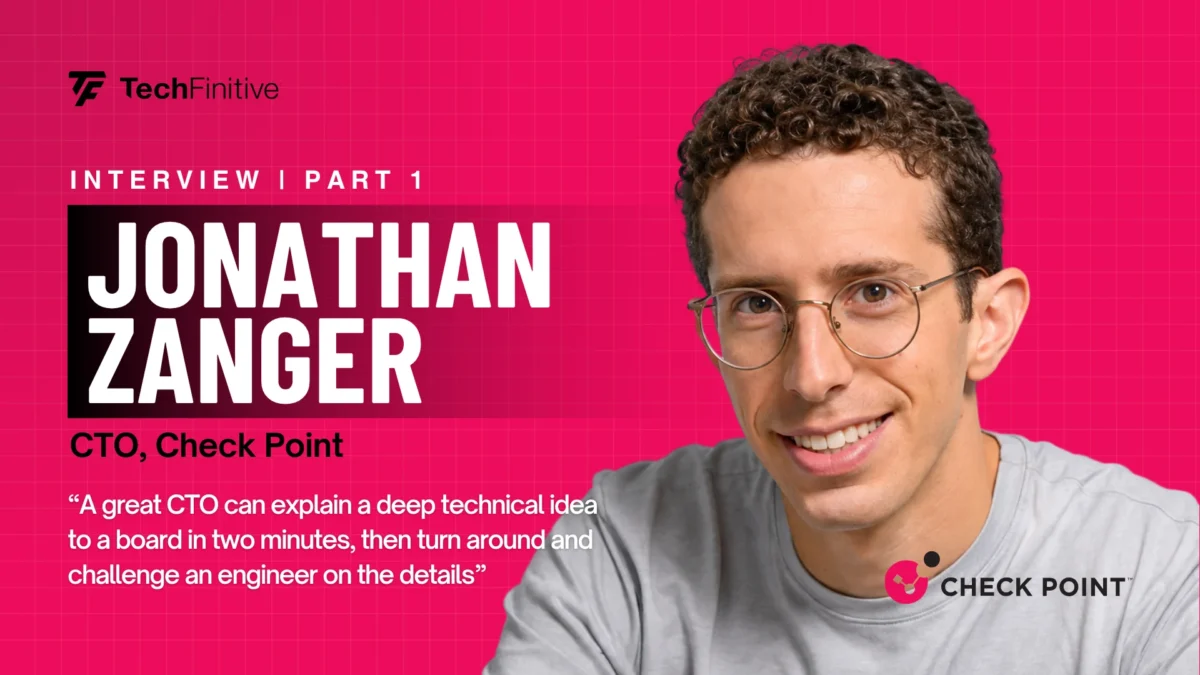
Jonathan Zanger, Check Point CTO: “Long-term bets have to live alongside real agility”

If you think it’s tough being the CTO of a typical business, imagine being the CTO of a technology company at the cutting edge of cyber security. That’s the reality that Jonathan Zanger, Check Point CTO, faces every day.
Here, he shares insights into the short term and long term aspects of his job – and how he came into the role in the first place. Plus, what he believe are the traits of a great CTO in the modern era.
How did you become interested in cyber security, and how did you come to be CTO at Check Point?
I’ve been drawn to technology for as long as I can remember. I learned to code around the time I learned to write. By kindergarten, I was already the class IT expert, the one the teachers called when a computer misbehaved. Growing up, I built software and websites for fun and joined every science and technology excellence program I could find. Curiosity was the engine, and it still is. It pushed me to learn across many fields, and that breadth turns out to be one of the most useful things a CTO can have.
Cyber security found me early, through national defense. In the Talpiot program and Unit 8200, I worked on some of the hardest technical problems I’ve seen. Over time, I led organisations of hundreds of people working on them. Three things kept me in the field. The first is the mission. Cyber security is one of the few places in technology where the line between good and bad is clear: you protect people, organizations, and countries from those who want to harm them. The second is the depth of the technology. You have to understand systems better than the people who built them. The third is the challenge. Most engineering problems hold still. In cyber security, the problem thinks back and adapts to whatever you build.
Later, after earning an MBA and a master’s in electrical engineering and computer science at MIT, I became CTO at Trigo. Trigo is an AI company that brings computer vision to physical spaces. Its models process video from many cameras at once, in real time, to understand what’s happening in a store as it happens. It was a startup operating at scale, deployed with major retailers, and that forced us to understand exactly what our customers needed. We built our own models, so we felt the AI revolution from the inside as each generation got dramatically better. It also showed me that a capability this powerful serves both sides. It would reach attackers as fast as it reached us. But it could also give defenders something they never had: the ability to see, understand, and act on everything happening across their environment, in real time. Security would have to change just as quickly to make that promise real.
That realization brought me to Check Point at a moment of real change. Our founder, Gil Shwed, became executive chairman, and Nadav Zafrir, whom I know from national service, became CEO. They’re building a leadership team that blends people who grew with Check Point and people with an outside view. As CTO, I focus on three ways AI meets security. Security for AI protects the AI organizations adopt. Security from AI prevents attacks that AI makes faster and cheaper. Security with AI makes our own defenses smarter. That work starts at home, with our internal AI transformation, and extends to our most innovative customers, whom we build alongside. I work closely with my peers across the organization on innovation, research, product strategy, technology partnerships, and acquisitions. Our mission is simple to say and hard to do: make our world a safer place to live and work.
Do you feel the role of CTO has changed over the past decade?
Yes, and the biggest shift is the half-life of a technical decision. A decade ago, a CTO could make a major architecture bet and expect it to hold for five years or more. Today, a single model release can change what’s possible, for us and for attackers, in a matter of weeks. Long-term bets still matter. You need a clear view of where the technology is heading. But they now have to live alongside real agility: the ability to adjust course quickly without breaking what customers depend on.
That pace also changes the talent you need. The skills that matter most now, like deep AI research and AI-native engineering, are rare and in high demand. Acquisitions are one way we bring them in. We acquired Lakera for its rare AI research capability, and Cyata as an AI-native company that builds with extreme velocity. Both teams raise the bar across our R&D, alongside the research and engineering depth we already have.
The second shift is specific to security. Attackers now adopt the same technology we do, at the same moment, with fewer constraints. That means part of our roadmap is set by their adoption curve. A decade ago, a security CTO studied yesterday’s attacks. Today, we have to anticipate what becomes possible next quarter. That takes two things.
The first is listening. I spend a lot of time with chief information security officers (CISOs), policymakers, and researchers, who are often the first to see what’s coming. The second is investing in research that looks ahead. Check Point Research studies how attackers use AI today. We also test emerging models and agent frameworks to understand how they could be misused tomorrow, and we work with academic partners on the threats that are still years away. When we understand an attack technique before it shows up in the wild, we can build prevention for it before customers need it.
What are the character traits of a great CTO?
The first is curiosity that doesn’t fade with seniority. The technology moves too fast for anyone to coast on what they knew five years ago. I still read papers, test new tools myself, and ask engineers to show me how things work. When I stop being surprised, I know I’ve stopped looking.
The second is translation. A great CTO can explain a deep technical idea to a board in two minutes, then turn around and challenge an engineer on the details. Both conversations matter. If the business doesn’t understand the technology, it makes the wrong bets. If engineers don’t understand the business, they build the wrong things.
The third is conviction paired with humility. You have to make calls with incomplete information and stand behind them. You also have to change your mind quickly when the evidence shifts. Ego makes the second part hard, so the best CTOs keep theirs in check.
Last is integrity about risk. In cyber security, the temptation is to overpromise. Great CTOs tell customers, leadership, and their own teams the truth, including what we can’t yet do.
Look our for the second part of our interview with Jonathan next week, when we talk about how he approaches cybersecurity.
More Check Point articles
About The Author