Trending Topics

 Trending
Zendesk retains Gartner Leader status as AI service shifts from answers to action

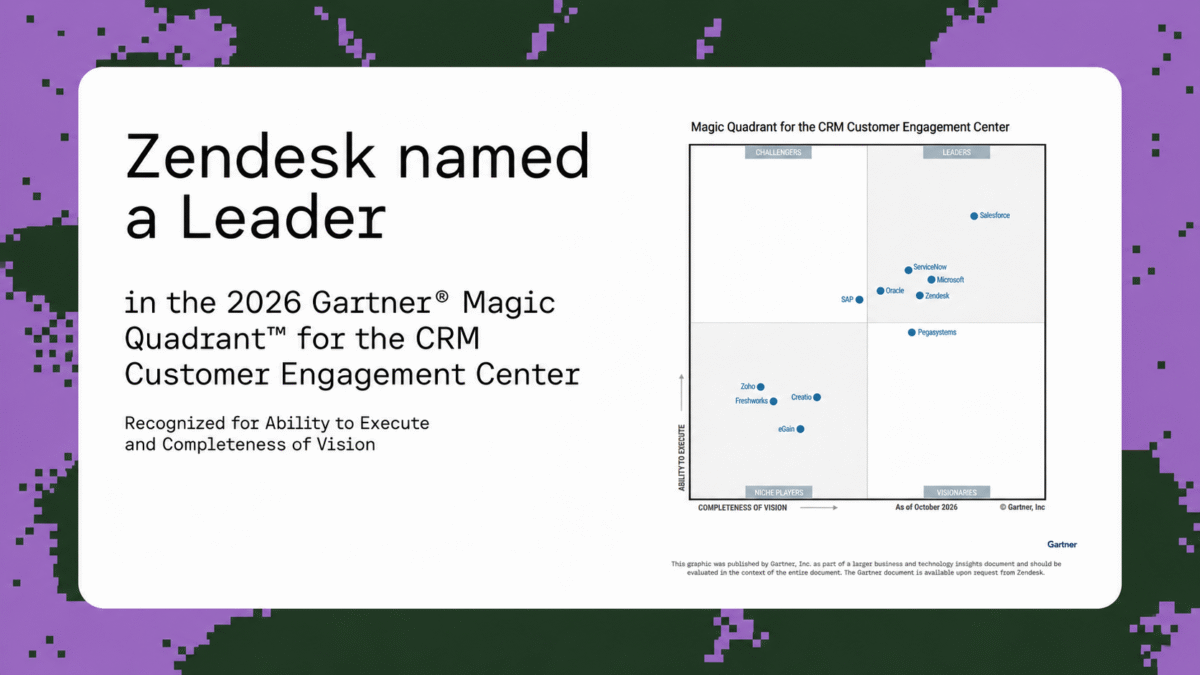
Zendesk was recently named a Leader in Gartner’s 2026 Magic Quadrant for CRM Customer Engagement Center for the second consecutive year. Announced on 5 November, the recognition comes because the company’s AI is evolving from simply answering basic customer service questions to doing tasks on its own, such as processing refunds and tracking packages.
This is a major industry award, no doubt. But, for businesses assessing Zendesk, the more useful question is what its AI can resolve, and under whose authority.
Zendesk puts autonomous service to work
According to Zendesk’s announcement, its Autonomous Service Workforce combines AI agents, copilots, knowledge, workflows and human teams through the Resolution Platform. The company says the system draws on roughly 20 billion ticket interactions, with AI agents able to reason through requests and act across connected systems.
In business reality, that includes order tracking, returns and delivery problems. Businesses can also build agents around their own policies. Zendesk reports more than one million Custom Agent executions during the first seven weeks after launch. That is an activity measure, however, not proof that one million customer problems were successfully resolved.
As we explored in our coverage of Zendesk’s refund agents, connecting support automation to refunds brings fraud controls and approval limits into the deployment decision. Letting an AI explain a returns policy is one thing. An agent moving actual money like a refund is another. Businesses have to set strict rules and fraud limits to ensure the AI doesn’t lose them money.
Count the outcomes, not just the activity
Zendesk’s employee-service figures illustrate why measurement deserves scrutiny. The company says 300 early-access customers generated six million workflow executions in five weeks, saving an estimated 500,000 hours. There is a bit of a caveat here because that wasn’t actually timed but calculated using a benchmark of five minutes per execution.
There is a commercial dimension, too. In our interview with Andrew Lawson, Zendesk’s EMEA sales chief explained that customers pay for AI resolutions confirmed by an independent evaluation. Routine exchanges and spam do not count.
“Customers are not impressed by an AI label on its own,” Lawson said.
That sets a useful test for the latest recognition. Buyers should distinguish workflow volume from verified resolutions, and estimated savings from measured improvements.
About The Author

Kihara Kimachia
NEXT UP