Trending Topics

 Trending
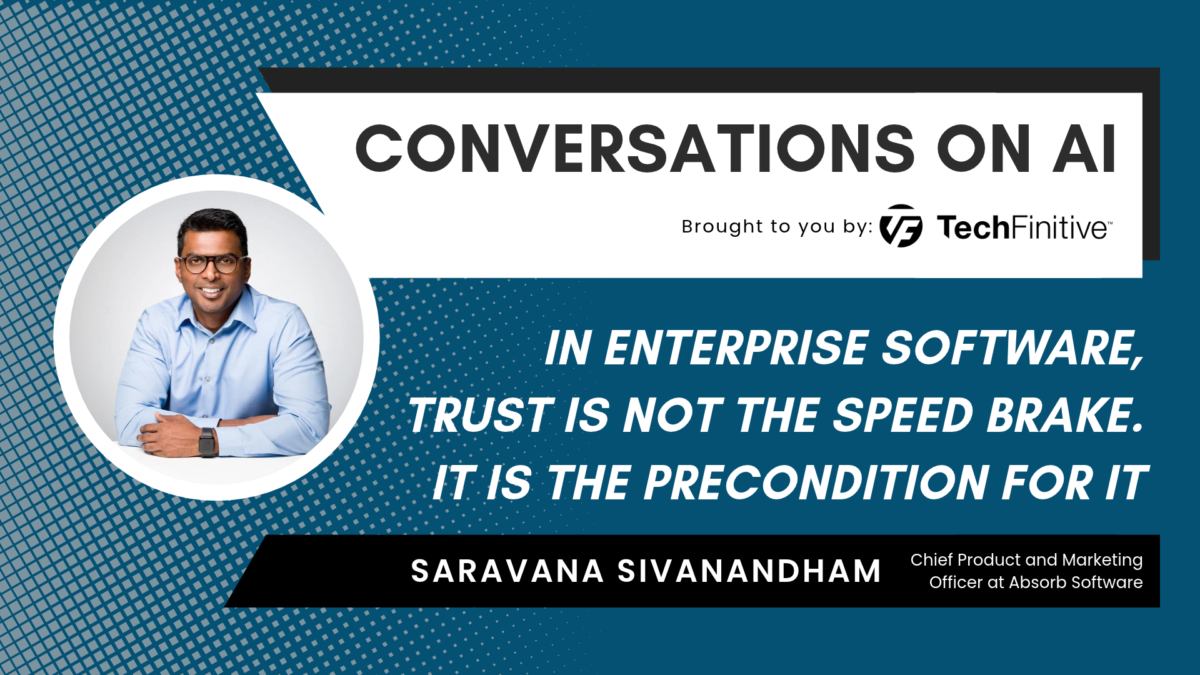
Saravana Sivanandham, Chief Product and Marketing Officer at Absorb Software: “In enterprise software, trust is not the speed brake. It is the precondition for it.”

Few doubt that AI is reaping unprecedented change, but amid it what’s being neglected is change management. That is the view of Saravana Sivanandham. He is Chief Product and Marketing Officer for Absorb Software, the Learning Management Software (LMS) that helps businesses future-proof their organisations – and their staff.
He said: “AI is quietly rewiring how work is structured. And the part almost nobody has priced in is not technical at all; it is change management.”
Having begun his career building enterprise software for tech stalwarts CA Technologies, HP, and Dell EMC, Saravana has witnessed plenty of change. His varied career spans multiple disciplines including engineering, product management, marketing, and strategic consulting.
How is AI ringing the changes for Absorb Software’s product roadmap
AI means adapting Absorb Software’s roadmap: “For years, the roadmap focused on improving the learning platform… the center of gravity moved to the layer above it: the intelligence that decides what each person needs, delivers it in the flow of work, and proves it changed an outcome.”
AI means they’re building faster but have also been delayed tools, until they had gathered enough intelligence. The now-released Aura is a set of agents rather than a bolt-on and, as such, adds genuine value, which Saravana says means judging it by actions rather than its ability to answer a specific question.
“Does it remember what happened and get smarter? And can it prove it changed an outcome, or only that it got used? A bolt-on fails all three. A system must pass them,” he said.
In that sense, AI-powered enterprise software demands more of the customer. “An agent is only as good as the knowledge behind it, so the real work of adoption is providing, organizing, and maintaining your own content and context, giving the system something true to reason from.”
Saravana is genuinely ‘moved’ by the difference AI can make to individuals, by understanding their roles and their knowledge gaps – and anticipating their learning needs. “For the first time, a person at work has something that knows their role, knows where they are struggling, knows the business context they are operating in, and reaches them before they go looking,” he said.
What’s more, AI has the capacity to prove the impact – and in the face of radical change, that’s invaluable.
“For 20 years, the honest answer to “did that training work” was some version of ‘we think so.’ That was tolerable when skills had a long shelf life. It isn’t tolerable now. The World Economic Forum projects that 39% of today’s workforce skills will be transformed or outdated by 2030, and 87% of organizations already report skills gaps they have or expect,” he said.
He added: “You can’t manage change at that speed with a completion report.”
It is a lesson he’d urge other SaaS providers to learn. Namely, not to drift away from the core of what your product delivers, but to improve it.
“Be honest with yourself about what your company already is. AI will amplify it either way.”
Everyone says AI is transforming software, but where do you believe the industry is still overestimating its impact and where is it underestimating it?
We have the timescale backward. In the short run, the industry overestimates AI; in the long run, it badly underestimates it. Most people are managing both mistakes at the same time.
The overestimation lives in the demo. A model answers a hard question well, the room decides the work has been transformed, and what changed is the interface. The process underneath it, the data it runs on, the permissions around it, and how anyone measures the result are all still sitting where they were. So, the conversation stalls at activity. More content generated, more questions answered, more sessions logged. That tells you the thing got used. It tells you nothing about whether it worked.
The underestimation is quieter and much bigger, and most of it sits at the application layer. Everyone is watching the frontier labs, waiting for the next base model, when the problems enterprises care about get solved above the model. You ground it in one customer’s own content and context. You tune it for a specific use case until it is genuinely good at one valuable thing instead of broadly impressive at everything. Do that, and an open-weight model you run under your own governance is usually more than enough, at a fraction of the cost of the frontier API everyone assumes they need. The biggest general model rarely wins the specific enterprise job. The system built around it does.
And the part almost nobody has priced in is not technical at all; it is change management. AI is quietly rewiring how work is structured. People pick up broader responsibilities, managers run bigger teams, and roles show up that nobody had a name for two years ago. The old ways people came up to speed – apprenticeship, shadowing, a manager with time to coach – were built for a slower kind of work and they do not scale to this. Ignore that, and AI hands you a faster version of the problems you already have.
Short run, this is about what a model can say. Long run, it is about what an organization can absorb. The industry is pouring almost all of its attention into the first. The second will decide the next few years.
How has AI changed your company’s product roadmap over the past 18 months? Were there projects you accelerated, delayed or abandoned altogether?
The biggest shift was where we build. For years, the roadmap focused on improving the learning platform itself. Over the last 18 months, the center of gravity moved to the layer above it: the intelligence that decides what each person needs, delivers it in the flow of work, and proves it changed an outcome. The platform mattered less in that move. It became what made the rest possible.
I want to be precise here, because it is easy to hear this as leaving the LMS behind, and the opposite is true. A system of record for what your people can do, years of your own proprietary learning content and data, and the governance and permissions already wrapped around it, is exactly what an intelligence layer needs to reason from. It is also what a competitor bolting a chatbot onto a thin data set does not have. AI without that foundation underneath it is a demo. With it, you can close the loop. The LMS stops being the front door and becomes the foundation, and that made the data we already held more valuable, not less.
This also has a practical side that matters just as much. AI didn’t just change what we build, it changed how fast we can build it. Our own R&D teams run on the same productivity gains we ship to customers, and we are now building roughly three times faster because of it. That is what lets us invest in the future without easing off the platform underneath it. We keep evolving the core at the pace our customers expect and fund the intelligence layer on top of it at the same time, rather than trading one for the other.
With that reframing in hand, the roadmap largely prioritized itself. We accelerated anything that put guidance where the work actually happens, which is why Aura shipped as a coordinated system of agents across the platform and Microsoft Teams rather than a single assistant, and why we designed measurement against real business outcomes from the start instead of added as reporting later.
We delayed things that were useful but didn’t compound yet. Aura Create, our AI authoring agent, is the clearest case. It could have launched with the first agents. We held it back because authoring only gets powerful once the knowledge layer beneath it is real, and it now draws on content already living in systems like SharePoint and Confluence and cuts the work of building and maintaining courses by up to a factor of ten.
The hardest calls were about focus, not cutting. General upskilling is the most obvious AI use case in our market and the one everyone demos. We chose not to lead with it, and to go first where the outcome is measurable and the value is provable: compliance, sales enablement, customer success enablement. Almost everyone in our space is climbing the adoption curve. Very few can prove accountability. I would rather be early to the thing we can prove.
Many SaaS vendors now describe themselves as “AI-powered.” What actually separates companies creating real customer value from those simply adding AI features?
Almost everyone added AI, so that is not the separator. The real one is whether you shipped a feature or a system, and it is the line we built Aura around. A feature is a chatbot bolted onto the side of the product. It answers a question, demos well, and doesn’t change how the work gets done. We built Aura as the opposite. It is a coordinated set of agents that finds where a capability gap is holding someone back, acts on it in the flow of their work, and then checks whether the outcome moved. One of those is impressive in the room. The other is still earning its place in month six, which is the only test that counts.
That difference is easy to check, and it is the same test we hold ourselves to. Does the AI only answer, or can it act? Does it start from zero every time, or does it remember what happened and get smarter? And can it prove it changed an outcome, or only that it got used? A bolt-on fails all three. A system has to pass them, and building something that passes all three is a great deal harder than adding a chatbot, which is exactly why so few have.
The third question is where most of the value hides. Attaching a result to a number the business already runs on – ramp time, win rate, resolution time, retention – is the hard part, and it is what buyers should demand. If a vendor can’t tell you what success will look like and how you will measure it, they aren’t selling you an AI strategy. They’re selling you a feature. Almost everyone is climbing the adoption curve right now. Very few can prove accountability, and that gap is where the real companies separate from the rest.
What is the biggest misconception enterprise customers still have about adopting AI within business-critical software?
That the intelligence comes in the box.
With traditional software, the capability arrives finished. You buy it, configure it, roll it out, and it does the same thing on day five hundred that it did on day one. Enterprise AI doesn’t behave that way, and most of the concerns customers bring to us early on trace back to expecting that it will.
The clearest one is content. Customers often assume the system already understands their business. It doesn’t. An agent is only as good as the knowledge behind it, so the real work of adoption is providing, organizing, and maintaining your own content and context, giving the system something true to reason from. People aren’t used to that being their job, and it is the difference between a system that becomes genuinely useful and one that sounds convincing.
The next cluster is data, privacy, and security, and the concern there is completely legitimate. Because the system runs on the customer’s own data, the questions get sharper: where does it live, who can see it, is it being used to train something outside our walls? What is usually wrong is the conclusion that adopting AI therefore means giving up control. Done properly it is the reverse. The data stays governed, isolated, and bound by the permissions the customer already set, and it is put to work under their control rather than handed away. The question is right to ask. The fear behind it is misplaced.
The subtler misconception is ambition. Because the reference point is the last generation of tools, customers scope AI to what was already possible: a faster search or a better chatbot and stop there. The more valuable question is the one the old tools could never answer. Not can it find the right course, but can it notice the gap, act on it in the flow of work, and show the outcome changed. And that last part, measurement, is where adoption should begin and rarely does. If you are still tracking whether people used the AI instead of whether it moved a number the business cares about, you have brought the old scorecard to a new game.
Underneath it all is the same misconception. Intelligence is not something you receive. You assemble it from your own knowledge, your own data, and your own definition of the outcome. The customers who understand that going in are the ones who get the most out of what they adopt.
If you were launching your company today with AI available from day one, what would you build differently?
I would start from a different primitive.
Every learning platform ever built, ours included, was built around the course as the atomic unit. That was the right choice for the question the industry was being asked at the time: whether a person completed the training they were assigned. The data model followed the question. Courses, enrollments, completions, a record you could stand behind in an audit. It worked, and that record is still genuinely valuable. But the question has changed, and if I were starting now, I would not organize the system around content. I would organize it around a person’s capability and the outcome it is meant to move, and let content be one of several things the system reaches for.
Almost everything else follows from that one decision, and the most important is memory. If the unit is capability rather than a course, the system must remember what actually worked, for this person, in this role, at this company, in this industry, and use it to shape what it does next. That means the outcome must be in the schema from the first version, not added later as reporting, because without the outcome there is nothing to learn from. Most enterprise software treats evidence as something you attach near the end, once the interesting engineering is finished. Built that way, a system can tell you what happened, but it can never get better at deciding what to do. That loop is the piece I would protect above everything else.
The second thing is that I wouldn’t let format be a design-time decision. The old model assumes learning is a course, so everything downstream becomes a variation on delivering one. If you start from the gap instead, the right response might be a 15-minute role-play before a difficult meeting, a mentor, a live session, or ninety seconds of reference on a phone in the field. That should be chosen at runtime for the person, the gap, and the time they have, which is a very different data model from a catalog with recommendations layered on top.
The third is scope, and it is the most expensive one to retrofit. Learning technology was built for employees, so the enterprise boundary became the product boundary. Work does not respect that boundary. Customers, partners, contractors, and field networks need the same guidance, and organizations increasingly want one system that reaches all of them under a single governance model. Designing for that on day one changes your permission structure, your data model, and your commercial model. Doing it afterward is much harder than people expect.
None of this is hypothetical. It is a fairly exact description of what we built Aura to be. The unit is a person’s capability and the outcome it is meant to move. It remembers what worked and starts the next decision from there. It chooses the format at the moment of need instead of handing someone a catalog. And it runs across employees, customers, and partners under one governance model. The one real difference between doing that today and starting from scratch is the foundation. We already had the record of what people can do and years of our customers’ own content and data behind it, which is exactly what the intelligence reasons from. That is the exact question we asked ourselves 12 months back, and the result is what Aura is.
How is AI changing the role of your customers? Are you replacing repetitive work, augmenting decision-making, or fundamentally changing how people do their jobs?.
All three, in that order, and the third is the one people underestimate.
The repetitive work goes first, and it is the least interesting of the three. Aura Admin Assist deflects 40 to 60% of routine support requests, work someone used to answer by hand. The time that comes back is real, and people appreciate it. But nobody’s job description changes because their ticket queue got shorter.
The decision-making change is bigger, and it shows up most clearly for managers. A manager has never really been able to tell whether training worked. They could see that people attended, then wait and hope. Now they can see who is ready and who isn’t, and do something about it before it matters, not after. The same shift hits the learning leader, who spent years defending the budget with completion rates, which is an activity number, and can now point to ramp time or win rate instead. Our 2026 AI in Learning Report, based on more than 1,700 learning professionals, found that fewer than 4% of organizations prioritize business performance when they adopt AI in learning, and 78% of learning teams are excluded from enterprise AI strategy altogether. Those two numbers are the same finding. Teams that measure activity aren’t invited to the conversation where strategy is set.
The fundamental change is happening at the individual level, and it is the part I find genuinely moving. For the first time, a person at work has something that knows their role, knows where they are struggling, knows the business context they are operating in, and reaches them before they go looking. An account executive with a difficult deal tomorrow doesn’t have to know what to search for. The system has already noticed the pattern in his own deals and offered him 15 minutes of practice on the objection that actually costs him. That isn’t a better tool; that is a coach, and almost nobody in the workforce has ever had one.
A second-order effect follows: ownership of learning moves. When learning attaches to an outcome, the person holding the budget is increasingly a sales leader, a customer success leader, or a compliance owner with a number they are personally accountable for. Organizations are shifting from HR-led training to business-led learning, with HR as the strategic enabler rather than the sole operator. The learning professional stops being a course producer and becomes more like a performance consultant who happens to have an unusually good instrument.
What has been the hardest challenge in bringing AI capabilities into your products? Technology, data quality, customer trust, regulation, pricing or something else?
Data quality, and then something that isn’t even on your list.
The technology was the least difficult part, and I say that without any false modesty. Model capability improves on somebody else’s roadmap, and you inherit it. What we couldn’t outsource was grounding, making the agents reason over each customer’s own courses, policies, and approved knowledge instead of the open internet. That work exposes something uncomfortable in almost every organization. The knowledge exists, but it is scattered across systems, contradictory in places, and thinnest exactly where the work is hardest, because the hardest work is the part nobody ever had time to write down. Point a capable model at ambiguity, and you get confident ambiguity, delivered faster.
The harder half of that problem, and the one I didn’t anticipate, is not teaching a system to answer. It is teaching it when not to. Most of our engineering effort went into the boundaries: what to do when the knowledge is missing, when two documents disagree, when the honest response is that we do not know and here is who does. That work is unglamorous, and it never demos well. But in a business-critical system, one confident wrong answer costs you more trust than a hundred correct ones earn. People don’t go back and re-check a system twice. They just quietly stop relying on it.
Customer trust was the other one, and it turned out to be an architecture problem rather than a messaging problem. Enterprise buyers asked very precise questions about where data lives, what it is used for, and who can see what. Our answers had to be structural rather than reassuring. Those constraints shaped what we could build, which is the correct order. Governance added at the end is not governance.
But the hardest thing isn’t on your list: internal alignment. Most companies are structurally set up to lose that one. Product defines value one way, marketing promises a second version, sales sell a third, and customer success is left to deliver whatever survives. Nobody intends that drift. It is built into the org chart, and AI makes it far more expensive, because the gap between what was promised and what the customer experiences is exactly where trust dies.
We deliberately organized against it, at both seams where the drift happens. Product and marketing sit in one organization, so we define what we build and what we promise once, rather than renegotiating it at a handoff. We also brought sales and post-sales together, so the team that makes a commitment and the team that has to deliver it after the signature are not separated by a cliff. Those sound like operating details. What they actually do is put the customer at the center of the structure instead of at the end of a relay. It is why we can commit to a measurable outcome in a sales conversation and have the people responsible for delivering it already working toward the same number. The more transformational the promise, the faster you have to prove it, and you cannot prove something that five teams describe differently.
There’s growing discussion around AI agents replacing traditional software workflows. Do you see the future as applications becoming collections of intelligent agents, or will conventional interfaces remain central?
My honest answer is no, at least not in the way the question is usually meant. One generic agent won’t replace the specialized systems underneath it.
It is worth being precise about what a general agent is actually good at. It reasons well, it retrieves well, and it can string together a few steps. What it lacks is domain judgment, your data, your permissions, or any memory of what has worked inside your organization before. The workflows that matter in an enterprise are not single exchanges. In our world, the loop is noticing that a capability gap is about to cost someone something, deciding what the right intervention is for that person in the time they have, orchestrating it, measuring whether performance actually moved, and using that result to make the next decision better. We are building agents specifically for that, for learning workflows, learning needs, and learning outcomes. No general assistant from a frontier lab is going to do that job, because it is not a reasoning problem. It is a domain, data, and accountability problem.
I would be equally honest about the other side of it. If your entire product is a simple workflow, or a nice interface over data retrieval, it will get replaced, and probably sooner than the people running it expect. That is the real dividing line in this debate, and it has very little to do with agents versus interfaces. Thin products get absorbed. Specialized systems that own a domain and carry accountability for an outcome do not.
What I think happens to platforms like ours is the opposite of shrinking. The value expands. Once an intelligence layer can reason and act across everything in one governed place, each additional capability compounds instead of just adding another module to a menu. That is why we have moved into areas we never built before. Credentialing, competency management, and frontline communication are all in beta with customers now. Those were separate problems in a world of separate tools. In a world of coordinated agents, they become part of one picture of whether a person is ready to do their job.
Where I do agree with the agents’ thesis is the surface. The interface becomes largely irrelevant. People will reach this from Microsoft Teams, a browser, a phone on a jobsite, or from whatever enterprise assistant their company has standardized on, which is why we are building an MCP server so that Absorb is natively reachable from inside the assistant they already chose rather than competing with it. But that is a statement about the front door, not about the building. As the surface commoditizes, the things that get more valuable are the unglamorous ones underneath: the system of record for what your people can do, the specialization, and the proprietary data the intelligence reasons from. A general agent can reach into almost anything. It cannot be accountable for an outcome in a domain it does not own.
How do you balance innovation with responsible AI? Where do you draw the line between moving quickly and ensuring customers can trust the outputs?
In enterprise software, trust is not the speed brake. It is the precondition for it.
A capability that customers won’t deploy at scale has not really shipped, whatever the release notes say. I have watched plenty of AI features get announced, then sit in a security review for two quarters, then go live for a pilot group of 50 people who were already enthusiastic. That isn’t fast. The genuinely fast path is building to the enterprise bar from the beginning, because that is the only version that reaches everybody. Speed in this market is measured in deployed users, not in ship dates.
So, the line we drew with Aura was a bar we set before beta, and the key was that both halves had to be true at once. Not whether the AI could produce an impressive answer in a demonstration, and then separately whether we could make it compliant later. It had to hold up in the flow of real work and meet enterprise standards for security, governance, and reliability at the same time. In practice, that meant a common customer-approved knowledge layer, agents that operate strictly inside the permissions the customer has already set, and complete tenant data isolation.
The other thing is that responsible AI only becomes real when you turn it from a set of principles into a set of numbers you have to hit before you ship. Ours were specific. Aura had to deliver a useful response to 99% of learner queries, resolve 95% of sessions in a single response, and produce 100% enterprise-compliant responses across our governance and safety testing. Those held through beta, and they have held as Aura has gone live with customers. The single-response number is the one I care about most, and it is the one people tend to skip past. In the flow of work there is no second attempt. Somebody between two meetings, or a technician standing in front of a machine, gets one shot at asking. A system that needs three exchanges to become useful only works for people who have time, and the point was to help those who don’t have time.
Which is why responsible AI in an enterprise context is much less about restraint than it is about precision. Be specific about what the system does and does not do, prove it with a number you are willing to be held to, and let customers deploy it with confidence. Done that way, it is not a tax on innovation. It is the thing that lets innovation reach people.
Beyond productivity gains, what business outcome are your customers most excited about when they invest in AI?
Proof. And then something that surprised me: what proof turns into once you have it.
Start with proof, because it is the thing this industry has never had. For 20 years, the honest answer to “did that training work” was some version of “we think so.” The system could tell you a course was finished, which is a receipt, not a result. That was tolerable when skills had a long shelf life. It isn’t tolerable now. The World Economic Forum projects that 39% of today’s workforce skills will be transformed or outdated by 2030, and 87% of organizations already report skills gaps they have or expect. You can’t manage change at that speed with a completion report.
So, customers come to us wanting to answer the harder question: whether learning actually improved performance and whether they can demonstrate it. Answering it requires the system to read from the places work it genuinely tracked – the CRM, the HR system, the support platform – rather than asking anyone to re-enter anything, which is why we built on open standards instead of a wall of custom integrations.
But the thing they get most excited about turns out not to be the retrospective proof at all. It is what happens when you can see capability in the present tense. Once the system knows what a person can do right now, the question changes shape. It stops being whether last quarter’s program worked and becomes whether this person is ready for the thing that is about to happen. Is this technician certified for the job I am about to dispatch them to? Is this clinician current for the procedure on tomorrow’s list? Is this rep ready for the renewal conversation on Thursday? Those are operational decisions, and no learning system has ever been able to inform them.
That is the shift I did not fully anticipate. We set out to prove the past, and what customers want is a decision about the next 24 hours. A completion tells you what somebody did last quarter. Readiness tells you what they can do tomorrow morning, and that is something you can put in front of a CFO, an auditor, or a board with a straight face.
Looking ahead three to five years, what part of today’s SaaS experience do you think will disappear because AI makes it obsolete?
All the work we currently make people do is on behalf of the software.
Every enterprise application charges a tax that we have collectively agreed to stop noticing. You learn where things live. You search for the right item. You assemble the report. You configure the system to approximate how your business works. None of that is your job. It is the software failing to do its own job and handing the remainder to you, and we normalized it by calling it “using software.” That is the part I expect will look genuinely strange in five years.
In learning specifically, two obvious things go. The catalog as the center of gravity goes first, because searching a library of courses is a task the system should be performing for you rather than delegating back to you. The completion report follows it, because once you can measure an outcome directly, nobody is going to keep accepting a proxy for it.
The third one I find quietly funny, given what we sell. A meaningful share of what our customers have historically had to learn is our own product. Administrators took courses on how to build courses. That entire category should disappear. You should be able to ask the system to do the thing and have it do it or show you how, and nobody should ever again sit through training on how to operate the software they bought to run their training.
The system of record doesn’t disappear, and people misread this constantly. Compliance obligations, audit trails, and defensible evidence of what happened aren’t going anywhere, and any vendor promising to replace them hasn’t spent much time inside a regulated enterprise. The record simply stops being the place you visit and becomes the foundation everything else runs on.
So, what disappears is the labor, not the substance. The software that survives will be the software that quietly does the work you used to do yourself, sitting on a record that still holds up the day somebody asks you to prove it.
If you could give one piece of advice to another SaaS executive planning their AI strategy today, what would it be?
Be honest with yourself about what your company already is, because AI will amplify it either way.
That sounds like a platitude until you watch it happen. If you have real domain depth and proprietary data, AI turns that into a genuine advantage, because the model is available to everyone and what you know is not. If your product is a thin layer over someone else’s data, AI makes that visible much faster than the market would have found it on its own. If your teams quietly disagree about what value means, AI won’t resolve that; it will accelerate the drift. It is a multiplier, and it has no opinion about the sign.
The practical form of that advice is to do the unglamorous work first. These systems reason from clear definitions of roles, skills, permissions, process, and business context. Deploy AI on top of vague role definitions and undocumented process and you don’t get a smarter organization. You get a faster one that is confidently wrong. That work is boring, nobody gets promoted for it, and it is the single highest-leverage thing most companies could be doing right now.
The second piece is about people, and it is where I see most rollouts stumble. Bring your workforce with you through transparency, clear expectations, and a phased approach rather than an announcement. Adoption is not a launch event. I said earlier that change management is the most underestimated part of all this, internally as well as externally.
It is worth being clear about what the prize is, because it is much larger than efficiency. We have known how people learn best for 40 years. Benjamin Bloom’s work on the two-sigma problem showed that students tutored one-to-one performed roughly two standard deviations better than students in a conventional classroom. The model was never in question. There were simply never enough teachers, so every innovation since – the classroom, the textbook, online courses, the LMS – bought scale by giving up personalization. That trade has been forced on us for centuries. AI is the first technology that removes it. Get the foundations right and you can finally give every person a companion that understands their role, their gaps, and the work in front of them. That will turn out to be the most profound thing AI does for the workforce and it will belong to the companies willing to do the boring part first.
About The Author