Trending Topics

 Trending
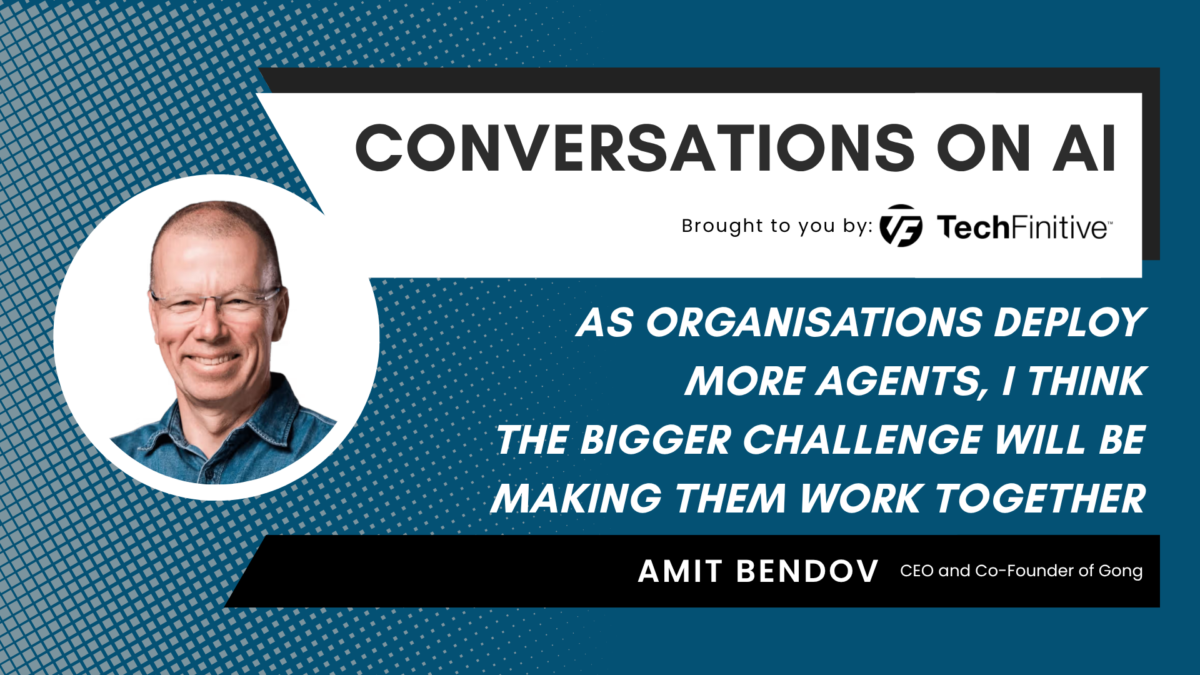
Amit Bendov, CEO and Co-Founder of Gong: “As organisations deploy more agents, I think the bigger challenge will be making them work together”

Remember the giddy days of 2015, when most people associated artificial intelligence with Will Smith in a warehouse full of robots? Well that was when Amit Bendov co-founded Gong to help businesses uncover the buying signals buried in customer conversations. Who better to speak to about AI than someone who has lived through the days of AI scepticism and into our hype-driven era where adding “AI” to product names can double a company’s value overnight.
Needless to say, he is not fond of this slap-AI-on approach. “The companies separating themselves are those building AI that is so intrinsic to operations, it’s nearly invisible,” Bendov told us. “AI that sits in the decision path – recommending next steps or acting autonomously – gives users far more value than a sidebar attached to existing UI.”
For him, it’s all about the bottom line and helping people do their jobs better. “Our data showed that historically, salespeople spent just 23% of their time actually selling. That’s like not starting work until Thursday afternoon,” he said.
“The question shouldn’t be, ‘Where can we add AI?'” he added. “It should be, ‘What could we help them achieve through AI that they can’t today?'”
Throughout our interview, Bendov is also keen to emphasis the value of humans. “I don’t see the winning model as full AI autonomy, but rather well-governed execution: AI bridging the gap between insight and action, while people remain responsible for approvals, oversight and making the biggest calls.”
And if you’re still hoping for AI to solve all your business problems in one fell swoop, Gong’s CEO has bad news. “Our own research found that nearly half of planned AI investments have been paused due to uncertainty about a model’s data and learning mechanisms, and customers now rank security guarantees and explainability among their top requirements before adopting any AI tool.”
We’re not suggesting that this interview holds all the answers either, but it’s well worth hearing from someone who helped create an AI assistant almost a decade before anyone else.
Everyone says AI is transforming software, but where do you believe the industry is still overestimating its impact and where is it underestimating it?
AI’s potential to fully replace people is being massively overstated in my view. Having built Gong before the AI gold rush we’re seeing today, it’s been fascinating to see the conversation shift from AI being ‘niche’ to now framed as an existential threat to human workers.
In sales, for example, ‘AI Sales Development Representatives’ have been touted as a replacement for the traditional sales rep. However, despite all the hype around autonomous AI, in my experience, it simply cannot replace people entirely. If anything, it makes the ‘human’ traits that set the best sellers apart – judgment, emotional connection, relationship building – all the more valuable.
AI is most powerful when it is used to augment human capabilities by providing in-the-moment suggestions or coaching, while freeing people from manual admin that gets in the way of higher-value work. For example, AI summarising a customer conversation is useful, but shallow. Actionable advice on how to handle an objection and what to do next is where that added layer of true impact lies – yet that level of embeddedness is being underestimated.
AI at its best functions as the connective tissue between teams, workflows, and data. It shouldn’t just be another feature bolted onto software, or it risks becoming bloat that people don’t actually use.
Point solutions can do a good job automating discrete tasks, but when AI is the operating system stitching together everything that used to live in people’s inboxes or across multiple platforms, that’s when it can deliver real-time insight that’s aware of the users’ context – think suggesting a next step based on what’s been most effective in the past, or generating a follow up message in the user’s actual tone.
Before a customer call, I used to need a team and hours of prep to brief me. Now, that briefing happens in seconds, pulled from every prior conversation, email and CRM record. We’re shifting from a CRM-centric world, where data sits in a system waiting to be entered, to an AI-centric one, where AI actively connects that data to the people and moments that need it.
That’s not a task getting automated, that’s the connective layer of an organisation getting rebuilt, and it’s why AI raises the ceiling on how much one person can competently cover, rather than shrinking the team.
Many SaaS vendors now describe themselves as “AI-powered”. What actually separates companies creating real customer value from those simply adding AI features?
Something being “AI-powered” doesn’t automatically make it valuable, as adding a superficial AI feature like a chatbot to an existing product is relatively easy. Creating a measurable improvement to customer outcomes is much harder and requires a greater level of integration.
The starting point should always be the customer problem, not the AI capability. The question shouldn’t be, “Where can we add AI?” It should be, “What could we help them achieve through AI that they can’t today?”
That distinction is becoming increasingly important. There are a lot of products that use AI to make an existing feature faster or more convenient, but that doesn’t necessarily change the outcome. The companies separating themselves are those building AI that is so intrinsic to operations, it’s nearly invisible. AI that sits in the decision path – recommending next steps or acting autonomously – gives users far more value than a sidebar attached to existing UI. The latter is almost always cosmetic, designed so firms can say their product ‘has AI’ to customers or their boards.
There is another advantage to AI that connects multiple systems. When the technology is embedded in people’s most common workflows, frequent usage creates a feedback loop that actively improves the underlying model. The more customers use the product and feed it proprietary data and insight, the more training it receives to hone future outputs.
That is the real litmus test that I would use for separating the real AI companies from those jumping on the bandwagon: not whether it has AI mentioned somewhere in its product descriptions, but whether the AI is embedded in a way that actually helps customers achieve materially better outcomes.
How is AI changing the role of your customers? Are you replacing repetitive work, augmenting decision-making, or fundamentally changing how people do their jobs?
It’s a mixture of all three, which is a signal that AI is being embedded into workflows the way it should be.
Starting with automation, there is a lot of repetitive work involved in managing a team or running a sales function that doesn’t necessarily require human judgment. For example, managers can now generate scorecards through AI for their team members in an instant, removing much of the manual work involved in coaching so managers have more time to focus on their people and the decisions that actually need their attention.
In terms of augmenting human judgment, Gong also proactively surfaces the most useful context needed for people to make critical decisions. Rather than manually scouring notes, emails and chats to remind themselves of a customer’s unique needs, our product can automatically provide them with the relevant context, staying one step ahead at all times.
Fundamentally changing how sellers work has been our North Star. Our data showed that historically, salespeople spent just 23% of their time actually selling. That’s like not starting work until Thursday afternoon. The industry has grown comfortable with salespeople spending a huge amount of their time on activities around selling rather than actually engaging with prospects and customers – that’s what we’ve aimed to fix over the last decade.
By taking much of the repetitive work off people’s plates, salespeople can spend more time with prospects and customers, close more business and spend more time developing their own skills. The outcome isn’t simply fewer tasks, it’s a reinvented operating model for sellers. AI can increasingly manage monitoring and execution, while humans focus on the things that require context, trust, creativity and judgment.
There’s growing discussion around AI agents replacing traditional software workflows. Do you see the future as applications becoming collections of intelligent agents, or will conventional interfaces remain central?
The near-term future isn’t autonomous agents replacing applications altogether. It’s more likely that we’ll see specialised agents embedded inside purpose-built applications, each handling a specific part of the workflow. One agent might manage follow-ups, another might update the pipeline, while a third might identify and correct issues in a forecast. The agent handles the work, while the application remains the primary workspace and control surface for the user.
That’s important because the goal shouldn’t be to make software disappear. It should be to make applications more useful. If an agent can handle the repetitive parts of a workflow, people can spend more time on decisions that require context and judgment while still maintaining visibility into what is happening.
As organisations deploy more agents, I think the bigger challenge will be making them work together. What makes multi-agent systems coherent is a shared data layer: a single, continuously updated context layer that every agent can draw from. Without that shared source of truth, a fleet of disconnected agents can actually create more fragmentation, not less. You could have dozens of intelligent systems, but if each has a different understanding of the customer, the opportunity or wider workflow, they won’t necessarily make the organisation more effective.
Humans will always have an important role. I don’t see the winning model as full AI autonomy, but rather well-governed execution: AI bridging the gap between insight and action, while people remain responsible for approvals, oversight, and making the biggest calls.
How do you balance innovation with responsible AI? Where do you draw the line between moving quickly and ensuring customers can trust the outputs?
We move fast, but we’re disciplined about knowing exactly what we don’t control. Early experimentation is how you surface what’s actually possible, so we give teams room to try things. The discipline is recognising the moment our customer and their data starts flowing into a model or tool we can’t fully see into, and drawing the line there before ambition turns into risk.
We only build on infrastructure where we have full confidence in how a model behaves: data isolation, licensing, and integrations we can audit. That often means choosing the stricter, enterprise-grade option over the fastest one available. Done properly, that constrains channels innovation rather than throttling it, because customers will only adopt AI they trust.
We’re seeing that trust gap play out industry-wide. Our own research found that nearly half of planned AI investments have been paused due to uncertainty about a model’s data and learning mechanisms, and customers now rank security guarantees and explainability among their top requirements before adopting any AI tool. That’s why we’ve built governance into the product itself, including custom redaction and ISO 42001 certification, rather than treating it as paperwork bolted on afterwards.
Responsible AI isn’t a one-time checkbox either. We regularly bring legal, security, R&D, and go-to-market together because each function catches risks the others miss. Speed and trust aren’t in tension when you’re deliberate about where the red lines sit.
Beyond productivity gains, what business outcome are your customers most excited about when they invest in AI?
Revenue growth. That’s ultimately what CEOs are measured against. Because Gong connects directly to their revenue functions, customers can see exactly how AI is helping them close more deals, retain clients more effectively, and forecast more accurately, so they can budget accordingly.
But if making more money were that simple, everyone would do it. Revenue growth ultimately results from driving improvements across several domains.
The first is productivity. AI can help new sellers get up to speed faster, so they become productive sooner. It can also increase the output of existing teams by reducing the amount of time they spend on repetitive work, giving them more time to actually sell. Better coaching is another important part of this. If every salesperson has access to better insights and guidance, you can raise the performance of the whole team rather than relying on a handful of top performers.
The second is predictability. Growth is much easier to manage when you can see what is happening across your pipeline. Better visibility into opportunities and customer interactions can help businesses forecast revenue more accurately and make better decisions about where to invest. It also helps teams identify which opportunities are most likely to convert and where they need to intervene.
The third is growth itself. This is where those productivity and predictability gains ultimately show up in the numbers: higher win rates, larger deal sizes, more new-logo acquisition, and better customer retention.
Some great reads from our Features section
- IFS Unleashed 2026: AI moves from answering questions to running operations
- Acumatica’s MCP connection brings ERP access controls to external AI tools
- Can AI magically solve SMEs’ stock management problems? No. Because magic has nothing to do with it
- Authority in the AI age: How to boost your brand in LLMs (and the things you shouldn’t even try)
About The Author