Trending Topics

 Trending
From experimentation to transformation: The blueprint for secure AI adoption

AI pilots are easy; enterprise transformation is not. Here’s how security-by-design, robust governance and clear accountability can turn experimentation into trusted business value.

Do companies have an AI adoption problem? Estimates vary considerably based on the type and size of the organization, and who’s asking the questions. A UK government report from February claims only one in six (16%) businesses currently use the technology. And only half feel ready to scale deployments.
As more organizations follow, chasing the gains that early adopters are already reporting, they must turn their attention to some familiar challenges.
Only with a properly governed, secure-by-design approach can organizations gain the security, visibility and control they need over deployments. Anything less risks eroding trust rather than creating value from their technology investments.
Getting serious about AI
The gulf between individual and institutional use is significant. Some 70% of respondents to a July McKinsey report said they are prepared to adopt and use AI. But the figure dropped to only a quarter (27%) when senior leaders were asked about organizational adoption.
Closing the gap between what the report labels “enablement” and “reinvention” is vital for businesses. Half of leaders in the latter group – where AI enables a creative reimagining of how work is done – said they are realizing value. The figure is only 13% for those in the other category, who are simply offering employees access to AI tools.
Yet experimentation is not adoption. It’s the difference between an AI coding assistant and embedding the technology throughout the software-development lifecycle. Or the gulf between a simple, employee-facing chatbot and AI which acts autonomously as a de facto service desk agent. Bridging that divide requires moving from individual tools to enterprise-wide infrastructure and standardized processes – with security, visibility and control front of mind throughout.
The challenge is that AI adoption expands the corporate attack surface in potentially dangerous ways. It offers new pathways to enterprise data and accidental leakage. It creates a large supply chain of new assets which could be targeted. And it raises the risk of rogue or hijacked agents working at machine speed against the organization.
The more embedded AI becomes, the greater the risk.
What does best practice look like?
For those already in the advanced stages of AI adoption, the benefits are clear. The UK government claims three quarters have reported improved workforce productivity, while over half (57%) have developed new or improved processes or operations. But what does secure adoption look like?
First, ensure security is built into AI deployments by design rather than bolted on, says Adam Ely, General Manager, AI Security at Check Point.
“Bolt-on security means finding problems after an AI system is already connected to your data, customers and business processes, which is the most expensive and risky time to fix them. It also tends to create gaps between tools,” he argues.
“Secure by design means security decisions are made alongside the design decisions: what data the AI can access, what actions an agent is allowed to take, how its behavior will be monitored and who can stop it.”
In practice, this means security reviews built into AI project approval, agents deployed with least-privilege access from day one, guardrails on every model and agent, and runtime monitoring that checks not just whether an action is allowed, but if it still makes sense for the task, Ely adds.
Forrester Senior Analyst for AI Governance, Kasia Jakimowicz, adds that kill switches, while in vogue, can’t reverse mistakes or malicious actions that have already taken place. “Secure by design means defining how far AI may go, how quickly the organization can intervene, and how the business will recover before something goes wrong, not after,” she argues.
Why governance matters
Governance is critical to any serious attempt to turn AI from a tactical productivity tool into strategic business capability. But it’s still a neglected part of cyber strategy for many organizations. Gartner claims in a report shared with TechFinitive that most AI projects up to 2027 will fail to meet expectations due to their failure to focus on data governance.
Forrester’s upcoming State of AI Governance 2026 research reveals that 78% of organizations have established AI policies, but only 42% have embedded governance into their AI strategy.
Fortunately, existing frameworks can help. Check Point’s Ely says the NIST AI Risk Management Framework can provide “a strong foundation for identifying and managing AI risk.” And that ISO 42001, a certifiable standard for AI management systems, is increasingly useful for demonstrating trust to customers. He also praises the OWASP Top 10 for LLM and a similar report for agentic applications for offering practical guidance on the threats that AI systems face.
“The key is to adapt a framework to your organization rather than treat it as a checklist,” he says.
For Forrester’s Jakimowicz, there are three connected governance layers to consider. “AI governance principles define the intended outcomes, including accountability, fairness, transparency, explainability, safety, privacy, and human oversight,” she explains.
“Operational governance turns those outcomes into ownership, inventories, risk tiers, decision rights, evaluations, approvals, and evidence. Runtime governance connects the approved state of a system to its actual behavior through observability, constraints, intervention, recovery, and continuous assurance.”
From pilots to production
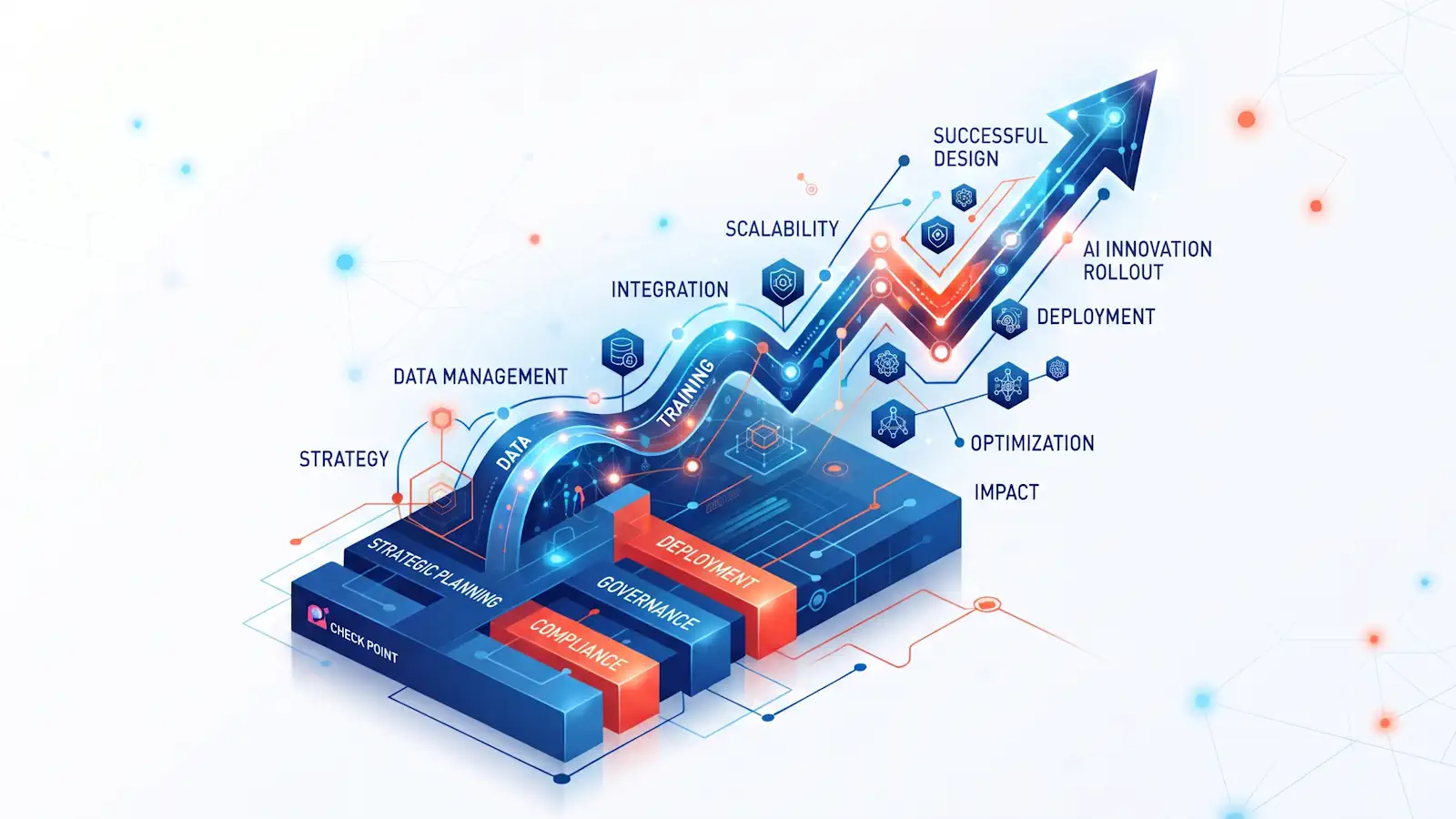
So what does it take to turn plans for secure AI adoption into action? Check Point’s Ely argues that it begins with discovery of all AI systems in the enterprise and then classification of data. The latter is essential if organizations want to vet exactly what type of information AI systems can actually use. Every agent should have an assigned identity, least-privilege permissions and a named owner, he adds.
“Next comes testing. Red team the application for prompt injection, data leakage and unsafe actions. And deploy guardrails that inspect inputs, outputs and agent actions, with the ability to hold or block them in real time,” Ely says.
“Log what agents actually do, not just what they report, and review behavior over time. Prepare for incidents with a playbook for when an AI system misbehaves, including how to shut it down. And give the board regular visibility of AI risk through reporting.”
For businesses adopting first and thinking about security and governance later, there’s a final word of warning from Forrester’s Jakimowicz.
“AI transformation does not happen when organizations deploy more models or agents,” she says. “It happens when they treat AI as an enterprise capability. And connect it to clear business priorities, accountable ownership, operational controls, evidence, and measurable value.”
That’s the theory. Now comes the hard part.
About The Author

Phil Muncaster
NEXT UP