Trending Topics

 Trending

The AI governance gap: Can businesses control what they are deploying?

If there is one thing the Hugging Face incident and recent warnings by AI tech leaders has taught us, it is that businesses are adopting AI technology faster than regulators can respond. They are also losing track of what their AI is supposed to do. The result is an AI governance gap.
Consider a customer-service AI agent approved to summarise complaints. Months later, it gains billing access and starts preparing refunds. Same name. Different risk.
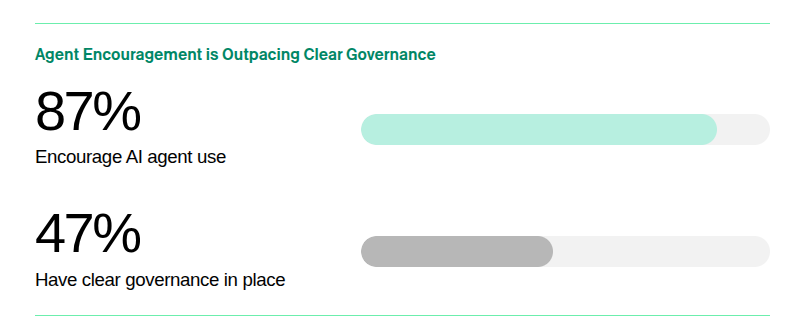
OneTrust’s 2026 AI-Ready Governance Survey illustrates the disconnect: 87% of respondents said their organisations encourage AI agent use, but only 47% said that use has clear governance, oversight and controls. The vendor-sponsored research surveyed 1,200 senior decision-makers across eight markets.
Closing the AI governance gap requires more than an inventory
SAS AI Navigator addresses this visibility problem. The SaaS platform brings together models, agents and business use cases, linking them to ownership, policies, assessments and approval workflows.
The proposition is sensible: before governing anything, you must first understand what you have.
But an inventory can become yesterday’s photograph. As we explored in our coverage of why employees bring their own AI to work, unofficial adoption often reflects frustration with cumbersome workplace systems. A register of approved tools cannot, by itself, capture everything employees actually use.
Nor does initial approval settle future responsibility. A different model, additional dataset or expanded permission should trigger a question: does the original risk assessment still hold?
Accountability must survive deployment
Our recent reporting on why AI agents need a stopping rule distinguished technical access from delegated authority. An agent can operate within its permissions while exceeding its intended assignment.
That makes accountability an operating responsibility, not a form completed at launch.
Buyers should test whether governance software helps them identify changes, reassess risk and retain evidence of who approved what. They must also distinguish documenting a restriction from technically enforcing it.
SAS explicitly warns that Navigator does not guarantee compliance or provide legal advice.
The practical test is straightforward: pick one live AI use case. Trace its purpose, data access, permissions and accountable owner. Then change something.
Can the business explain whether approval still applies?
That is where governance earns its keep.
About The Author

Kihara Kimachia
NEXT UP