Trending Topics

 Trending
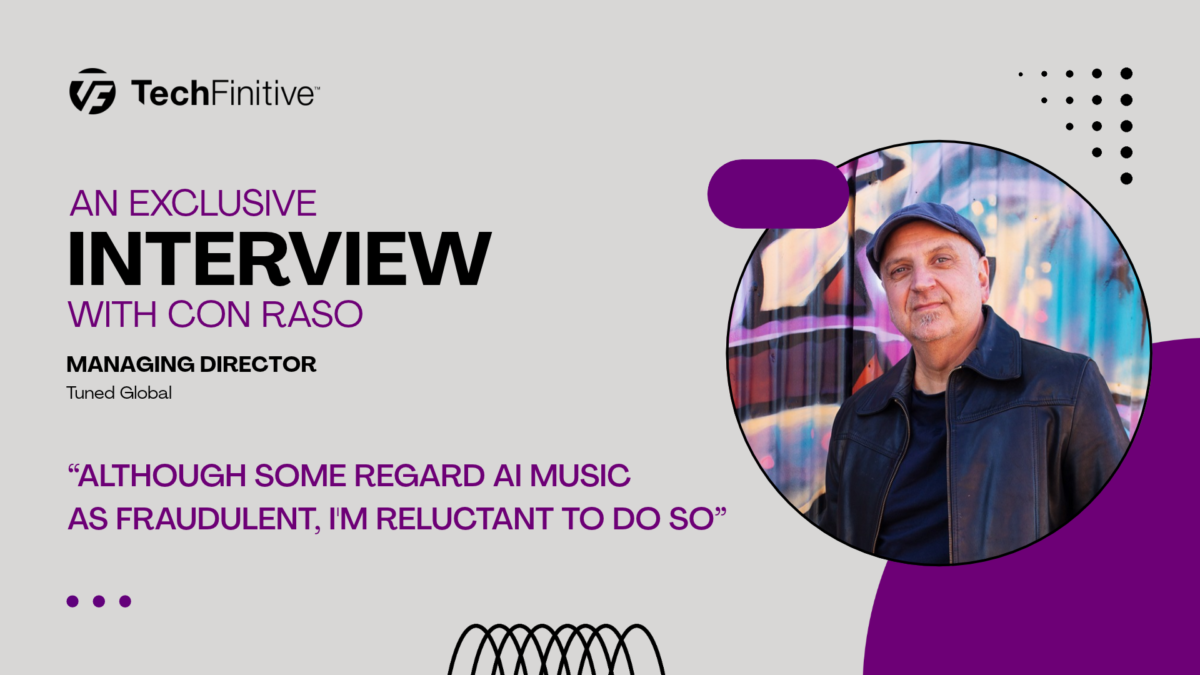
Con Raso, Managing Director and Co-Founder of Tuned Global: “Although some regard AI music as fraudulent, I’m reluctant to do so”

The next phase of music technology may be less about generating songs with AI and more about changing how people interact with music. As intelligent agents become part of everyday digital services, music could increasingly be selected, adapted and delivered without users having to open a dedicated streaming app. That raises new questions around licensing, personalisation and how artists and rights holders are paid when their work appears in experiences that were never designed around traditional streaming.
Con Raso, Managing Director and Co-Founder of Tuned Global, believes 2027 could mark an important shift in this direction. Rather than building more standalone music services, he sees an opportunity to make licensed music available to a wider range of AI-powered applications, allowing agents to select and adapt tracks within the boundaries of existing rights agreements.
The implications extend well beyond AI-generated tracks. Raso expects more interactive music experiences to emerge in gaming, where players could have greater influence over what they hear, as well as new ways for personal AI systems to carry music preferences between otherwise disconnected services. He also sees opportunities for AI to make content filtering more sensitive to children’s ages, cultural differences and local requirements.
There are challenges to address. Streaming fraud remains a concern for the industry, while licensing models have yet to catch up with the possibilities offered by more dynamic and participatory music experiences. For Raso, the technology may move faster than the commercial frameworks needed to support it.
Tuned Global provides the infrastructure behind digital music services, including APIs, licensing and rights management, analytics and white-label streaming platforms. The company says it has supported more than 40 businesses across 70 countries since 2011.
In this interview, Raso discusses how AI agents could change music discovery and delivery, why gaming may become a more interactive music environment, and what the industry needs to do to make these new experiences commercially viable.
As AI adoption accelerates, where do you expect the biggest opportunities to emerge for businesses building music and audio experiences in 2027?
For years, music services have been built around how people search for, discover and choose music. But what happens when the person is no longer the one making those decisions? 2027 could bring more music services designed to work directly with AI agents, letting them find, choose and deliver music while respecting the licensing and rights attached to its use.
Rather than asking how we build yet another music application, we should be asking how we make music available to an entirely new generation of intelligent applications. That could create demand for music in places where a traditional streaming service would never have made sense.
Much of the debate around AI in music has focused on generating new tracks. Do you expect the next wave of innovation to be more about using AI to transform the user experience, and what could those experiences look like?
The discussion around AI in music is already shifting past whether AI can produce a new track. As licensed environments open up, existing music can be altered, adapted or reworked into new versions, with the original rights holders, songwriters and artists still getting paid.
Over the coming year, I expect people to start asking, “What kind of user experience do I want to enable with agentic AI?” The questions might become: how do I modify music, and how do I create different versions of it? This would happen within a framework that makes sure the original rights holders, songwriters and artists are compensated for that inclusion.
Fraud detection is becoming an increasingly important part of music technology infrastructure. How do you expect the way platforms identify and manage streaming fraud to evolve in 2027, particularly as AI-generated content becomes more prevalent?
The industry has moved quickly from acknowledging streaming fraud as a major problem to expecting platforms and partners to demonstrate how they tackle it in practice, including within contracts. Although some regard AI music as fraudulent, I’m reluctant to do so. In my view, fraud has more to do with how music is used and distributed, and I think that will only become a greater focus in 2027. Increasingly, it’ll come down to detecting not just the music itself but how it’s experienced and used, and understanding how the fraudulent streaming happened.
Gaming represents a significant opportunity for music technology, but traditional licensing models can restrict experimentation. How could giving developers and smaller studios more freedom to test music experiences help create new commercial models?
Gaming is fundamentally a social experience, but music hasn’t always evolved alongside it. It has typically been selected by developers and governed by traditional synchronisation licensing, which wasn’t built for these kinds of dynamic, interactive experiences. I think 2027 will be the year we start to see real innovation in how players participate in the music experience: not just listening to a soundtrack chosen for them, but influencing what they hear, sharing music with others and making music part of their interactions within a game.
I suspect the licensing models will take longer to develop than the technology itself. However, I believe early innovators will begin to show just how significant the opportunity could be, and that will help push the commercial models forward. There are parallels with how music evolved on social platforms, where new forms of engagement eventually led to new licensing approaches. If the industry can develop more flexible licensing models, the commercial opportunity could reach well beyond traditional sync revenue, creating new ways for artists and rights holders to reach and engage audiences.
Personalisation is already central to streaming, but consumers increasingly move between very different digital services. Could personal AI eventually allow a user’s music tastes and preferences to move with them from one experience to another?
Personal AI could act as the bridge between services that are otherwise disconnected. It may be that my own personal AI knows me, and I can pass some of that knowledge to another service automatically.
When we think of it that way, as simply transferring knowledge from an AI model, it’s easier than saying, “I need all of my history and many things working together.” How do we understand the taste profile of someone moving from Spotify to an in-flight experience, for example, and what does that really mean for them? I think it would be hugely impactful. We might begin to see this towards the end of next year, though it will still be at a very early stage.
Governments and technology companies are facing increasing pressure to create safer digital environments for children. Could AI enable more sophisticated approaches to age-appropriate music and entertainment than today’s relatively simple content filters?
The wider debates around children’s safety online will call for more nuanced music filtering than today’s basic explicit-content controls, particularly across different countries and cultures. This is where AI could play a part: how well can it determine the acceptable threshold for different age groups across services and regions worldwide?
With governments and parents scrutinising children’s access to open social platforms more closely, I hope more attention will turn to closed ecosystems that are built to be engaging for children rather than being merely restrictive.
Recommended reading
About The Author