Trending Topics

 Trending
Five mistakes businesses make with QR codes


QR codes are a brilliant way to reach your audience. They can offer information, direct potential customers to your website, and build relationships with incentives and loyalty bonuses.
If you want to make the most of their potential, however, you need to use them effectively. Here are five common mistakes you should be aware of – and avoid.
1. Cutting out the redirect
When a visitor scans your QR code, they’re instantly connected to your website – but a professionally generated code won’t usually have your web address encoded into it. Rather, it will point to a redirection server, operated by your QR provider, which will forward the connection to the correct URL.
Although this step is normally invisible to the user, it’s vitally important for your business. It lets your partner log each scan of the QR code, to track who’s visiting your site and when. It also gives you the ability to change the destination of the code – so, for example, when a marketing campaign ends, you can make all the associated QR codes redirect to your main site.
Unfortunately, many businesses don’t realise the importance of the redirection. “We’ve had cases where a client downloads QR codes from our website, and then the marketing team recreates them so they don’t point to our server any more,” warns Jean-Charles Passepont, CEO of QR specialist Unitag.io.
“They become static, with their final destination hard-coded into them. And then two months later the client comes back to us saying ‘I don’t understand, I see people scanning these codes, but there’s no record of it, no analytics’. We’ve seen this mistake made not once, but multiple times.”
The lesson is simple: if you want to get the best from your codes, always use the assets generated by your partner – accept no substitutes.
2. Getting locked into a single provider
Using a third-party server for your QR codes has significant benefits, but it can cause problems if you want to move to a different partner.
“A lot of people create QR codes that point to their provider’s domain,” explains Marko Pavuna, Unitag’s chief marketing officer. “Then one day they decide to leave the service, but they still have these QR codes on their marketing or packaging – and they realise that the codes can’t be migrated.”
There’s a simple way to avoid falling into that trap. “We, and most other professional providers, offer a domain-name solution, which lets the client put their own domain name behind a QR code,” explains Pavuna. Via that domain, the partner can manage your QR traffic for as long as you’re working together; if you need to move on you can redirect the domain to your own server and keep control of your codes.
3. Hiding your codes
QR codes have a certain functional elegance, but let’s be honest – they don’t always fit organically into a creative design. In promotional material or branded communications, there’s often a temptation to hide the QR code away, perhaps on the back of a leaflet or buried among the small print.
Doing so is a mistake. Your QR code is arguably the most important part of your marketing, because it’s the element that transforms the campaign from passive to interactive. Make it big and visible enough that passers-by can see it’s there and scan it with ease.
That means not making it too small, and certainly not concealing it round the back of your materials. You want a potential visitor to feel that they can scan it effortlessly, without having to walk up to a poster, crouch down in front of a display board or physically pick up a product and examine it to find the code.
4. Insufficient testing
Many businesses make the mistake of assuming that, because they can scan a QR code on a computer screen, that same code will be scannable when it’s printed and displayed in its intended location.
In fact, all sorts of factors may affect the legibility of a QR code. The printing process can introduce blurring or visual glitches that reduce the code’s readability – or you might inadvertently use a low-quality version of the code.
“Sometimes people take a code that’s been created on the web, and the resolution isn’t high enough for what they want to do,” warns Pavuna. “With the right provider you can download high-quality codes in formats such as PDF, PSD or SVG.”
Scannability becomes even more important if you want to tweak the appearance of the code to follow your branding, such as using custom colours or overlaying a logo on top of the QR grid. Especially if you’ve adapted the code, it’s vital to test, test and test again at every step of the process.
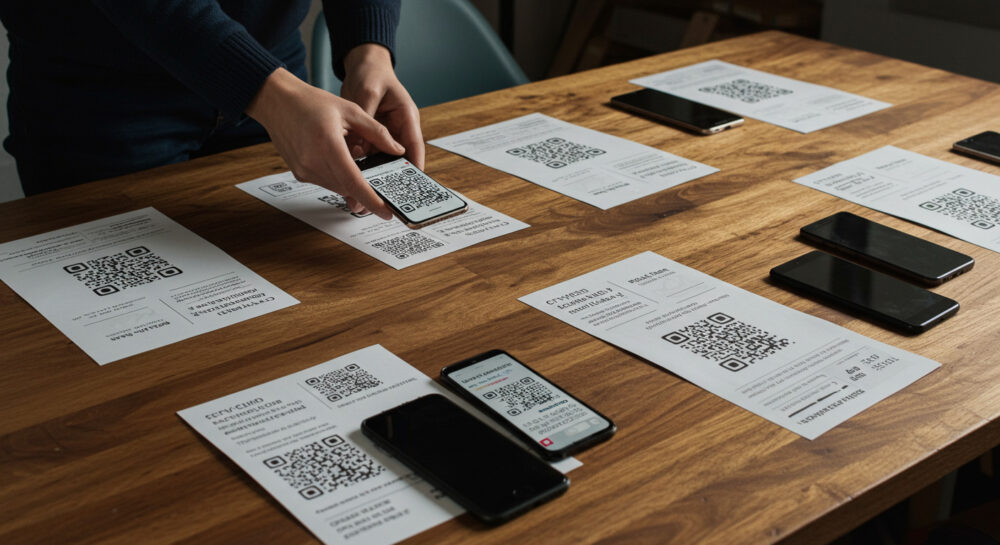
“We always tell our clients, once you have your QR code ready, make sure it’s still scannable,” says Passepont. “Test it on screen, then print it and test again. We’ve seen some clients skip these steps: they test it while creating, but then they change the colour without realising that this will affect the print contrast. They create thousands of QR codes, and then they send them to be printed – and none of them work.”
Test on as wide a range of devices as possible too. There are hundreds of different models of phones out there with different camera hardware and QR-recognition features, and a code that scans perfectly on one phone could fail on the next.
5. Not working with a partner
It’s tempting to use a free QR service to produce ad hoc codes, especially when you’re starting out. But short-term economies can have long-term consequences. Free services typically don’t offer analytics, so you’ll be missing feedback on how your codes are working and how you can best evolve your use of them.
Most free services don’t support redirection either, so once you’ve printed a code its destination can never be changed. Or, they may limit your usage to a certain time period, or a certain number of scans – after which the code stops working, unless you pay whatever fee is asked for.
With a specialist such as Unitag, such issues go away. As well as providing professional services, Unitag can offer valuable guidance on starting your QR code journey, how to print and present your codes for maximum readability, how to encourage visitors to scan, and – crucially – how to ensure brand safety and online security. With a range of prices to suit organizations of all sizes, there’s no reason not to work with the experts.
More articles in partnership with Unitag
About The Author

Darien Graham-Smith
NEXT UP