Trending Topics

 Trending
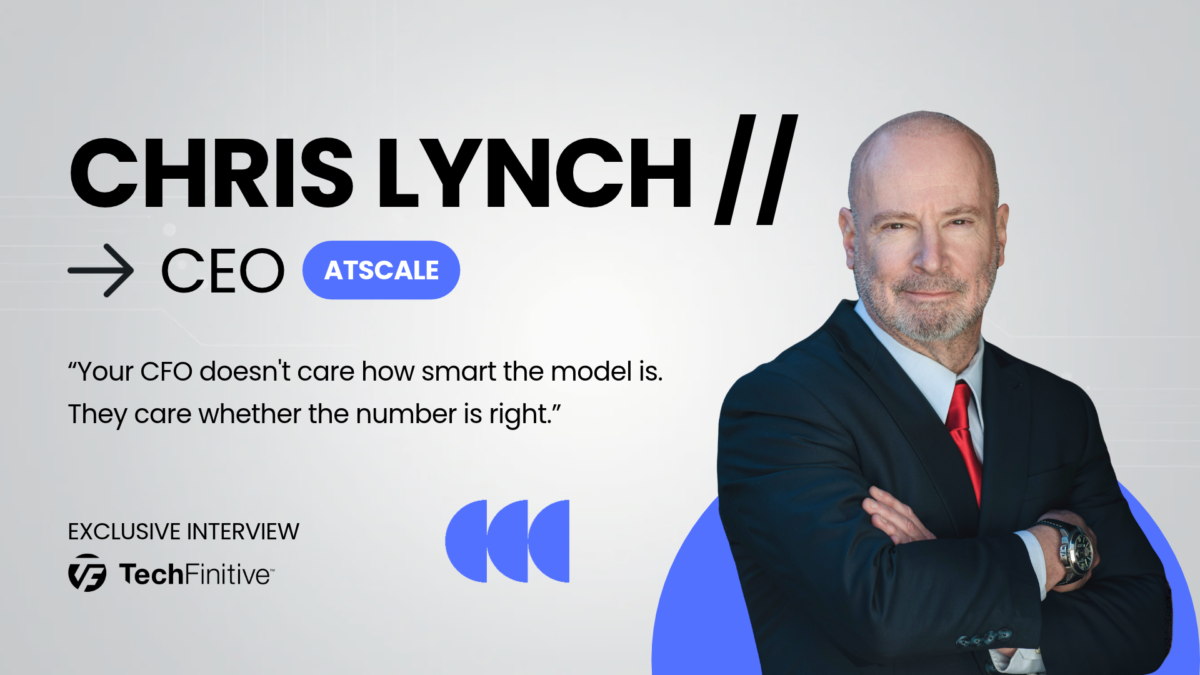
Chris Lynch, CEO of AtScale: “Your CFO doesn’t care how smart the model is. They care whether the number is right.”

Enterprise AI can query databases and produce answers to complex business questions, but understanding what the underlying figures actually mean is another matter. Revenue, for example, could refer to bookings, recognised revenue or annual recurring revenue (ARR). Without consistent definitions, even technically correct queries can produce commercially misleading results.
Chris Lynch of AtScale believes businesses have focused too heavily on improving AI models while overlooking the business context they need to work effectively. His argument centres on the semantic layer: a way of giving AI systems access to consistent business definitions and calculations, rather than leaving them to interpret database structures and make assumptions about individual metrics.
AtScale’s own testing offers an indication of the potential impact. Across seven leading AI models, the company found that introducing its semantic layer improved performance by between 55% and 108% on a first run, without retraining or fine-tuning. The results suggest that better access to business context could be as important as advances in the models themselves.
For organisations looking to put AI agents to work on financial and operational data, the distinction has practical consequences. A plausible but incorrect figure can influence decisions before anyone realises something is wrong.
In this interview, Lynch discusses the role of semantic layers in enterprise AI, how businesses can establish consistent definitions for their data, and why they should start with trusted business metrics before handing AI agents greater autonomy.
For readers unfamiliar with semantic layers, how do they help AI answer business questions more accurately?
Think of a semantic layer as a calculator for AI.
Every company runs on a few hundred numbers: revenue, margin, churn. The definitions behind them live in spreadsheets, warehouse code and people’s heads, and they rarely agree.
We have models that can reason through almost anything, and we’re asking them to guess what a company means by revenue, then guess at the math. That’s backwards.
A semantic layer takes the guessing out. The model handles the question. The semantic layer applies the business definitions and computes the answer the same way every time, for every model and every agent. Then you keep at it: model the business, measure the answers, compute, repeat.
Your CFO doesn’t care how smart the model is. They care whether the number is right.
Leading AI models answered fewer than four in ten business questions correctly when querying databases directly. What were they getting wrong, and why does that matter?
The SQL was fine. The business understanding wasn’t there.
The model sees a column called revenue and has to pick: bookings, recognized revenue or ARR. Three different numbers. It joins two tables and doubles your order count.
And the wrong answer looks exactly like a right one. The query runs, the number is plausible, and nobody catches it until a person or an agent has already acted on it.
An AI that’s wrong six times out of ten is a liability. If a human has to check every answer, what have you automated? You’ve built a very expensive guessing machine.
A smarter AI model can’t reason its way to a company’s definition of revenue. Are businesses spending too much time choosing models and too little defining what those models need to know?
Yes. And model choice still matters.
Models differ in strengths, and in cost by as much as an order of magnitude. We ran BIRD-Interact, a public benchmark that tests whether AI can answer real business questions against real databases. Gemini stood out at knowing when to ask a clarifying question. We use Claude for our coding agents. Open-weight models run in your own environment, pinned to a version, which matters for sovereignty.
But no leaderboard knows how your company calculates revenue. That’s your business logic, and it has to come from you.
In our preliminary results, the lowest-ranked model with the right business context beat the highest-ranked model working alone. A model writing its own query for a single business question produces hundreds of lines. Through a semantic layer, the same question takes about three, because the joins, the grain and the filters are already settled. Every line the model writes unsupervised is a line that can be wrong, and nobody is reviewing hundreds of lines of machine-generated SQL before they act on the number.
Get the definitions right and every model you pick gets better.
Adding AtScale’s semantic layer improved accuracy across all seven models tested. What does that consistency tell you about the causes of unreliable AI answers?
It tells me the industry has been working on the wrong problem.
We tested seven leading models from six vendors. On their own, none got much more than a third of the business questions right. Give them the business definitions and an engine to compute the answer, and every one improved, by 55% to 108% on a cold first run. No retraining, no fine-tuning.
Gemini jumped 345% when measured on the second clarifying question it asked before answering. That’s preliminary and not yet verified by the benchmark team, but it shows what resolving ambiguity up front is worth.
The models at the top of the leaderboard improved too. Raw intelligence was never the bottleneck. Context was.
That’s where the next breakthrough in enterprise AI comes from.
Where should a business start? Who should own shared business definitions, and how should teams test whether AI answers stay accurate?
One department, ten metrics. Start with finance.
That’s where the numbers carry the most weight and a wrong one gets noticed fast. Take the ten metrics your CFO shows the board and ask whether every team calculates them the same way. In most companies we work with, they don’t, and it takes an afternoon to find out.
Finance owns the definitions, because finance answers for the numbers. The data team delivers them, the same way, to every application and every agent.
Then test it like you’d test any financial system. Build a suite of real business questions with known answers, run it on a schedule, and feed every failure back into the definitions.
Don’t start with autonomous agents. Start with people who know the numbers and will tell you when one looks off. Earn their trust, then automate and expand to the next department.
Hold AI to the same standard you hold the people running the business.
Some great reads from our Opinions section
About The Author