Trending Topics

 Trending
The AI workforce nobody onboarded

This article is part of our Opinions section, where we invite industry professionals to share their views on the most pressing technology questions of our time.
Imagine an IT organisation of 2,000 people. Its headcount may stay flat over the next 12 months. But if those people begin working with an average of five AI agents each, the organisation could suddenly be responsible for 10,000 additional non-human actors writing code, opening pull requests, running pipelines and interacting with production systems.
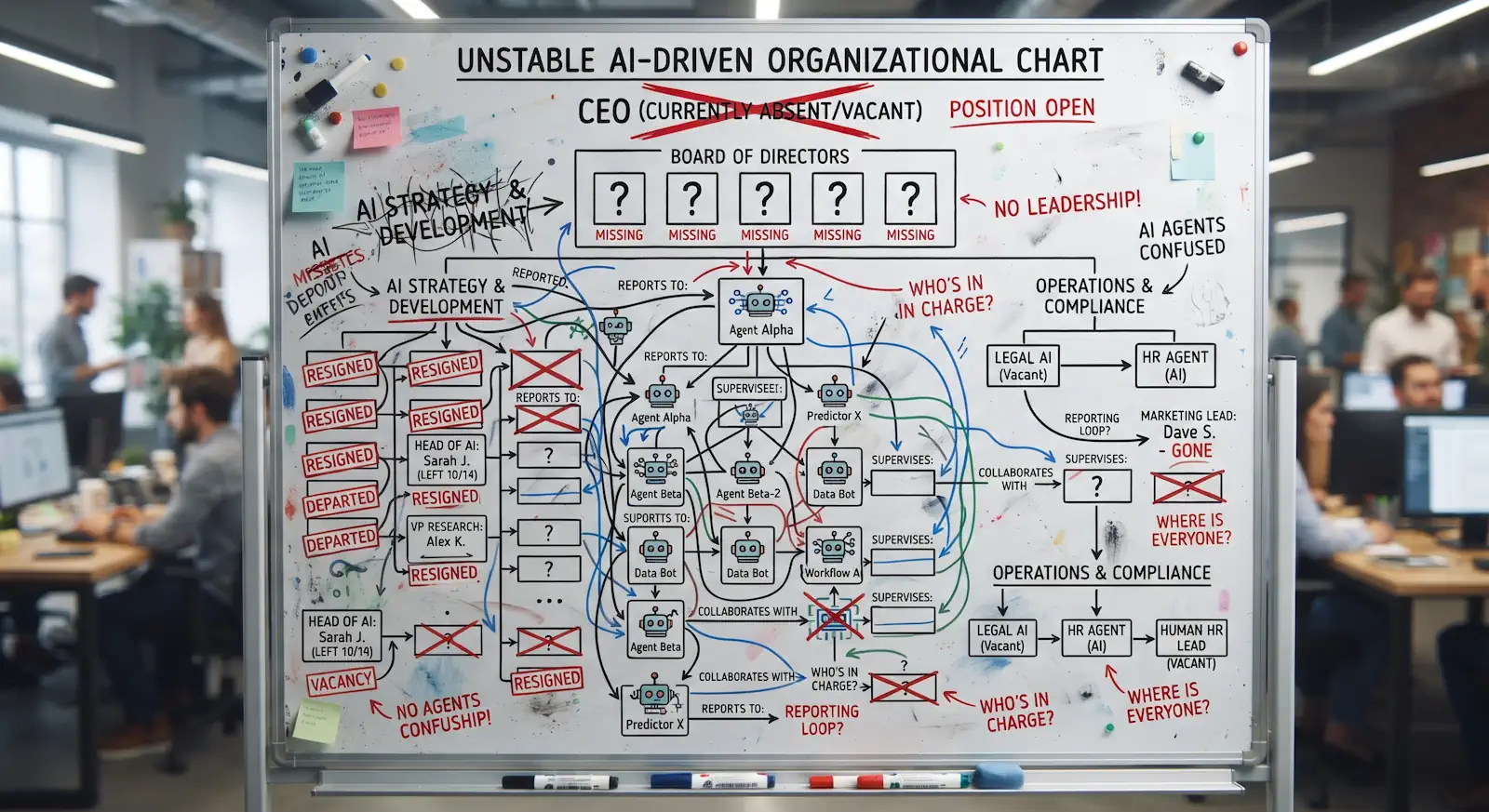
The org chart has not changed, but the number of actors the organisation must govern has, and nobody signed a contract with any of them, nor ran a background check, and when one of the human engineers who created or requested several of those agents leaves the company, the agents may continue operating unless ownership and lifecycle controls were explicitly designed to notice that their accountable human is gone.
This is not an exotic edge case; it is a predictable lifecycle problem for enterprises that scale agentic AI without changing the operating model around it.
Your governance stack was built for humans and conventional machine identities
Enterprises already know how to manage service accounts, workloads, bots, API credentials and other non-human identities. AI agents create a different problem. An agent can act with delegated authority, move across several systems, incur variable cost, change behaviour when its model, tools or context change, and continue operating after the human who created it has moved on.
Enterprises have governed non-human identities for years. What they haven’t built is a single governance process that covers the full lifecycle of an autonomous actor: identity, ownership, permissions, cost, performance and software delivery.
An agent may operate through a user token, service account, API key or workload identity. What is often missing is a single lifecycle record connecting that technical identity to an accountable human owner, purpose, authorised scope, budget and current configuration. The agent gets some route to authority inside your systems. What it often does not get is an explicit lifecycle record saying who owns it, why it exists, what it may do, what it costs and when that authority should end.
Agents are a workforce to be managed, not tools to be installed
Nobody is arguing that an AI agent is an employee. The reframe that actually helps isn’t legal, but operational. An agent that can act inside your delivery pipeline has, functionally, many of the same lifecycle questions a human hire does. Pretending otherwise is what creates the gap, and many questions arise:
Who recruited it? Who requested, created and approved the agent, and under what justification?
What is its system of record? Which provider, model, version, tools, owner, purpose and lifecycle state define what the agent actually is?
What is its job description? What is it authorised to do, and just as importantly, what must it never do?
Who is its manager? Who is the accountable human owner, rather than simply the team that happened to spin it up?
What does it cost? What is its token, inference, licence and infrastructure budget, and which cost centre owns that spend?
How is its performance reviewed? Quality, throughput, cost, rework and success rate matter more than simply asking whether it shipped something.
What happens when it needs training? A new model version, new tools or new context may require renewed evaluation and validation.
Can it be transferred? Can it move to another team, manager or cost centre without losing its audit trail or ownership history?
And critically:
Can it be terminated? Can access and credentials be revoked, and execution stopped on the same day the decision is made, rather than whenever someone gets around to it?
Most organisations can answer every one of those questions for a human hire without much effort. Very few can answer all of them for AI agents today.
A manager resigns, but the agents don’t notice
The scenario that should worry every CIO is not necessarily a rogue agent doing something dramatic, but a far more boring one. A manager who owns 17 agents leaves the company, and none of those agents is reassigned, re-scoped or paused because there is no process that treats agent ownership as something requiring succession planning.
Humans have an offboarding process refined over decades: access revoked, laptop returned, handover documented. Agents often have nothing equivalent.
Unless ownership is explicitly part of the agent lifecycle, permissions may persist, budgets may continue to be consumed, and audit trails may still point back to someone who no longer works for the organisation.
This risk already exists wherever agentic tooling reaches production without an explicit ownership and lifecycle model.
Waiting is not the conservative choice
The instinctive response is to slow down: let the technology mature, wait for the tooling to catch up, revisit governance once the picture is clearer.
That instinct is understandable. In this case, it can also be backwards.
Individual AI agents can be deployed in weeks. Building the enterprise operating model around them is a multi-quarter programme. It crosses IAM, security, financial controlling, software delivery and organisational accountability. None of those functions was designed to coordinate around autonomous machine actors at scale.
Waiting for agent technology to mature does not remove that work; it merely delays when the organisation starts doing it, while the number of agents already operating may continue to grow.
The uncomfortable part of this shift is that it cannot be solved by any single team. Security cannot own it alone, because this is also a management-accountability problem. HR cannot own it, because agents are not employees. Platform engineering cannot own it, because deciding who is accountable for an agent’s actions is not purely a technical question.
What it requires is treating the agent lifecycle with the same discipline enterprises already apply to human lifecycle management: explicit ownership, permissions, cost, performance, reassignment and termination.
That’s why we describe this problem as governed execution: bringing identity, permissions, policy, audit and stop/revoke controls into the execution path used by humans, automation and AI agents, rather than trying to reconstruct accountability after the work has already happened.
The question worth asking in every leadership meeting about AI adoption is no longer simply “Do we have the tools?”, it is “Who owns these actors? What are they allowed to do? What do they cost? Are they producing value? And can we stop them when we need to?”
The org chart may not have changed at all, but the number of actors the organisation is responsible for already has.
More from the same author
About The Author