Trending Topics

 Trending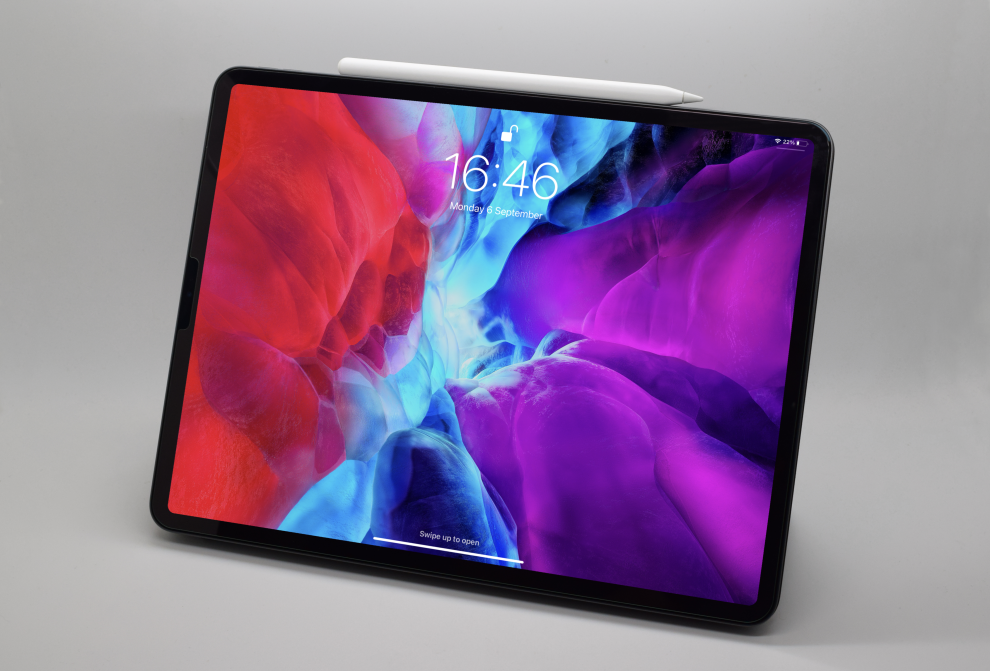
Should I buy an iPad for university?

It’s a brand new academic year. For most, it’s a return to the norm – moving to the year above, seeing friends again, and handing in homework you did the night before. However, for a lot of students, it’s the first year of university. More often than not, that undertaking prompts the idea of buying a new laptop. In recent years, however, the laptop as a student’s companion has met a new challenger – the iPad. So, can you take on university without a keyboard and trackpad?
why should I listen to you?
That’s a good question. I’m heading into my second year at university studying Marine Biology and completed the first year using an iPad Pro. I had a PC for more intense stuff (ok, it was really for Minecraft…), but lectures and study were taken on by the iPad, in tandem with an Apple Pencil. As a result, I’d say I’ve got a pretty good perspective on how well it works for a student (for a scientific course at least).
Notetaking
I’ll start with the iPad’s strongest aspect when it comes to university life; the excellent notetaking ability. It’s worth noting (excuse the pun) that to take full advantage of the iPad for your studies, you really do need an Apple Pencil. Typed notes are an option, but you’ll require a Bluetooth keyboard (or the infinite patience to use the on-screen keyboard).
However, if you are considering an iPad for university, you’re almost definitely thinking of written digital notes, which the iPad does exceptionally well. The latency of the pencil to the screen is ridiculously low, and if you can get past the sensation of writing on glass, it’s almost as good as paper. Personally, I don’t mind it, but there are screen protectors or stylus nibs that can emulate the paper sensation.
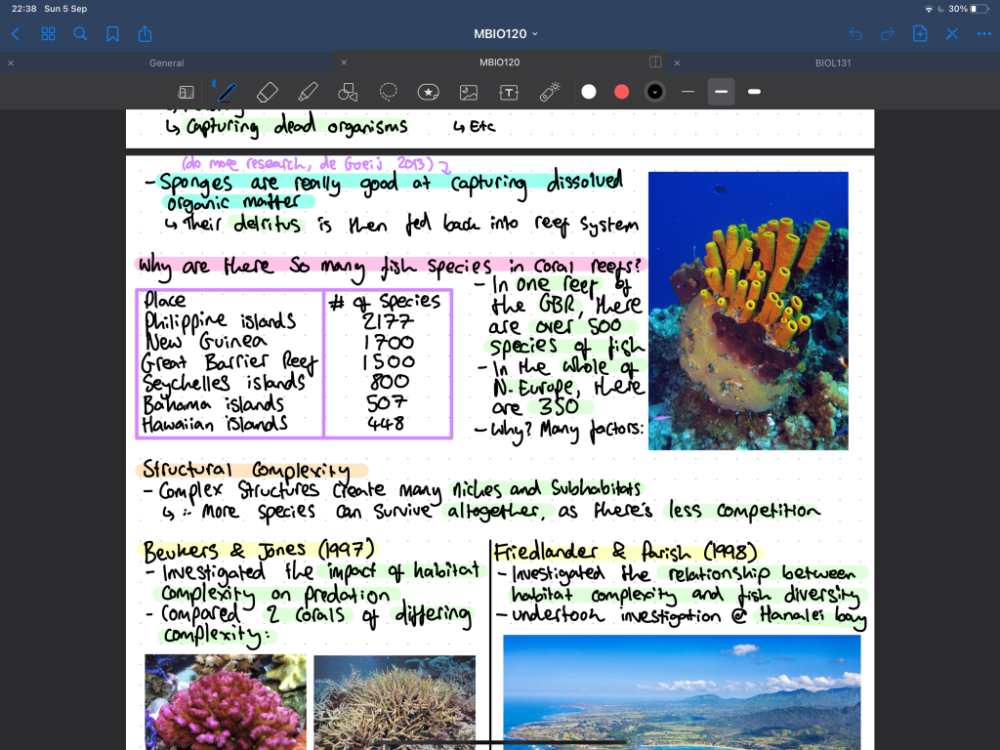
So, the tech is great – but so far it just sounds like the world’s most expensive piece of not-paper. The true strength of the iPad as a tool for education is its flexibility; the Apple Pencil doubles for almost any piece of stationery. Every colour of pen, pencil, and highlighter is quite literally in the palm of your hand. You can integrate images, videos, and voice clips into your notes, and annotate PDFs and PowerPoints without the hassle of printing every page. Moreover, multitasking allows you to research and revise simultaneously. After all, your notebook and search engine are one and the same.
Everything being stored on one device (and backed up frequently) means that you’re never going to misplace your notes either. This is especially useful when it comes to revision; instead of rifling through pages to find something, a keyword search scans your writing and displays it every time you even scribble the word.
Related reading: Paperlike Review: Does it really make your iPad feel like paper?
Can it replace a laptop?
Academically speaking, it’s a tough question, and the most important factor is the course you’re taking. If your degree will require specific software to be used, it’s hard to argue for the iPad. For example, illustration or photography is heavily reliant on software either unavailable or not supported to the necessary extent (I’m looking at you, Photoshop). As a result, you’ll need a laptop to do your assignments.
Moreover, while the majority of courses don’t require special software, they do require essays. This is where the iPad alone will really falter. Even though Word actually works well on the iPad, typing with the on-screen keyboard is a rather unfriendly experience. Unless you’re willing to buy a Bluetooth keyboard, you’ll have to head to the library to tackle those tasks.
Beyond academia though, you probably wouldn’t miss out on much. Well-established software will have an iPadOS version (Microsoft Office, for example), and your browser of choice will most likely function the same as its desktop counterpart. The same can be said for streaming services and social media, which you probably already use on a mobile device. As before though, some software just won’t be available. The gamers among us will be hit especially hard – the App Store isn’t exactly Steam. There are some great ports of popular indie games like Stardew Valley and Terraria, but the experience won’t be the same on a touch screen.
Portability
Heavy bags are an inconvenience at any time, but especially when you’re at university. Travelling between lecture halls and your accommodation will be an almost daily occurrence – I mean, what are the chances you’ll be forced to stay home and watch lectures online?

Popular laptops for students are thin and light, and the iPad is no different – in fact, it’s better. Compared to the MacBook Air (an annual nominee for best student laptop) the heaviest iPad is half the weight and twice as thin. It barely takes up a rucksack laptop sleeve, leaving you more space for whatever else you’ll need for university life.
If you end up needing extra peripherals, however, like a keyboard and mouse, it suddenly becomes a lot less convenient. Not only is it extra weight, but it’s two more things to remember to pack, and two more things knocking around in your bag. It’s a minor problem, but it’s one that laptop users don’t need to deal with.
Conclusion
So, should you buy an iPad for university? You’ll be thrilled to hear that it depends on a few things, namely course requirements and personal preferences. If your course requires you to use specialist software, then the iPad loses a lot of appeal. Beyond Microsoft Office, it’s unlikely that the necessary application is on the App Store. Otherwise, the strongest argument is in its use as a digital notebook. If you enjoy taking written notes and want to make it more convenient and effective, then an iPad will be a perfect companion for your university career.
READ NEXT: Huawei MateBook X Review: Is this the perfect student laptop?
Tech reviews, resources and guides
About The Author

Fraser Campbell
NEXT UP