Trending Topics

 Trending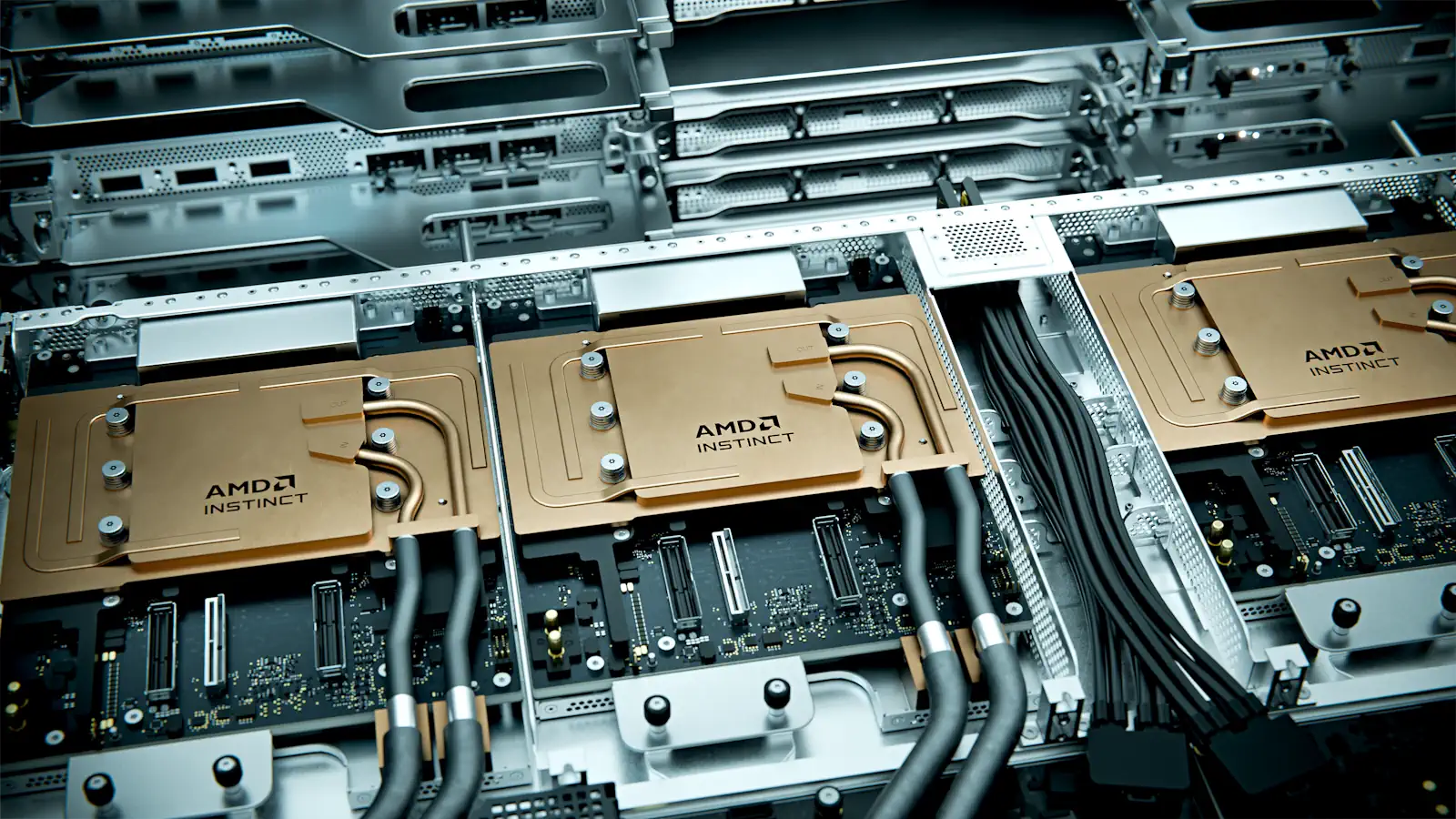
AMD lays down gauntlet to Nvidia with release of Instinct MI455X – and promises giant leap in performance with next year’s MI500 series

AMD CEO Dr Lise Su today announced the launch of the Instinct MI455X, its fifth generation AI data centre GPU, claiming it was now the best performing GPU in the industry. And, crucially, that it provided up to 18x lower token cost compared to the Instinct MI355X.
“Customers really care about cost per tokens,” said Dr Su, “and with every generation of Instinct, we’re driving the cost per tokens down, and that’s with more memory, more bandwidth, more compute, and we’re taking another major step with MI455, delivering up to 18 times more tokens per dollar, so customers can serve far more users with the same investment.”
Along with the MI455X, its GPU for frontier AI (such as Anthropic and OpenAI) and AI factories, it also announced the Instinct MI430x for sovereign AI and high-performance computing (HPC).
“The AMD Instinct MI400 Series extends our AI portfolio with purpose-built solutions optimised for the full spectrum of AI and HPC deployments,” said Vamsi Boppana, Senior Vice President, AI, “built on an open software foundation that gives customers the flexibility to innovate at every scale.”
Key figures for AMD Instinct MI400 Series
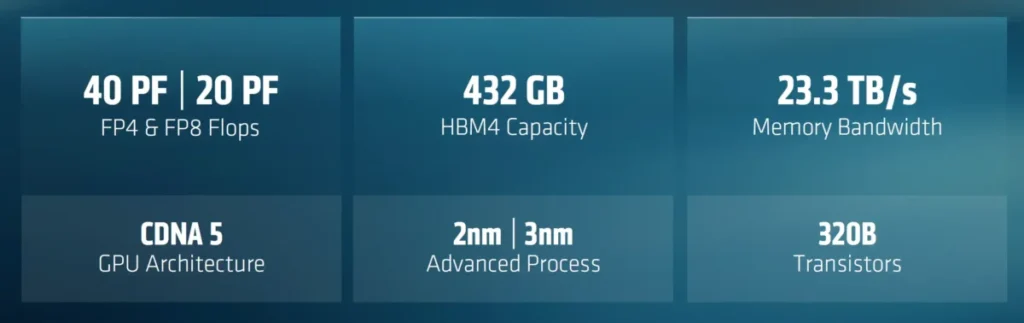
As the slide above shows, taken from the AMD Advancing AI 2026 keynote, the MI455X packs some big numbers. When part of the Helios rackscale system, which Dr Su announced was now in production, it delivers 30% more tokens per dollar than an Nvidia Rubin NVL72 – according to AMD.
AMD also claimed industry-leading rack scale performance, with up to 15% higher token throughput (tokens per second per GPU) compared to Vera Rubin.
The MI430X looks pretty impressive too, with AMD promising that the GPUs “deliver up to 288 TFLOPS of hardware-based FP64 performance for scientific computing”.
Launch of AMD Instinct MI350P
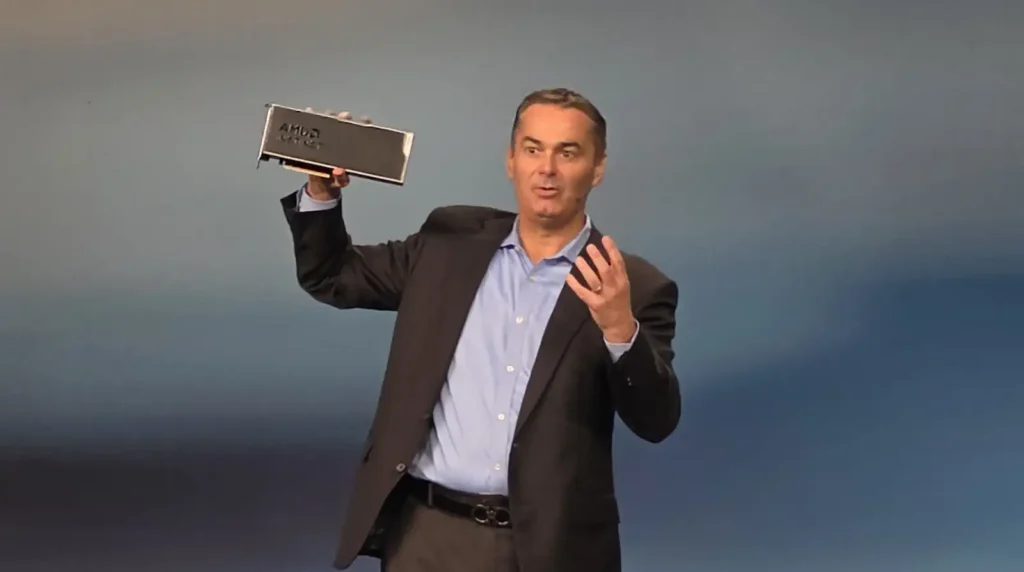
There was one more thing for enterprise AI customers: the AMD Instinct MI350P. Dr Su left this announcement to Dan McNamara, General Manager of Compute and Enterprise AI.
“Every enterprise wants AI in the data centre, but the challenge is how do you add those capabilities without starting over?” he asked. “That’s exactly what the 350P is designed to solve. It’s an air-cooled GPU designed to fit within the power and tooling of enterprise servers today without the facilities upgrade, making it easy to bring LLM scale inference to today’s enterprise data centre.”
But, he insisted, it’s still fast. “A single MI350P can support up to 260 billion parameters, allowing customers to run the majority of enterprise AI workloads. And the economics are actually even better and more compelling. The 350P delivers more than four times the tokens per second per dollar than the composition.”
What’s coming next: Instinct MI500
Sometimes a picture tells a story better than words. That’s exactly the case with this slide, again taken from AMD’s keynote at today’s AMD Advancing AI event.
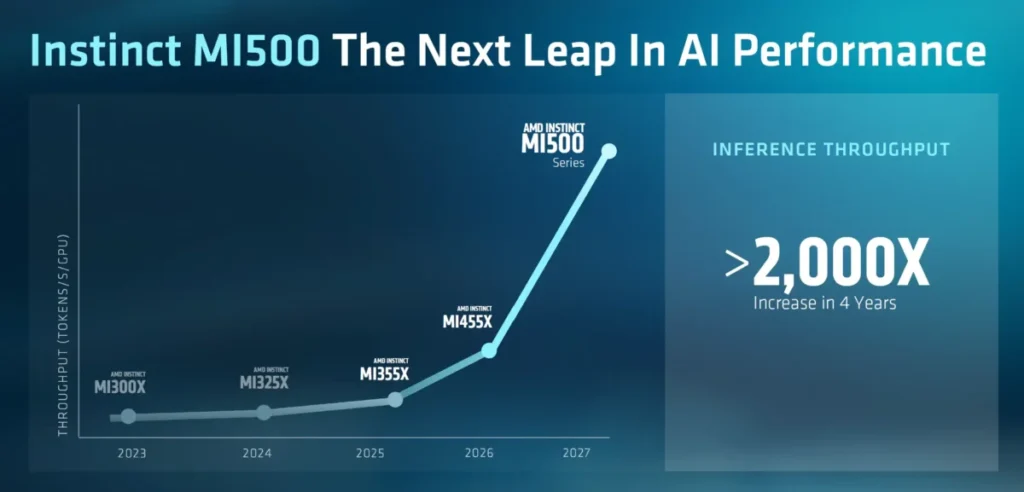
The left-hand “y” axis shows the throughput of each AMD Instinct card, in terms of tokens per second per GPU. The “x” axis details time, starting with 2023 with the MI300X before showing a big jump in 2026 for the newly announced MI455X – and then going full hockey stick growth with next year’s MI500 series.
While we would normally take such claims with a hefty pinch of salt, AMD has consistently delivered on its timeline promises for the past decade. Although we suspect Nvidia has a beefy upgrade to match.
What’s for sure is that the frontier AI companies will benefit from lower costs per token, as will enterprises who invest in AI factories. Despite talk of an AI bubble, there’s no obvious sign of it popping yet.
About The Author

Tim Danton
NEXT UP


