Trending Topics

 Trending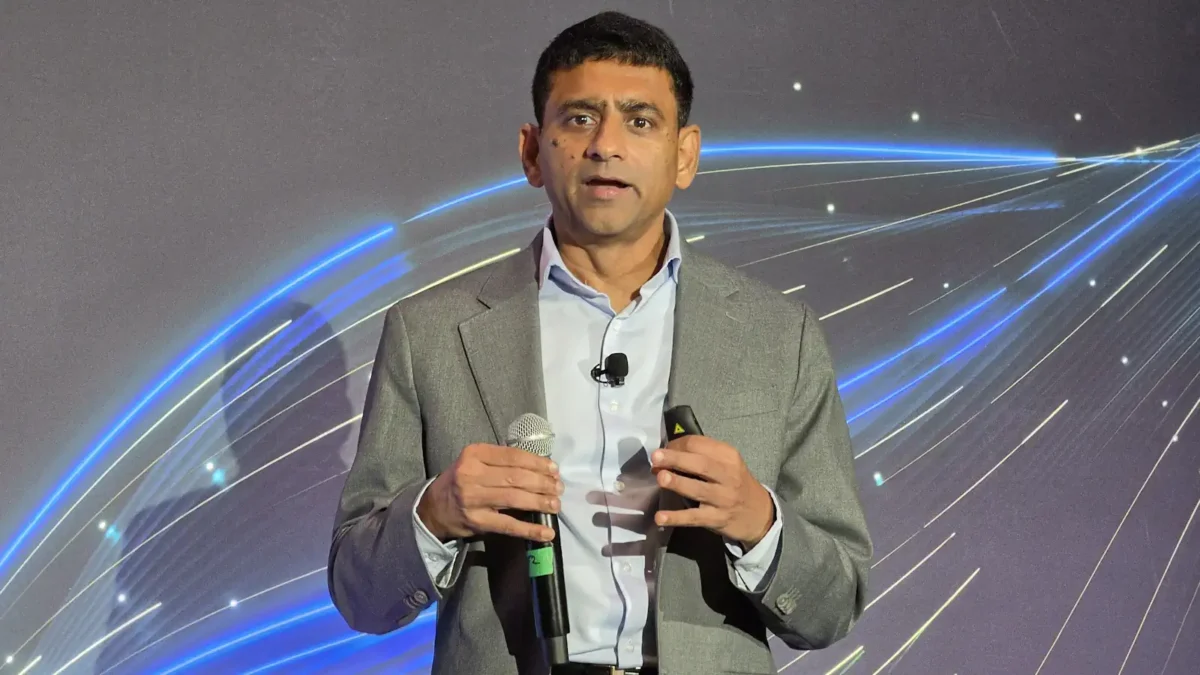
AMD lays out EPYC 9006 plans that could see it surge past Intel this year

AMD today laid out its plans for world dominance – in terms of server CPUs at least. Following the news in May that it had begun ramping up production of the next-generation EPYC processor, codenamed “Venice”, it formally named the family of processors and set out their release dates at its Advancing AI 2026 event in San Francisco.
TechFinitive is on the ground, including at a behind-closed-doors event for invited media to go deeper into the products.
“It’s not just a single processor,” said Ravi Kuppuswamy, SVP and GM of Server Product & Engineering AMD. “It is a purpose-built portfolio that services and optimises for different requirements of the modern data centre. And then this portfolio gives different customers what they want to accelerate their workloads.”
AMD announced four products that formed this portfolio, along with projected shipping dates:
| Name | Focus | Max no. of cores | Shipping date |
| AMD EPYC 9006 SP7 | All-out performance | 256 | Q4 2026 |
| AMD EPYC 9006 SP8 | Enterprise/performance per dollar | 128 | 1H 2027 |
| AMD EPYC 9006X SP7 | High-performance computing (HPC) | 96 | 2H 2027 |
| AMD EPYC 9006 LP | AI host node (low power) | 72 | 2H 2007 |
The suffixes (SP7, SP8 and LP) refer to the sockets each CPU drops into. SP7 is the highest performance and used by hyperscalers such as AWS and Microsoft Azure. SP8 is the type of socket found in enterprise servers. And LP refers to low-power servers, which are commonly used to train and run power-hungry AI models.
So, first up will be the all-powerful AMD EPYC 9006 SP7 platform aimed at hyperscalers.
EPYC 9006: Probably the best server CPUs in the world
Kuppuswamy went on to claim that “Venice is the world’s best server CPU for cloud, enterprise and AI. Period. Every benchmark that Venice can be used for, you’re going to find Venice better than the competition.”
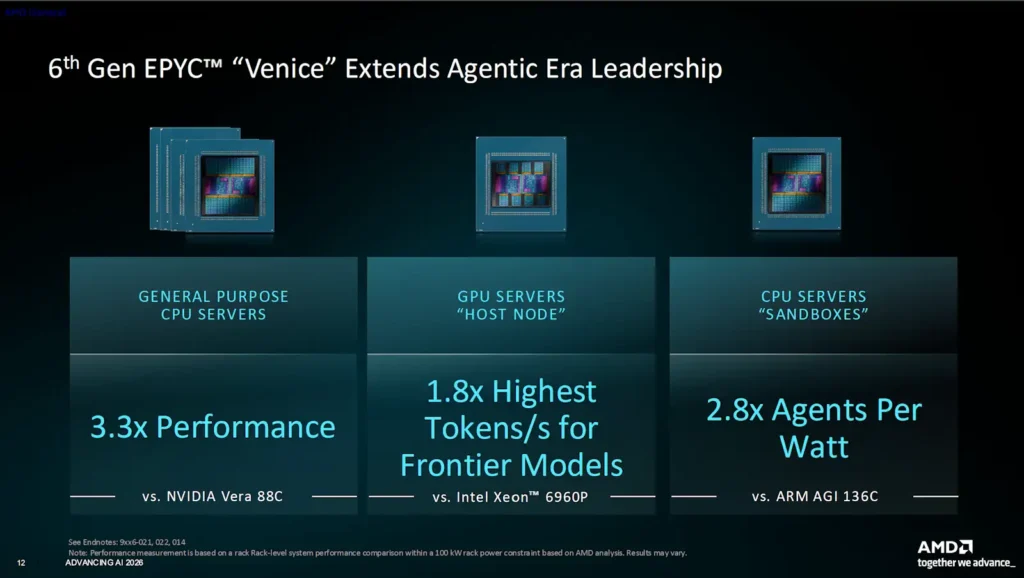
One reason he is so confident stems from AMD’s next-generation cores, Zen 6, with the EPYC 9006 SP7 family featuring up to 256 cores in one chip.
Built on TMSC’s 2nm architecture, Venice will also be the first processor in the world to support PCIe Gen 6 storage. That instantly removes one of the performance barriers, and AMD also confirmed that it would use the next generation of its Infinity Fabric architecture, doubling the speeds with which data can be shared between the cores.
Crucially, AMD also believes that Venice will beat ARM-based processors in terms of efficiency. Because at the same time that AMD has challenged Intel in the x86 space, the ARM architecture has stolen market share from Intel for low-power servers.
Eating Intel’s lunch
Let’s come back to the headline of this article: that AMD could, for the first time in history, have a greater server CPU market share than Intel.
First, some context.
In 2017, Intel was the undisputed king of server CPUs. Out of 100 servers sold that year, around 99 had Intel inside. Yet here we are, less than a decade later, and AMD looks set to overtake it one of the most important measures: revenue.
“This is a great story for us to show from 2017, where I think we had a whopping 0.2% market segment share,” said Kuppuswamy, referring to the slide below. “To 46% as latest reported in in Q1, and… every week, we are finding that there are more customers.”
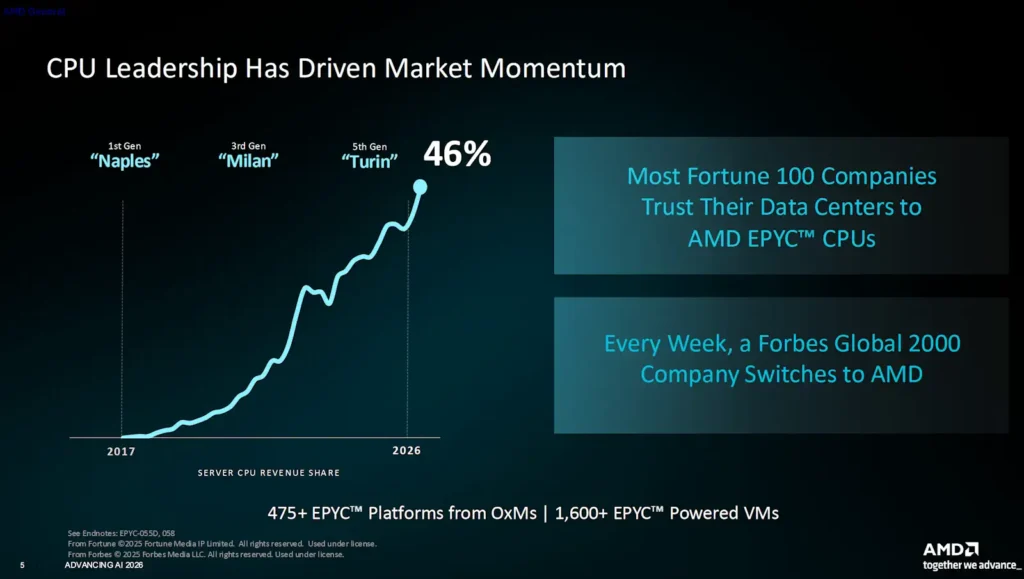
To be clear, this slide only refers to the x86 server market, which means that Intel still has 54% market share as things stand. And it refers to revenue, not unit sales.
But unless Intel has something extraordinary up its sleeve, it does seem likely that when we compare 2026’s market share of x86 server CPU revenue AMD will be top dog. Now that would be an amazing achievement in the space of a decade.
Related articles
About The Author

Tim Danton
NEXT UP


