Trending Topics

 Trending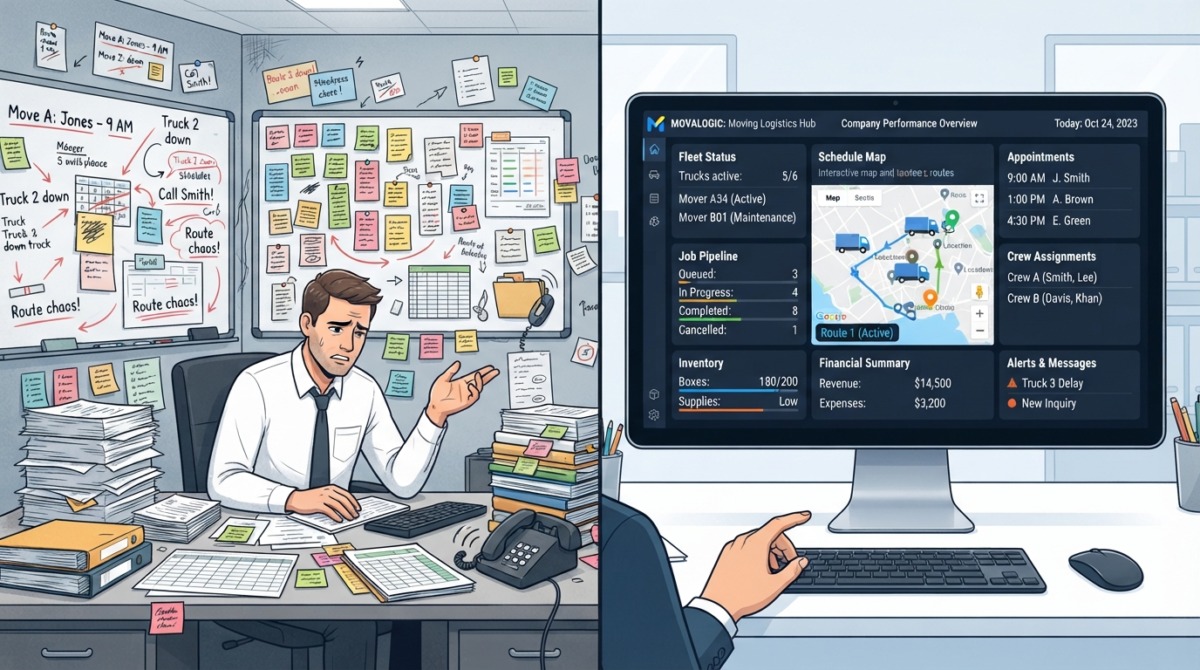
Can one CRM handle every stage of a move? MoversTech thinks so

This is a sponsored article brought to you by MoversTech CRM
A moving company quotes a job in one tool. It schedules the crew in a shared spreadsheet. It tracks the truck on a whiteboard, then invoices through a separate accounting system, and follows up for a review through yet another app entirely. By the time the customer leaves a review, four or five different platforms have touched a single job, and nobody owns the full picture. That fragmentation is common enough in the relocation industry that it barely registers as a problem anymore. It’s just how the work gets done. The real question is whether a single platform could actually replace all of it, and a growing number of moving companies are starting to test that assumption for themselves.
What does A Move’s full lifecycle actually involve?
A single move touches far more stages than most software categories are built to handle. Lead capture, quoting, crew scheduling, dispatch, day-of coordination, invoicing, and post-move follow-up each function like their own mini-project. Yet all of them belong to the same customer relationship. Comparisons of general CRM options for medium-sized businesses usually assume a fairly linear sales pipeline: lead, deal, close.
A move doesn’t behave that way. It keeps generating new operational tasks long after the deal technically closes. Packing supply orders, last-minute date changes, and add-on services requested a week out are all part of that. That’s exactly where generic CRM software tends to run out of road, since most of it was designed for a pipeline that ends at the signature.
Why do most moving companies still run on separate tools?
Most companies end up with a patchwork setup for a simple reason. No single tool historically covered the whole job, so they bolted pieces together as needs appeared over time. A quoting tool here. A dispatch spreadsheet there. A separate app for crew communication, and another for invoicing. MoversTech CRM has watched the same turning point repeat across the moving companies that adopt it: the moment dispatch stops re-checking a paper quote against what the crew actually planned to do that day. That single reconciliation step, repeated across dozens of jobs a week, is where a lot of operational time quietly disappears.
Where does a fragmented system actually break down?
The break usually happens at the handoff between sales and operations, not within either department alone. A sales rep books a job with special conditions, like a piano or a tight parking situation. That detail then has to survive the jump into a completely different system before dispatch ever sees it. Manual re-entry is exactly where those details get lost, quietly and without anyone noticing until moving day. Insurance requirements, storage add-ons, and access restrictions at the destination address are especially prone to falling through this gap. None of them are the kind of thing a busy dispatcher thinks to double-check.
It’s also why claims handling sits inside MoversTech as its own connected module rather than a side inbox: a damage claim filed weeks after a move still needs to reference the original job file, the crew on site, and whatever storage arrangement followed it, and losing that thread is how a manageable dispute turns into a drawn-out one. This mirrors a broader shift happening across software generally.
As embedded integrations increasingly become a product decision rather than just an IT one, buyer expectations have shifted as well. Buyers now assume a platform should connect its own pieces internally, instead of asking each department to bridge the gap by hand.
Has CRM software actually evolved to cover this much ground?
Broadly, yes, and the shift has moved fast over the past decade. CRM platforms used to function as glorified sales-forecasting tools. They tracked deals without much regard for what happened after a contract was signed. Everything downstream of the signature got left to whatever tools a department happened to already be using. In an interview with commercial director Dawood Khan, he described how CRM has moved well beyond that narrow function.
Modern platforms increasingly support the operational relationship with a customer, not just the sales conversation that started it. That same logic applies directly to moving companies, where the sale is really only the first third of the customer relationship. A platform built solely for the sales stage was never going to be enough for a job that keeps going for weeks afterward.
How many moves are we actually talking about?
The scale involved makes fragmented systems a bigger liability than they first appear. According to the U.S. Census Bureau’s most recent geographic mobility data, roughly 11% of the U.S. population changed residences in 2024, split between in-state and out-of-state moves. That’s tens of millions of individual jobs moving through moving-company pipelines in a single year. For a company handling even a small share of that volume, every job that requires manual re-entry between systems adds real labor cost across a busy season.
CRM adoption research backs this up in dollar terms: recent analysis puts the average return at $3.10 for every dollar a business spends on CRM software.[1] That return depends heavily on whether the platform actually gets used consistently across every department, not just sales.
The real test isn’t features, it’s whether it holds together
Software vendors will always claim broad coverage. That’s simply the nature of the pitch. The more useful question for a moving company evaluating any platform is narrower and more concrete. Does a lead captured on day one still carry its full context by the time a crew shows up weeks later? Does that same context flow cleanly into the invoice and the follow-up request afterward, without someone retyping the same address a third time? If the answer holds up under a real, messy job rather than a clean demo, the platform has actually solved the fragmentation problem. That continuity test, run against your own busiest week rather than a sales pitch, is the one worth running before anything else.
[1] Nucleus Research, “CRM returns $3.10 per dollar spent” (2023 analysis of CRM ROI case studies).
About The Author

Gabriel Jones
NEXT UP


