Trending Topics

 Trending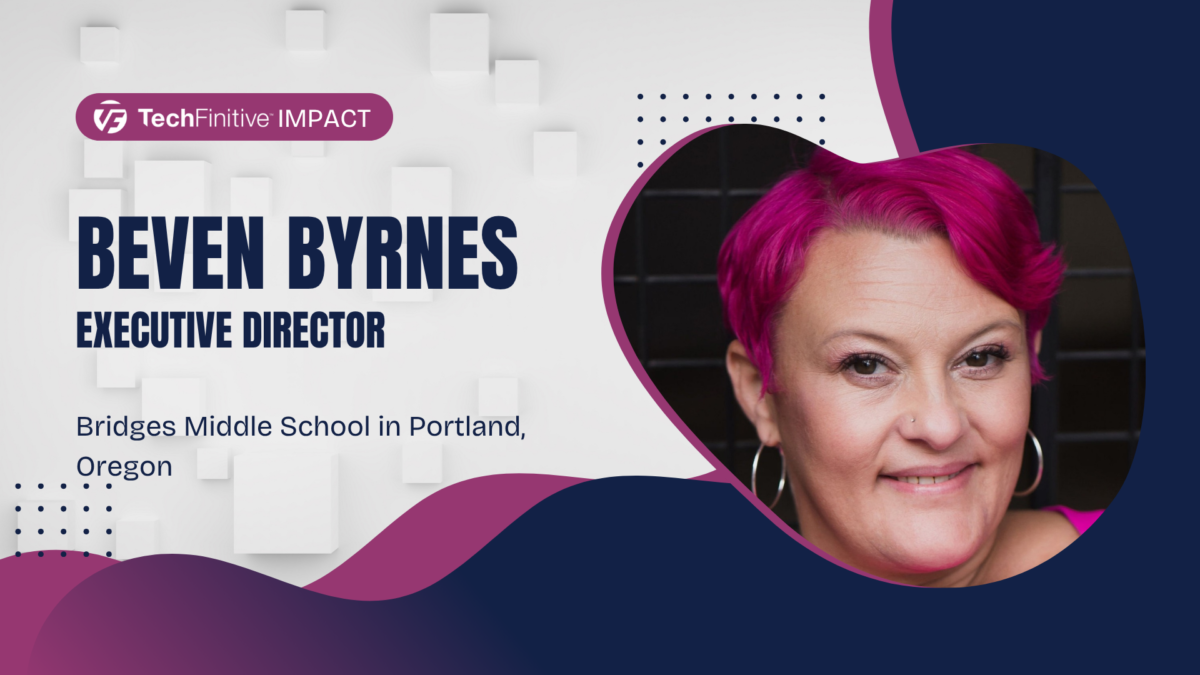
Where assistive technology ends and dependency begins

Technology shapes almost every aspect of modern life, but some of its most important stories are found beyond the commercial world. With TechFinitive Impact, we hope to offer a platform to leaders from charities, educational institutions, non-profit organisations, research bodies, social enterprises and other mission-driven organisations to share their expertise on how technology can address society’s biggest challenges. These articles are intended to inform, inspire and encourage meaningful discussion around the role technology can play in creating positive change.
Here, Beven Byrnes, Executive Director of Bridges Middle School in Portland, Oregon, examines where assistive technology ends and dependency begins, offering insights on scaffolding learning for neurodivergent students effectively.
Assistive technology has done real good for students with neurological differences. Thanks to it, a dyslexic kid can now listen to a textbook instead of drowning in it, a nonspeaking autistic student can say what they think through a communication device, and a kid with a motor or writing difference can get their ideas down through text-to-speech. These tools open doors that used to stay shut, and I would not want to run a classroom without them. But there is a newer question sitting under all the enthusiasm, and it matters as much to the people building these tools as to the teachers using them. When does a tool that helps a student get past a barrier start doing the thing the student was supposed to be learning to do?
The double-edged sword of educational technology
There are two ways technology helps students: one amplifies a skill the student already has while the other removes the need for a skill the student is still building. From the outside they can look identical, and over a few years they land in completely different places. Text-to-speech reading a science article to a dyslexic student is the first kind. The point of that lesson is the science, not decoding practice, so the tool just gets the kid to the actual learning faster. But an AI that writes the student’s essay is the second kind, because now the thing being skipped, organizing your thoughts and getting them into words, is the exact skill the assignment was meant to build in that child
We don’t have to guess the consequences of education built on the second kind. Last year MIT’s Media Lab put EEG sensors on 54 people writing essays, some with ChatGPT, some with a search engine, some with nothing but their own heads. The ones using the AI showed the weakest brain connectivity of the three groups, and when they were later asked to write without it, they still trailed the people who had never used it at all. Most of them could not quote a single line from the essay they had just turned in, because in any real sense they had not written it. The researchers called what was piling up cognitive debt.
The same study, though, also found that when they ran it the other way around, the people who wrote their first essays on their own and only then got the AI used it well. They stayed engaged and treated it like an instrument. When the skill was already there, the tool made it sharper. When it was not, the tool mostly stood in for it, and the skill never formed underneath. A wider body of work points the same direction. A study of 666 people last year linked heavier AI use to weaker critical thinking, and the effect was strongest in the youngest users, who are of course the ones still forming those muscles in the first place.
The risk for neurodivergent students
This becomes especially clear with differently abled students. A kid with an executive-function difference is already leaning on outside structure to plan, start, and organize their work, and that is fine, that is what support is for. But if the structure is a tool that plans and organizes for them with one tap, the kid can move through years of school without ever building their own version of it, and executive function is not a subject you can cram back in later. Self-advocacy is the same. If an AI always speaks up for a student, requests accommodation, smooths over the conflict, the student never gets the reps that add up to an adult who can do it alone. The tools can end up protecting kids right out of the skills they most need.
The oldest idea in good teaching is the scaffold, a temporary support you put around a skill while it is forming and then take away on purpose as the student gets stronger. A scaffold that never comes down stops being a scaffold and becomes a permanent part of the building, which is the end of most AI tools. They are tuned to complete the task, every time, with a little less effort from the user each time, because that is what makes a product feel magical in a demo. For a student who is still developing the skill underneath, that is backwards.
Principles for building better learning tools
So a few things for anyone building these tools. Design the fade in from the start. A tool made for a learner should be able to step its support down as the student improves, from doing the step, to walking the student through it, to getting out of the way. Give the student the part of the work that builds the skill and let the tool carry the part that does not. And watch the right number. If your dashboard rewards tasks completed and minutes saved, you will build something that quietly maximizes dependence without ever meaning to. For a learning tool, the outcome that counts is whether the student reaches for it less as the year goes on.
This is not only a classroom problem. The same research that watched students lose their own essays is now watching knowledge workers lose the thread of their own analysis, for the same reason. Any tool that does a task for you will, over enough repetitions, take back a little of your ability to do it yourself. That is a fair trade for a skill you already own and do not need to keep sharp. It is a bad one for a skill somebody is still building, and for a kid, almost everything is still being built. That is the whole reason to get this right for them first. Keeping technology out of their hands was never the goal. The goal is tools that make them more capable and then have the good sense to step back once they have done their job.
More great reads from our opinions section
About The Author

Ricardo Oliveira
NEXT UP