Trending Topics

 Trending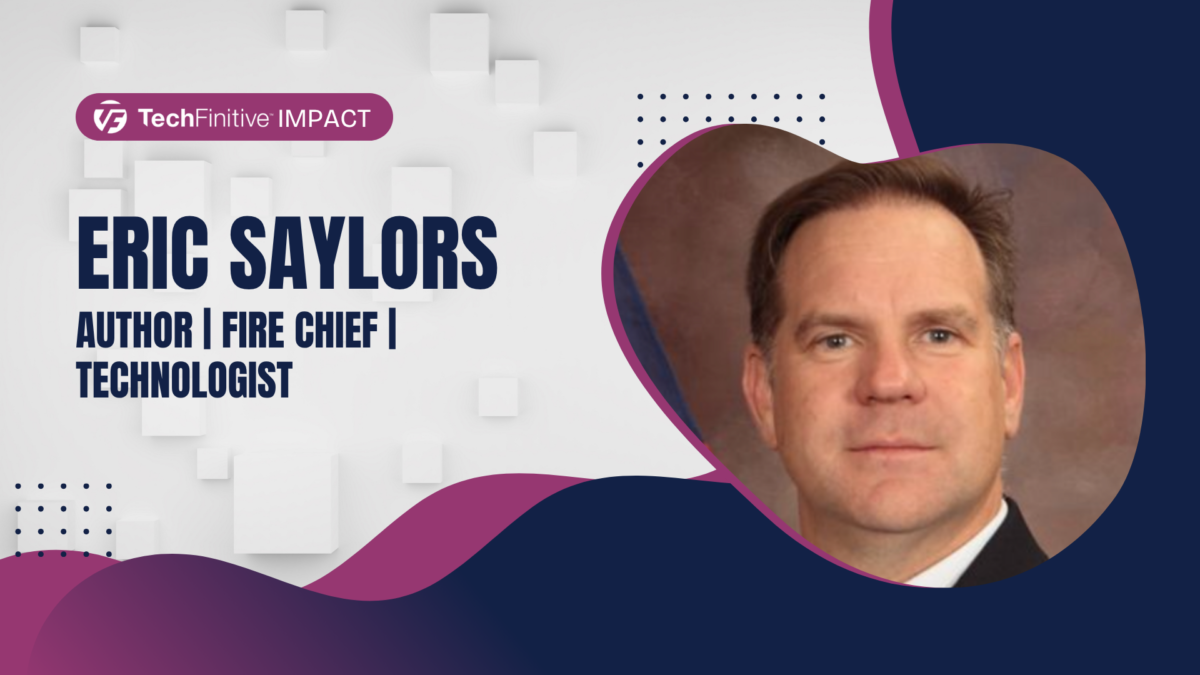
From recovery to anticipation: how AI can strengthen interconnected infrastructure

Table Of Contents−
Technology shapes almost every aspect of modern life, but some of its most important stories are found beyond the commercial world. With TechFinitive Impact, we hope to offer a platform to leaders from charities, educational institutions, non-profit organisations, research bodies, social enterprises and other mission-driven organisations to share their expertise on how technology can address society’s biggest challenges. These articles are intended to inform, inspire and encourage meaningful discussion around the role technology can play in creating positive change.
Here, Eric Saylors, Fire Chief of the El Cerrito–Kensington Fire Department, explores how AI could help emergency and infrastructure leaders move beyond simply responding to failures, instead identifying cascading risks and acting before a local disruption becomes a much wider crisis.
At the scene of a major fire, the most dangerous problems are rarely the ones easiest to see. Flames may threaten an electrical substation; the resulting outage may stop water pumps; falling water pressure may constrain firefighting; damaged telecommunications may disrupt coordination; and failed traffic signals may complicate evacuation. Each asset may have a different owner, dashboard and emergency plan, but the public experiences one cascading emergency.
That is the central resilience challenge of an interconnected world. The Cybersecurity and Infrastructure Security Agency warns that disruption in one infrastructure system can cascade into the disruption of many others. Power depends on communications and fuel. Water depends on electricity, treatment chemicals and digital controls. Hospitals depend on all of them. Digital services, in turn, depend on power, cooling and physical access. Treating these as separate systems may simplify administration, but it no longer reflects operational reality.
Resilience must begin before failure
For decades, resilience was often measured by what happened after a disruption: how quickly service could be restored, how much backup capacity was available and whether continuity plans worked. Those measures remain important. However, recovery is the last opportunity to limit damage, not the first.
Modern resilience must also include anticipation: detecting conditions that make failure more likely; understanding which dependencies will be affected next; and acting before the cascade gains momentum. This does not mean predicting every disaster with certainty. It means moving decisions earlier, when operators still have choices.
Artificial intelligence is well suited to this task, because it can examine more signals, relationships and scenarios than any one person or isolated control room can process at once. The US Department of Energy has identified opportunities for AI in grid planning, operations, reliability and resilience; they include renewable-energy forecasting, accelerated grid modeling and smarter operational applications. The important point is that AI does not replace experienced operators; it gives them a broader and earlier view.
Moving from dashboards to system-level intelligence
Most infrastructure organizations already collect large volumes of data. Utilities monitor load, pressure, flow and equipment condition. Emergency services track incidents and resources. Transportation agencies monitor congestion and road closures. Information technology teams watch network performance and cyber alerts. Weather services provide increasingly detailed forecasts.
Yet more data does not automatically create greater awareness. Data is usually organized around departments, contracts or assets rather than around the event unfolding across them. A fire chief may see fire conditions but not the load on a nearby communications site. A water operator may see declining pressure without knowing that evacuation traffic is delaying a repair crew. A hospital may know its generator fuel level without seeing that the same supplier is serving several other critical facilities.
AI can help create system-level intelligence in four ways:
- It can build and maintain a living map of dependencies. This map is not merely geographic. It identifies which services depend on which assets, under what conditions and with what degree of urgency. A water pumping station may depend on a particular electrical feeder, a cellular connection, a specialist technician and access through a flood-prone road. Graph-based models can represent these relationships and identify assets whose failure would have disproportionate consequences.
- AI can fuse weak signals. A single temperature increase, pressure fluctuation or communications delay may be unremarkable. When combined with wind forecasts, maintenance history, fire-camera imagery, cyber alerts and resource availability, the pattern may indicate growing systemic risk. AI can continuously compare current conditions with historical patterns and expected behavior, then flag combinations that deserve human attention.
- It can test possible futures. A digital twin—a continuously updated virtual representation of a physical system—can be used to examine what may happen if an asset fails, demand spikes or access is lost. The National Institute of Standards and Technology notes that digital twins can monitor status, detect anomalies, predict system behaviour and help prescribe future operations. For resilience planning, the greatest value is in the ability to ask “what happens next?” before taking an irreversible action.
- AI can support coordinated decisions. Instead of generating another alert, a system can identify the likely operational consequences and present response options: protect a communications repeater, isolate a feeder, reposition water supplies, alter an evacuation route or move medical resources before access deteriorates. The output should include confidence levels, assumptions and the evidence behind the recommendation. The decision remains with accountable human leaders.
A real-world model: finding fire sooner
California’s wildfire detection program illustrates this shift from passive monitoring to anticipation. ALERTCalifornia combines a network of cameras with an AI tool developed alongside the California Department of Forestry and Fire Protection and an industry partner. When the system detects a possible fire, it provides an estimated location and level of certainty; trained watchstanders validate the alert before resources are dispatched.
The platform also supports real-time monitoring, evacuation awareness and observation of fire behavior. Camera images can be updated every 15 seconds and incorporated into geographic information system applications used by emergency managers.
The lesson extends beyond wildfire. The program does not simply automate a human task. It connects persistent sensing, machine analysis, geographic information and operational judgement into a faster decision cycle. Similar approaches can be applied to electrical faults, water contamination, transport disruption, equipment failure and cyber-physical attacks.
The real transformation challenge is integration
For most enterprises, the barrier is not the absence of an AI model. The barrier is fragmented operations. Supervisory control and data acquisition systems, geographic information systems, asset-management platforms, computer-aided dispatch, weather feeds and cyber tools often use different identifiers, time standards, access rules and data definitions. Without a common operating model, AI may produce technically impressive results that cannot be trusted or acted upon.
A practical program should begin with one high-consequence scenario rather than an enterprise-wide technology purchase. Select a plausible cascade—such as wildfire, grid outage and water-pressure loss—and map the participating assets, organizations, data sources, decision rights and operational thresholds. Connect only the highest-value data first. Define the decisions the system must improve, not merely the predictions it should make.
The next step is to test the model through exercises and historical replay. Measure whether it creates meaningful lead time, reduces missed dependencies and improves coordination. Track false alerts and instances in which operators reject recommendations. Those disagreements are valuable: they reveal missing context, poor data or assumptions that must be corrected.
Organizations should also preserve manual operating modes and clearly define where human approval is mandatory. AI supporting critical infrastructure must be monitored for model drift, cyber manipulation, data-quality failures and unintended behavior. The National Institute of Standards and Technology’s AI Risk Management Framework provides a structure for incorporating trustworthiness into the design, deployment and evaluation of AI systems.
This kind of governance work is not optional. A US Government Accountability Office review found that none of the initial 17 federal critical-infrastructure AI risk assessments fully addressed six foundational risk-assessment and mitigation activities. Gaps included evaluating both the likelihood and consequences of risks and connecting specific mitigation measures to the risks they were intended to address.
Anticipation without overconfidence
AI cannot remove uncertainty from disasters. It can create new dependencies, vulnerabilities and attack surfaces if organizations place too much authority in an opaque model. Critical infrastructure operators must therefore consider not only attacks conducted with AI, but also attacks against AI systems and failures arising from poor design or implementation.
The goal should not be for autonomous infrastructure to make unreviewed life-safety decisions. The goal should be informed human action, supported by systems that detect change earlier, reveal hidden connections and explain why a situation may deteriorate.
This changes the meaning of resilience. Recovery asks, “How quickly can we restore what failed?” Anticipation asks, “What conditions are forming, what else will be affected and what can we do while options remain?”
The organizations that make this transition will not necessarily be those with the largest AI budgets. They will be those that treat infrastructure as a shared system, establish trusted data relationships across organizational boundaries and practise coordinated decisions before the emergency. AI is the intelligence layer that can make those relationships visible. Used responsibly, it can help leaders act before a local failure becomes a regional disaster.
About The Author

Ricardo Oliveira
NEXT UP