Trending Topics

 Trending
Is Microsoft rethinking its commitment to Stratos amid project setbacks?

When Microsoft cast its gaze on the expansive Texas plains, it wasn’t thinking about building new AI data centres. It wanted to tap into Stratos, a carbon capture and storage (CCS) initiative that could transform the company’s environmental impact.
In a groundbreaking deal almost exactly a year ago, Microsoft purchased half a million metric tonnes of carbon removal credits from Stratos, a venture spearheaded by Occidental Petroleum, one of America’s oil giants. Despite the fanfare of the ambitious partnership, Stratos’ launch is behind schedule after being beset by protests and regulation delays.
Microsoft’s carbon removal bet is massive, but the numbers behind its own pollution tell a more complicated story. Is Stratos a genuine leap toward sustainability or just another chapter in tech’s climate gamble?
Why has Microsoft invested in Stratos’ CCS technology?
In its 2025 Environmental Sustainability Report, Microsoft omits Stratos but gives a broader statement on its carbon removal endeavours:
In FY24, Microsoft entered long-term agreements to procure more carbon removal than all previous years combined – 22 million metric tons.
What this shows is that Microsoft is prepared to invest heavily in carbon removal projects. However, ‘jam tomorrow’ long-term agreements are easy to make, especially for a tech giant with deep pockets. Curiously, Microsoft’s money doesn’t seem able to give it the ability to reduce its current emissions.
Microsoft is blowing too much smoke up its own chimney.
Let’s begin with a positive. Microsoft’s latest data shows that its 2024 Scope 1 greenhouse gas emissions were down by 1% against 2023. That’s its first reported drop since 2018. Of more concern is that 2024 is still 19% higher than 2020.
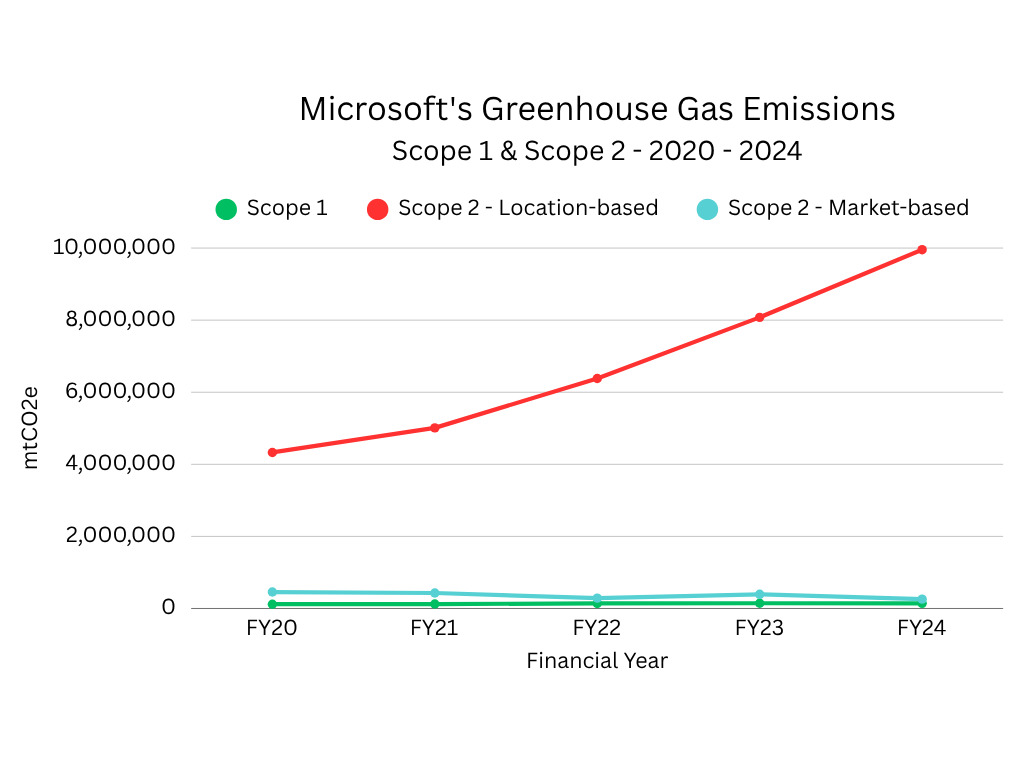
Microsoft’s Scope 2 reporting shows a slightly different picture. Market-Based emissions (associated with energy contracts or renewable energy purchases) are down to their lowest figures since 2020. This could be an indicator that the company is making better choices with some of its energy contracts. However, Location-Based emissions (calculated using the emissions of the local energy grid where the company consumes power) have risen 20% year-on-year and are up a staggering 78% from 2020.
Microsoft’s report also lists that the amount of carbon credits contracted in the last fiscal year was 21,927,370. This is a year-on-year increase of 337% and a rise of 1,476% since 2021.
| 2021 | 2022 | 2023 | 2024 | |
| Total carbon removal credits contracted | 1,391,187 | 1,443,981 | 5,015,019 | 21,927,370 |
The price of a carbon credit varies wildly, so it’s impossible to put a value on exactly how much Microsoft has spent trying to offset. However, there’s an important footnote in Microsoft’s report:
This number might change based on actual versus projected outcomes related to contract fulfilment (delivery of credits).
Frankly, it doesn’t matter if Microsoft contracts a gazillion credits a year. If the supplier of those credits doesn’t deliver, then it’s a contractual matter. There is potentially no impact on the actual emissions being pumped into the atmosphere. By 2050, Microsoft plans to remove from the environment all the CO2 it has directly emitted (or consumed via electricity) since the company was founded in 1975. To have any chance of succeeding, it needs to invest in CCS projects like Stratos. At the moment, that’s a problem.
Is Stratos operational?
Certainly not all of it.
For clarity, Stratos is the name of DAC (Direct Air Capture) system that will pull carbon dioxide from the atmosphere. The underground storage is the responsibility of the Brown Pelican CO2 Sequestration Project. Both entities are owned by Occidental Petroleum (Oxy) and collectively the project is known as Stratos.
The stumbling block (which we reported last year) was bureaucratic, rather than technical. In order to sequester CO2 underground, Stratos required Class VI drilling permits. These are granted after strict requirements have been met.
Earlier this year, 1Point5 was granted permission to drill three Class VI wells after passing EPA (Environmental Protection Agency) scrutiny. This was despite protests by residents over concerns about the long-term management of the area by the Texas state regulator, the Railroad Commission of Texas (RRC). This body is also responsible for around 150,000 inactive, unplugged, oil, gas and injection wells in Texas and concerns about leakage, degradation of water quality and increased seismic activity have led to questions being raised about the RRC’s stewardship of existing wells and new projects like Stratos.
Virginia Palacios is the Executive Director of Commission Shift, an organisation that holds the RRC to account within a shifting energy landscape. I asked if she was surprised that the Stratos’ Class VI licences have been granted:
“No. Sadly, we’ve become accustomed to state and federal agencies ignoring public concerns. We were surprised to see that the Trump Administration EPA took some of our concerns into account and required the Brown Pelican facility to re-plug all plugged wells in the area of review with CO2-resistant cement. One of the more disturbing responses to our comments was that the EPA chose to ignore all the problems RRC has mismanaged in the Class II program when they granted these Class VI permits.”
Get your CO2-Sequestration-Silver-Bullets here…
There is a lot of money to be made by storing CO2 in the ground in Texas. To grease the wheels of progress, the RRC has requested primacy in order to issue its own Class Vi permits. Simply, the more permits granted, the more money comes flowing in.
Given the historic stewardship concerns about the RRC, Virginia Palacios has reservations. “There have been some recent improvements at the RRC, but we still feel that granting them primacy of Class VI wells would be too soon. The EPA should wait and let the RRC’s program changes show improvements for a few years before it goes ahead and grants Class VI primacy.”
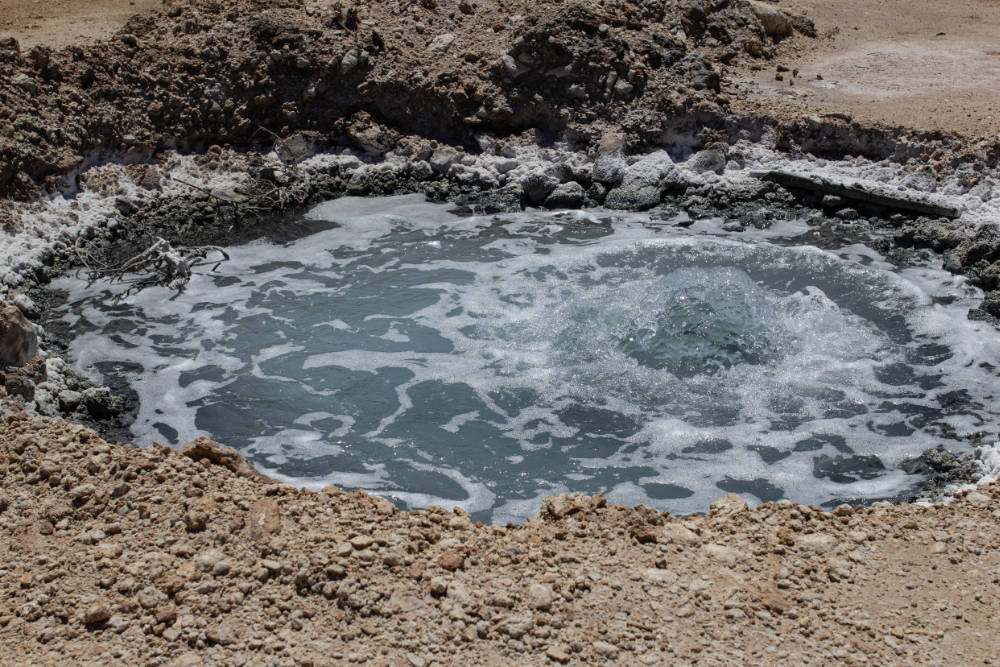
Commission Shift works closely with the RRC and Virginia has seen the beginning of small improvements. “We were happy to see the Texas Legislature approve $1.5 million and 5 new staff for an underground injection control (UIC) investigation team. That’s essential to understand how to address all the geyser-like well blowouts, earthquakes, sinkholes and leaks from unplugged wells we’re seeing in the state. The RRC has largely taken measures in an experimental, not preventative fashion. They wait to react to big problems.”
Primacy pays
If this all sounds a little messy rather than the super-slick PR release proclaiming that Stratos and CCS will solve the climate crisis, then we’re not quite done.
Part of the argument for granting primacy is that ‘local knowledge’ is greater than state or national level. However, with so much money to be made from CO2 sequestration, Virginia points out the concerns about vested interests.
“With primacy, the federal government acknowledges the expertise of local state agency personnel, presuming that the state is best equipped to self-govern,” she said.
“What it doesn’t take into account is that the state agency is led by elected officials that get two-thirds of their campaign contributions from the same companies they oversee. This creates a conflict of interest that undermines the public interest.
“Therefore, the philosophy that local experts know best doesn’t apply in this situation. The campaign donors have more influence over the agency than the local experts. This leads to bad decision-making that can harm the public.”
The current reality of CCS
Aside from genuine concerns about primacy, transparency and safety, there’s the question about CCS’ feasibility as a working technology. A 2024 report published by Imperial College London’s Department of Earth Sciences and Engineering said:
The deployment of CCS has fallen short of near-term projections from integrated assessment models. Globally, ~70% of the 149 projects proposed to be operational by 2020, aiming to store 130Mt of CO2 annually, were not implemented.
This is the gamble with current CCS. Friends of the Earth Scotland reported that £500 million of UK public money has been poured into CCS since 2010. There is still no commercial-scale project operating in the UK.
In the USA, the Petra Nova Carbon Capture Project, also in Texas, opened in 2016 but temporarily closed in 2020. This wasn’t because of being overloaded with captured carbon, but because the wholesale oil price was too low. Why? Well, a handy use for injecting CO2 into the ground is to release impossible-to-drill oil. That was Petra Nova’s purpose.
If that’s a surprise to your environmental leanings, then Imperial College London’s report may cause additional shock:
Project cost, low technology readiness levels among the capture technology, and a lack of revenue streams, e.g., oil production, are among the major contributors to projects stopping. Among existing actively operational CCS projects, only around 9Mtyr of a total capture capacity of 45Mtyr is injected for dedicated storage, with the rest used for enhanced oil recovery.
So, most of the ‘planet-saving’ CCS projects stall because they’re essentially not making enough revenue for oil companies. The majority of CCS projects running today function to surface more oil, with a side-hustle in removing CO2.
Is this a climate technology that Microsoft wants to invest in?

Stratos sucks, but not hard enough
Microsoft has committed to buying 500,000 mtCO2e of credits from Stratos over six years. And, to be clear, 1Point5 has always made it clear the Microsoft’s credits will not be used to tap for oil.
In 2024, Microsoft’s declared its Scope 2 location-based emissions to be 9,955,368 mtCO2e. If we re-ran Microsoft’s 2024 Scope 2 as a theoretical timed simulation, beginning on 1 January, then Stratos’ 500,000 mtCO2e of credit will burn out on 18 January.
If we re-run this simulation on Microsoft’s direct emissions, Scope 1, then Microsoft’s Stratos credits will burn out at the end of January on year two of its six-year agreement.
Obviously, my cronky simulations should not be considered scientific. Their purpose is to crudely demonstrate that it will take more than investments in Stratos and planting trees for Microsoft’s emissions to decline with meaningful rapidity.
Has Microsoft lost faith in Stratos?
Objectively, the longer Stratos is delayed, then the less valuable it becomes to Microsoft.
I asked Microsoft to clarify if it was still supporting the Stratos project and what it estimated that the delay in obtaining the Class VI permits may have cost in terms of uncaptured CO2. Finally, I wanted to know how it was planning to assure the public that its partnership with Stratos won’t result in environmental harm and water contamination, especially in vulnerable communities.
Microsoft responded:
Unfortunately, we are unable to accommodate your request at this time.
I think that’s the modern form of ‘no comment’. It’s certainly not a ringing endorsement for Stratos’ involvement in its carbon reduction planning.
Do we need to give Microsoft and Stratos more time?
Stratos needs more time to fire up and attempt to deliver a workable CCS solution. TechFinitive has contacted 1Point5 and Virginia Palacios has contacted the RRC, to ask when Stratos will be operational. Neither of us received a response.
Microsoft, frankly, needs to enact tangible emissions reduction, rather than spend cash on carbon capturing projects which don’t exist. However, this is also true of virtually every tech firm on the planet, particularly ones that are driving the AI revolution.
Is CCS the answer ‘we’ are looking for?
CCS is a phenomenally expensive technology and is therefore being pimped as an investment vehicle to help secure financial growth.
A simplified explanation is that ‘we’ can safely ignore the agreed 1.5°C target set in Paris. We can continue to mine, consume, waste, fly and generally abuse the planet. Even if the increase in temperatures reaches over 2°C, CCS technology will mature and bring ‘us’ back to below 1.5°C. This concept is known as Overshoot. Although it has been part of the net zero discussion for decades, it is now seen as a dangerous myth.
However, future solutions, like workable CCS, ignore that although ‘we’ live on the same planet. ‘We’ experience climate change differently depending on where ‘we’ are.
In the Global North, ‘we’ may notice higher food prices or more insurance claims after storms. However, strong infrastructure and wealth allow many to adapt and recover.
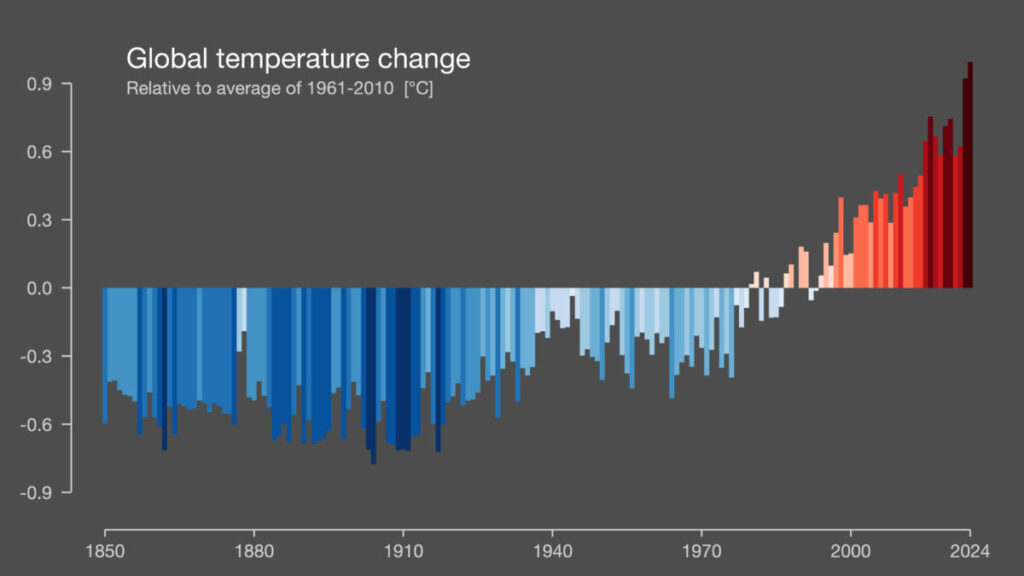
In the Global South, ‘we’ are already dealing with life-threatening consequences: devastating floods in Pakistan in 2022 displaced millions, while recent heatwaves and wildfires in India and Chile destroyed crops and homes, forcing migration and deepening food insecurity.
Although the North has contributed most to historical emissions, the South is bearing the brunt of extreme weather, with fewer resources to cope.
While Microsoft’s investors bet on tomorrow’s solutions, millions need climate action today.
The numbers which Microsoft Excel cannot hide
Despite all the fanfares for the progress of clean-energy, recycling and electrification, greenhouse gasses continue to rise and, according to the World Meteorological Organization’s 2024 State of the Global Climate report:
The human-caused increase in the concentration of CO2 in the atmosphere is the largest driver of climate change. CO2 accounts for around 66% of the radiative forcing by all long-lived greenhouse gases since 1750 and about 79% of the increase over the past decade. Current atmospheric concentrations of CO2 are higher than at any time in at least 2 million years.
If you’re wondering what the real-world implication of those numbers are for humans as a species, then Professor James Dyke, Associate Professor in Earth System Science, and Assistant Director of the Global Systems Institute at the University of Exeter has simplified things to make them very clear.
The rapid phase out of fossil fuels is absolutely central to our efforts to avoid catastrophic climate change. If we do not do this, then we are toast.
Irrespective of whether Stratos ever stores a molecule of carbon, Microsoft needs to slash its emissions yesterday, if not before.
When the dust settles on contracts, promises and projections, only the carbon left in the air will tell us who truly changed the world and who merely changed the narrative.
Which list will Microsoft be on?
More articles on sustainability and tech by Lee Grant
About The Author

Lee Grant
NEXT UP


