Trending Topics

 Trending
What Cisco, Dell, HPE, Lenovo and Supermicro had to say about AMD’s EPYC Venice portfolio

Now that the dust has settled on AMD’s EPYC Venice announcements, it’s time to hear what its customers have to say. AMD invited senior representatives from Dell, HPE, Lenovo and others to respond at its recent In Depth event in Las Vegas shortly before the official launch, and their views were surprisingly insightful.
For once, this wasn’t simply a “gather companies on stage and make them say great things about us” kind of event. If anything, it was more “this is what our customers are asking for”. With a decent helping of why AMD EPYC Venice met those needs, of course.
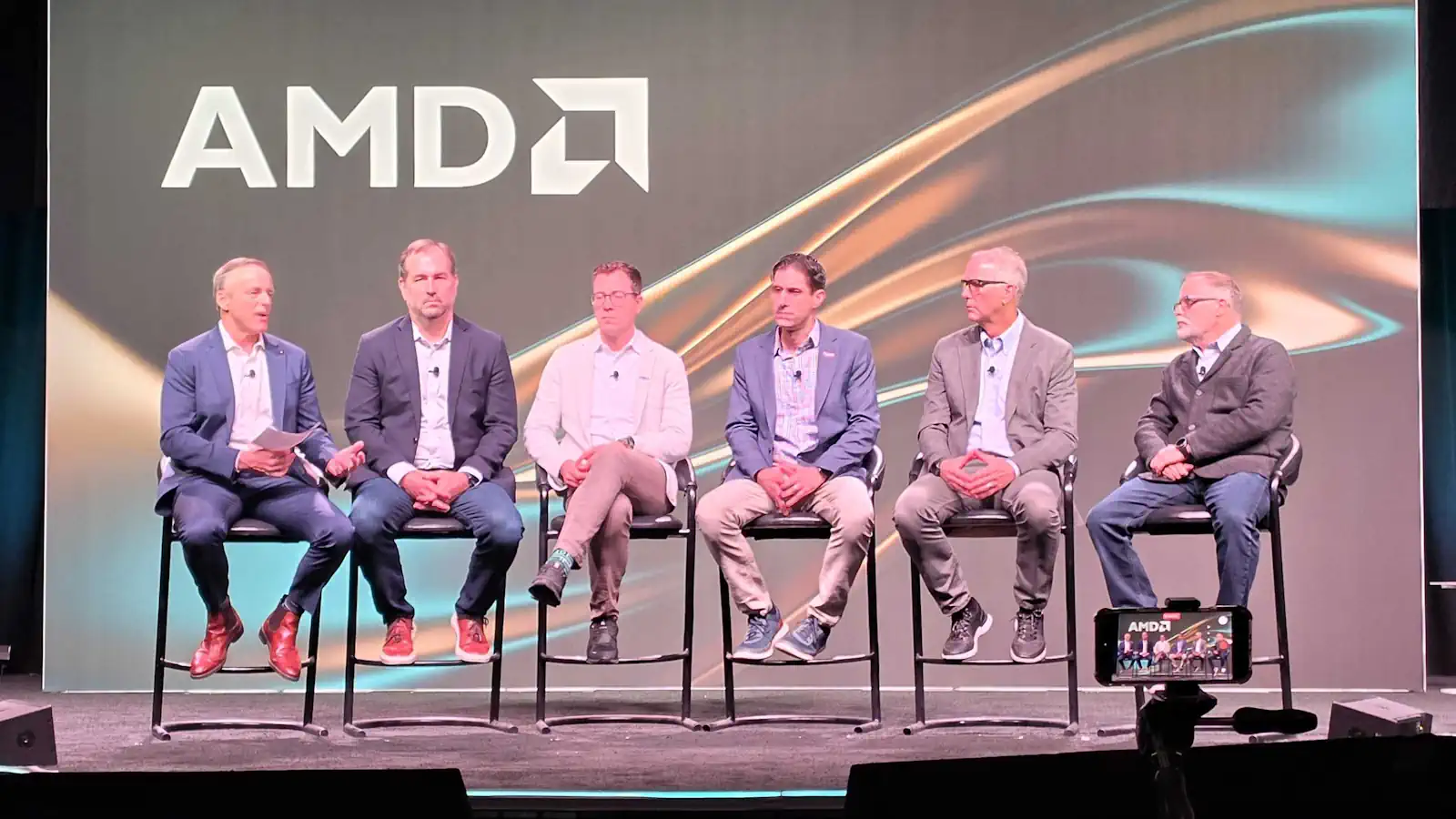
Having said that, my first impression on seeing the six men on stage was that Donald Trump’s attacks on “woke” diversity is working perfectly. But let’s move on.
Here’s the line-up:
- David Dicker, CVP, Enterprise Business Group, AMD
- David Schmidt, VP, Compute Infrastructure, Dell
- John Carter, VP, Compute Business Unit, HPE
- Scott Patti, VP, ISG Product Offerings, Lenovo
- Michael McNearney, Senior VP, Marketing and Network Security, Supermicro
- Todd Brannon, Senior Director, Solutions Product Management, Cisco
Has AMD EPYC Venice arrived at the perfect time in the refresh cycle?
“Refresh is is a fantastic story,” said Lenovo’s Scott Patti. “When you look at the capabilities and what you’re doing with Venice – 70% better performance before 3x the memory bandwidth – I mean, think about all the great things you can do with that product.”
But he was keen to point out that it wasn’t just about saving dollars through consolidation. “While some… customers are thinking about end of life systems, security patches and whatnot, they’re also thinking about how do I deploy infrastructure for this new agentic era that we’re in.”
HPE’s John Carter agreed. “It used to be [during refresh cycles] you knew what you were getting. I had A last time, now I get B. We don’t live in that world anymore.”
He also praised AMD for its “opinionated view” on what the new silicon was capable of and how it could help businesses move into the agentic AI era. “It doesn’t leave us guessing, and it doesn’t leave the end customer guessing.”
Dell’s David Schmidt pitched in with similar views. “We think customers are looking at their workloads, they’re looking at agentic… They’re going to do it 24/7, and so when they say, ‘Hey, my refresh cycle, do I have a do I have enough horsepower for where my workloads need to go?’ The answer is just a resounding no. It’s just not about getting that stair step function like the old days.”
How big a limitation is power budgets in data centres? And can AMD EPYC Venice help?
Schmidt raised also raised an interesting point about available power in data centres. “We had this conversation at breakfast this morning,” he said. “I said, 30 kilowatts to a rack is maybe a standard example, and then we all kind of agreed that that’s wishful thinking.”
Instead, enterprise customers “tell us that the normal is 15, 20 kilowatts a rack, and so we’ve been thinking a lot about power as well. Like, where previous designs maybe spent 19, 20% of system power just running fans trying to circulate air, and we still have a lot of customers living in an air-cooled world.”
Patti says that customers he speaks to who are “stuck” on a power envelope will be attracted to the EPYC Venice. “Taking legacy two-socket systems, refreshing them down to 256 cores in a single socket can replace a lot of older gear, so we are helping customers stay in that footprint.”
At the same time, he mentioned another organisation that’s burning through colossal amounts of energy per day due to token generation. “That same customer, when they went through the last refresh cycle, didn’t even know what a token was… So while we need to continue to help them in their legacy infrastructure, we do need to go down the modernisation conversation.”
How will AMD EPYC Venice help enterprises execute their AI strategies?
When asked about the most pressing AI workloads he was seeing, HPE’s John Carter made an excellent point: “Every single conversation I have [is around] business services. How do we afford to keep investing in the technology we need for our business to move forward, even though costs have gone crazy?”
He added that “the conversation has evolved”. Rather than talk about AI, customers are talking about business outcomes. “It’s more of how to help us manage through it, help us be a partner, and think about not just this step, but the next five steps, and how we work together over time to the right solution.” Whether that solution be a financial tool or infrastructure via HPE GreenLake.
Patti agreed. “Everyone sees the AI adoption. How are we going to get this in the enterprise? How are we going to maximise this in the enterprise? And so there’s budget conversations, but there’s more of the urgency of how can I get deployed faster?” In particular, “I’ve got to get to AI faster than my competitors”.
Supermicro’s Michael McNearney pointed out that developers in particular will enjoy having the power of AMD EPYC Venice on tap. “Usually, when you talk to developers these days, they’ll just tell you how many agents they have running. ‘I got nine agents working for me.’ So I think there’s just that momentum, it’s a strong business model.”
Schmidt added that companies need to “fundamentally redefine” their business processes rather than “sprinkle a little agentic work here, sprinkle a little agentic work there”.
“It’s not just about generating code,” he said. “Just from the operational aspect, if you’re not redesigning that from the grounds up, you’re going to miss the true opportunity that AI provides. So I think that’s what every enterprise is going to have to go through, that evolution.”
Striking the right balance: How can AMD EPYC Venice help
Dell’s Schmidt pointed out that customers need to be careful to buy the right hardware. “Don’t just try to rush to deploy a bunch of accelerators,” he said. “You might actually not need that. In some cases, CPUs are are actually pretty good tools in the overall AI toolbox, particularly with some of the smaller open weight models.”
“At Supermicro, we love our SKUs,” said McNearney. “So I think we got like 20 SKUs out there trying to optimise different features, finding out what the right customer mix is, the right customer demand is to sort of do that. Some people want more I/O, [some] want to connect more GPUs, [some are happy to] sacrifice memory.”
Cisco’s Todd Brandon also highlighted that finding the right balance between CPU and GPU was key at the edge. “I see a lot of customers now, and we’re helping them through it, trying to figure out what’s the most efficient way to power this model. And it’s not always a GPU.”
Related articles
About The Author