Trending Topics

 Trending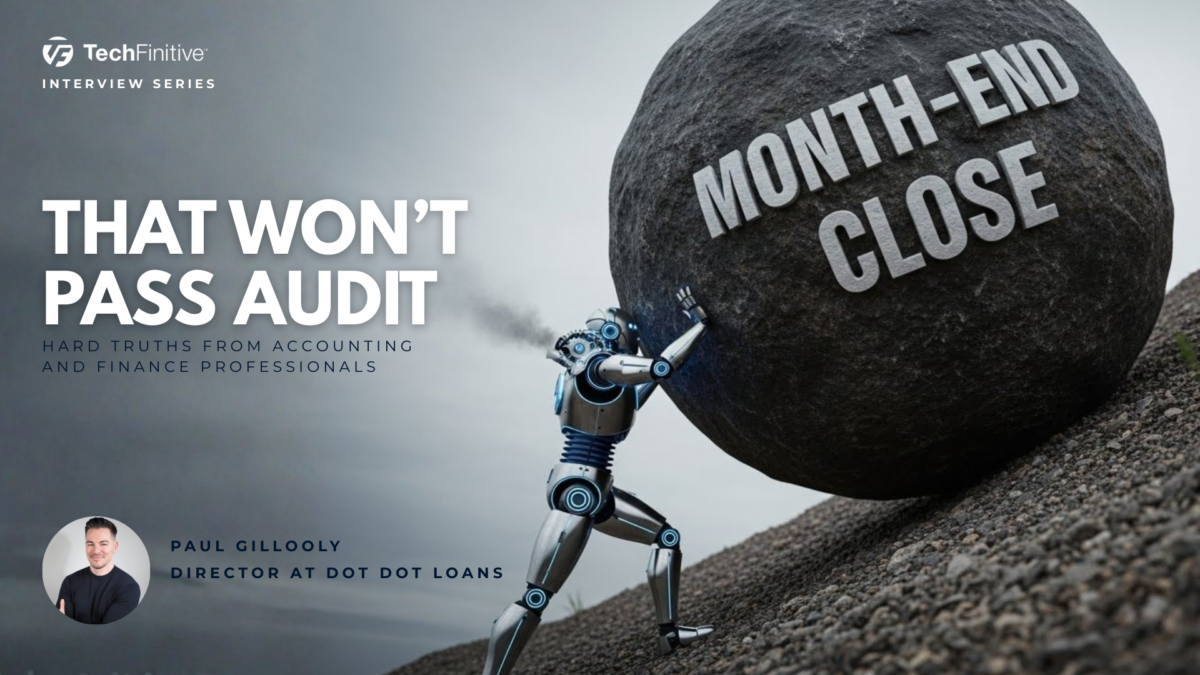
Paul Gillooly, Financial Specialist and Director at Dot Dot Loans: “Closing the books is now an obsolete description for finance teams”

If the name Paul Gillooly seems familiar, that’s because he’s an expert on personal finance who’s often quoted in publications such as The Mirror and The i Paper. He’s there because, as a Financial Specialist and Director at leading UK-based loan provider Dot Dot Loans, he has a keen understanding of finance. One built up with over a decade of experience in subprime lending, and one he shares freely in this expansive interview.
Here, in our new interview series “That Won’t Pass Audit“, we focus on the intersection between technology and finance. Naturally, you can’t move for the word “AI” in any industry, and finance is no different. Where it does differ from most is the intense level of scrutiny from regulators and auditors.
“We can all agree that it is tempting to go fast, but in finance, if you can’t prove it, it didn’t happen,” Paul told us. “[We] have cultivated the practice of starting every automation project with the same two questions: ‘Can we audit this?’ and ‘Would this hold up in a review six months from now?’
But that doesn’t mean that Dot Dot Loans is taking things slow. If one thing is clear from our interview, it’s that the company is taking advantage of AI and its twin colleague automation wherever it can.
“The more you postpone automation, the greater the risk to the processes,” said Paul. “When a manual process collapses, you will not simply lose time. You will lose the confidence stakeholders have in the process.”
Dot Dot Loans has also used AI to help predictive analytics, which “used to take weeks”, Paul revealed . “Now, it can take days or sometimes even hours to detect red flags.”
With all that potential time to be saved, we suggest it’s well worth you taking a few moments to discover exactly how Paul thinks all companies in his industry could take advantage of AI and automation.
How has the role of the finance function changed in the last three to five years, and what do you think most organisations still underestimate about that shift?
Over the last five years, the finance function has transformed from processing data in the background, to an integral part of frontline business strategy and compliance. This shift is especially pronounced in industries with high compliance requirements, such as subprime lending. “Closing the books” is now an obsolete description for finance teams. We are now expected to understand and identify business risks, ensure we are company compliant with regulations, and provide leadership with actionable insights in real-time.
Most organisations still fail to understand and appreciate the urgency of this shift. They view digital transformation as a one-time event, rather than a process that requires constant change. Simply adding new automation features, dashboards and a few other techno-crunching extras is not sufficient. The real work is in re-conceptualising the finance structures, roles, compliance frameworks and other organisational structures so that the team is designed with agility and auditability in mind. If you do not do both, the systems you create will fail to support you when you most need them.
Which accounting or finance processes are still far more manual than they should be, and what’s stopping teams from automating them?
Reconciliations, for sure. We have been hearing about automation for so long, and still far too many reconciliation processes are completed using spreadsheets, manual data pulls, and different tools that don’t connect or communicate with each other. In lending, where data integrity and reporting accuracy are of utmost importance due to the liability of reporting errors and the risk to the bottom line, that kind of inefficiency is more than just an unnecessary frustration. It’s dangerous.
What’s stopping automation, then? In most scenarios, it’s not technical issues. It is fear. Finance leaders fear loss of control or added complexity. But, the reluctance to implement manual processes for retention of ‘control’ is the only remaining economy. The more you postpone automation, the greater the risk to the processes. When a manual process collapses, you will not simply lose time. You will lose the confidence stakeholders have in the process.
What impact has AI had on your finance or accounting workflows so far and where do you see the most realistic near-term value?
AI hasn’t taken anyone out of my team, but it has made everyone smarter. For example, in subprime lending, we use AI to flag anomalies in repayment behaviours and optimise credit risk models. Predictive analytics used to take weeks. Now, it can take days or sometimes even hours to detect red flags.
However, the most realisable value of AI in finance is not replacing people, but augmenting their judgements. AI doesn’t make decisions for us. What it does is identify patterns that we would have otherwise missed. In our line of work, making a misjudgment on the affordability or overly assuming the compliance trigger is deadly. Having that in the system is not a luxury. It is a safety net.
How do you balance speed and automation with control, auditability, and regulatory compliance?
Let’s be honest, this is one of the toughest questions in consumer finance. The level of scrutiny from the FCA, auditors or internal risk teams defines this space. This is why we have cultivated the practice of starting every automation project with the same two questions: “Can we audit this?” and “Would this hold up in a review six months from now?”
We do not sacrifice control for speed because we bake it into the process. Every automated workflow is complemented with decision rule documentation, exception trigger documentation, and audit trail documentation. And just as importantly, we train our teams to trust but verify. There is a common saying, “Automation is the stepping stone to human error”, but we prefer to build the level of human oversight that automation should complement.
We can all agree that it is tempting to go fast, but in finance, if you can’t prove it, it didn’t happen. This is the mindset we operate under.
What skills do modern accountants and finance professionals need today that weren’t essential five or ten years ago?
Technical accounting and regulatory fluency are the still foundational, but today, if you can’t interpret the data gaps, reconcile the systems and provide a clear explanation to the non-financial audience, you will struggle. The communication gaps are not a soft skill, they are the office barriers.
Here at Dot Dot Loans, we appreciate what I like to call, “digital fluency”. This is the ability to interact with APIs, decipher data structures and question the reasoning behind different systems. While finance experts don’t necessarily need to know how to write code, they must know how automation, risk models and workflows interconnect; otherwise, they’re unable to be good custodians of speed and/or compliance.
How are finance teams preparing for increased regulatory complexity, reporting requirements, or scrutiny in the years ahead?
Building ‘resilience’ is the smartest thing finance teams can do, in addition to ’embedding’ compliance into their culture. This means investing in scalable infrastructure, like a modern ledger, integrated data pipelines, and real-time monitoring. It also means investing in people so that they are not merely responding to regulations, but are in a position to anticipate them.
We are continually stress-testing our controls to align with the FCA in-the-moment. Instead of waiting for auditing to find our gaps, we create our own simulations. Keeping the financial integrity of the customer journey in mind, we collaborate with compliance, product, and even customer service cross-functionally.
This means that the regulatory complexity is not likely to go away. It also means that, by treating compliance as a process that is ‘alive’ rather than a checklist, you can stay ahead of regulatory complexity.
More interviews
- Chris Petzoldt, Founder and Partner at Pretian Squared: “Knowledge is power and data the new moats”
- Sean Nappo, Executive Vice President, Americas, at Aptean: “Looking ahead five to ten years, an ERP will no longer be a back‑office system”
- IBM Apptio explained: why Fortune 500 companies love this product, according to a VP who’s been working there for more than six years
- Ben Cicchetti, SVP, Marketing and Communications at InfoSum: “Personalisation starts and ends with data”
- Claire Carter, Director of Access ERP at The Access Group: “Any improvements we make internally have a direct impact on our customer experience”
About The Author

Tim Danton
NEXT UP


