Trending Topics

 Trending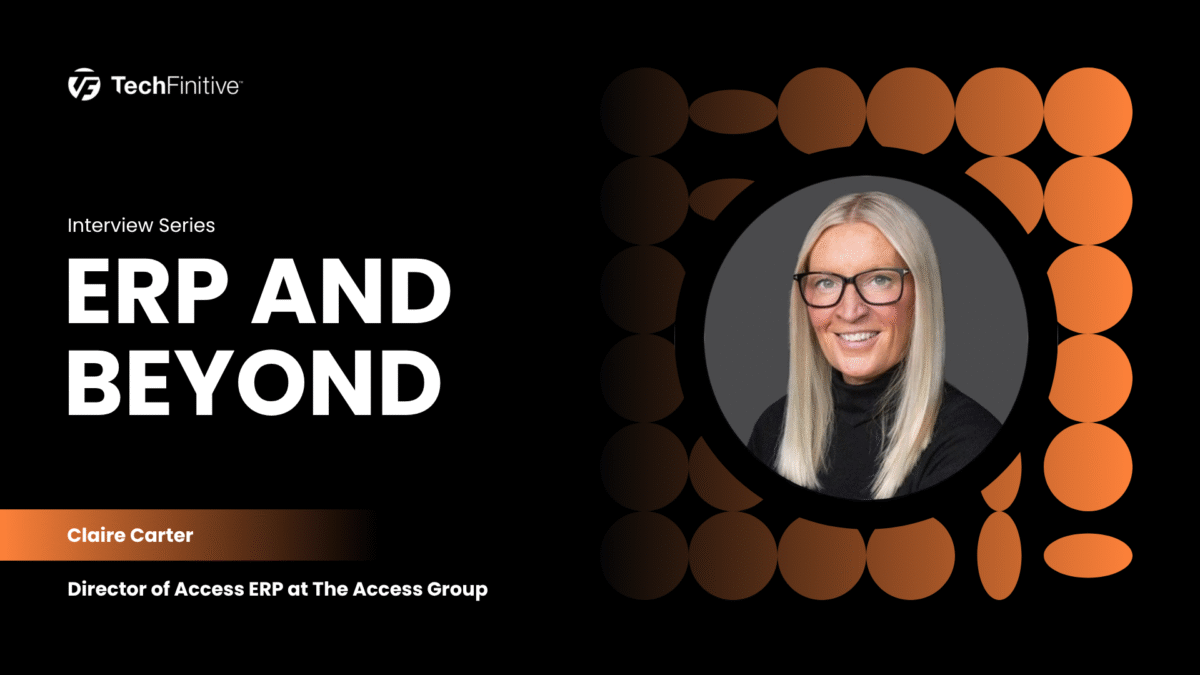
Claire Carter, Director of Access ERP at The Access Group: “Any improvements we make internally have a direct impact on our customer experience”

Claire Carter has spent over two decades helping businesses connect people, processes and technology. Having started her career in the field of tax and accounting, Claire built expertise leading major transformation projects, aligning strategies and organisations to prepare them for emerging markets. Now she’s putting that valuable experience into use as Managing Director of Access ERP at The Access Group.
For Claire, implementing ERP is about far more than software: it’s about unlocking a “single source of truth” that can allow for growth and global scalability “regardless of business, size and sector”. When ERP systems are properly integrated, she has found they can save a significant amount of time for the average finance team. For example, by removing the need to manually consolidate data, a task that costs companies almost six working weeks a year.
For all of the benefits of a successful integration, however, Claire warns about the dangers of a poorly planned, poorly implemented system. Too often, companies make the mistake of focusing on the technology and forgetting about the aftermath, especially when it comes to proper onboarding for employees moving to the system.
“Because of the size of ERP systems… people, processes and systems need to be foundational pillars,” Claire explains, “otherwise there is a risk of poor implementation and minimal adoption which could be detrimental.”
Claire wouldn’t have such a clear view of the dangers, of course, if it weren’t for her years of experience working so closely with people and technology alike. Some of these lessons are simply things you have to go through to learn, which is why our first questions concentrate on Claire’s time in the ERP field.
Introduction
Can you tell us about your role and your experience with ERP systems?
Before becoming Managing Director of ERP at The Access Group, I worked across many different companies, focusing on tax and accounting. My main focus is always on how to empower teams and improve processes for employees and customers. Over my twenty-year career, I have seen many technology changes in the sector that have really transformed ERP systems and the way people work.
Opportunities and benefits
In your view, what’s the biggest advantage a well-implemented ERP system can bring to an organisation?
The whole point of a well-implemented ERP system is that it makes a business more effective and reduces silos. As businesses, we’ve been striving for years to get a single point of truth – surely something so simple should be straightforward? Regardless of business, size and sector – getting that single source of truth enables scalability, resulting in operational efficiencies and, of course, growth.
However, when looking at our Missing Middle research, carried out in June 2025 across 400 UK CFOs, what was astounding was the amount of time finance teams were spending manually consolidating data across systems – a massive 20 hours per month, with every single respondent spending more than 5 hours per month on that work. Let’s think about that – on average, organisations are losing 6 working weeks per year just gathering and reconciling numbers. This huge productivity drain is a consequence of not having a single version of the truth across silos.
Now CFO’s are recognising the impact of integrating systems, to get that version of the truth, with 72% saying that the ability to integrate with third-party systems is important when choosing financial software. When done correctly, the results speak for themselves – One customer said: “We used to wait 24 hours for a management report, now we get it instantly”. Imagine the impact that kind of intelligence can have across all businesses.
Challenges and pitfalls
What are the most common reasons ERP implementations fail or fall short?
In my experience, ERP implementations need thought and consideration – it’s a big deal, and needs to be well thought through with partners who understand your business, whilst understanding the software. Software that’s rightsized for you and your business, today and tomorrow.
Implementation and onboarding is often overlooked. Because of the size of ERP systems, which often span multiple functions and teams, people, processes and systems need to be foundational pillars otherwise there is a risk of poor implementation and minimal adoption which could be detrimental.
Our research found that 54% of mid-market leaders said their current ERP system isn’t the perfect fit. What we often find is that software is designed for either small businesses or large enterprises, and is rarely tailored to the particular needs of mid-sized organisations. Why is this so important? The challenge with implementing the incorrectly sized ERP comes down to three key things:
- Scalability – ability to future-proof your business as it grows
- Compliance – ensuring you have the correct tools in place to remain compliant
- Cost – People, Monetary Cost & Reputational Cost
Finally, be realistic about timescales. We’ve already touched on why an ERP system is a big deal – it’s important to build in the appropriate timescales to make sure you’re doing the job justice whilst getting the right people involved. Adoption needs to be across the board; it’s not just an ‘IT Job’ – integrating a new ERP is a great opportunity to realign the business and get it excited about change, but only if the legwork is done upfront.
Trends and the future
What role do you see AI and machine learning playing in ERP in the near future?
AI is an interesting one – it’s often billed as a silver bullet. Whilst it can massively improve operational efficiencies and we’re wholeheartedly adopting it here at The Access Group, it still relies on the fundamentals being in place.
1. Making sure you have the right systems, people and processes in place.
2. How can AI make you get faster, smarter and more data-driven?
Interestingly, from our research, finance leaders are optimistic but also cautious – 75% of CFOs and finance directors believe integrating AI into financial solutions is important for success by 2025. The biggest opportunity is a challenge that all leaders across the board face – how do we do more, with less? It’s no surprise that 47% of CFOs say that automating reports would be the biggest boost to their team’s productivity. Drilling down to the next level, other specific workflows that could benefit from automation are invoice processing and expense processing and of course, more accurate cashflow forecasting.
Reports from McKinsey show that only 1% of CFOs have automated three-quarters of their financial processes. From our experience, this low adoption isn’t down to lack of trying – it’s simply that mid-sized firms often lack systems that could automate the end-to-end. In summary, AI can 100% help us get here faster, but it has to be underpinned by the fundamentals.
ERP integration and strategy
How should companies think about integrating ERP with other key systems, like CRM or supply chain tools?
We’ve already touched on the holy grail – ‘a single source of truth’ – but that’s pretty much impossible if a holistic approach to integration and systems strategy isn’t adopted.
Let’s think about ‘the happy path’. When systems, AI and processes work properly, the impact on our people is evident – confident decision making based on trusted, real-time data. Those annoying repeatable tasks are picked up by AI, and that constant duplication of efforts is reduced. The benefit is two-fold; not only can the impact be felt internally, but the knock-on impact externally can be palpable. Billing errors, delayed quotes, and wrong stock items vanish – if we get the happy path right, it becomes a competitive advantage.
When thinking about the strategic impact of integrating an ERP with other key systems and processes, it should be a top-down approach and part of a well-considered, longer-term roadmap. The danger of a bottom-up approach is more silos and reduced data integrity – the complete opposite of what our customers want to achieve.
This strategic, holistic approach to ERP management is giving CFOs a bigger seat at the table. 73% of mid-market finance decision makers say the CFO/FD role is expanding into the broader business, underpinning this is the strong foundations we’ve already spoken about – the CFO can’t be strategic if their day-to-day is searching for that single version of truth and consolidating spreadsheets.
In summary, if ERP integration is done well, it can truly catapult our finance teams from data fixers to strategic business partners of tomorrow’s AI-fueled, robust business.
Personal Insights
What’s the most exciting ERP innovation you’ve come across recently?
Speed. Quite simply, speed. We need the people, processes and systems in place in order to succeed, and this is helped by ERPs specifically designed for the mid-market coming into play. Add on the AI layer, and think about how quickly we can all start moving forward.
Finance leaders are super clear in what they want help with: 54% want help with anomaly detection, 54% need support with budget and resource allocation, and 50% want support with forecasting and scenario planning. It’s our job to look at how we help solve these problems quickly and efficiently.
What’s really exciting about this is the power it gives our people – removing routine tasks reduces frustration, increases engagement and empowerment and imagine what could be done with those 240 hours a year that’s currently used on reconciling data.
I touched on it briefly, but it’s often overlooked. Any improvements we make internally have a direct impact on our customer experience, which in turn impacts growth.
Finally, what makes the smartest mid-market companies? The ones focused on people, systems and processes – that then look at how to automate, operationalise and empower with AI.
Other interviews
- Adi Krysler, VP Marketing at Oktopost: “Don’t fall for the AI polish”
- Costanza Ghelfi, Chief Product Officer at Making Science: “You can’t get personalisation right without getting privacy right first”
- Áine Dundas, Head of EMEA Marketing at Notion: “As a marketing leader, I’m living in an unprecedented era of martech transformation”
About The Author