Trending Topics

 Trending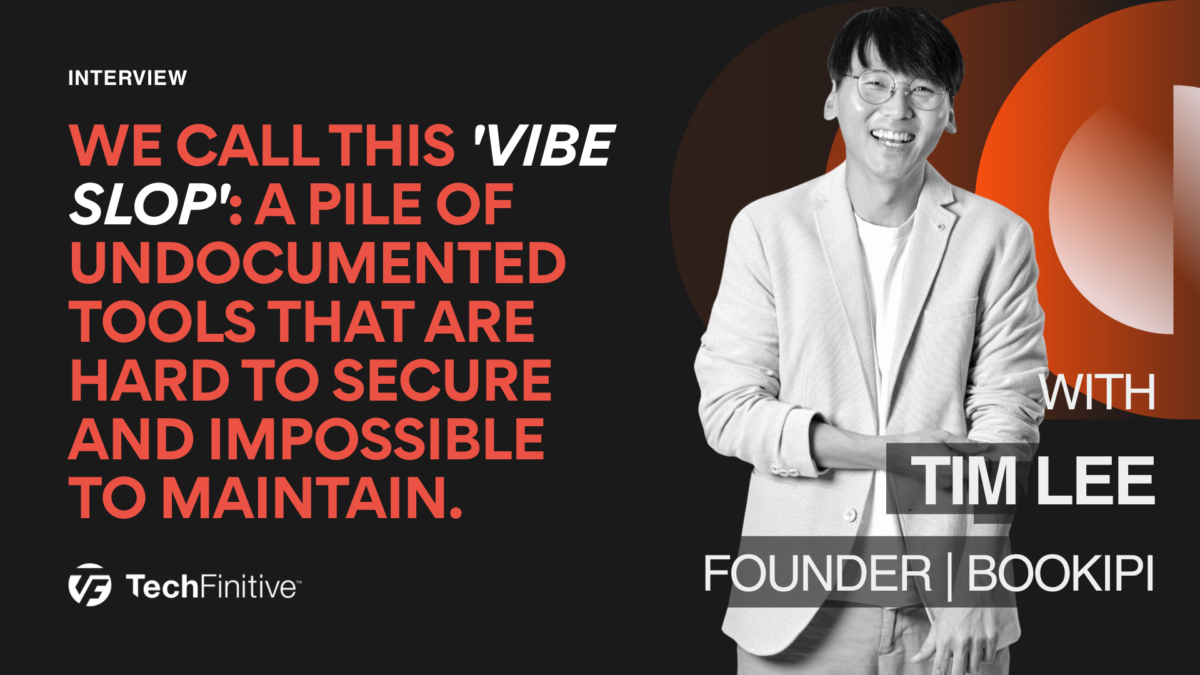
Tim Lee, Founder of Bookipi: “We call this ‘vibe slop’: a pile of undocumented tools that are hard to secure and impossible to maintain.”

Software-as-a-Service was meant to make business technology simpler. For most small businesses, it has done the opposite, leaving owners to run a dozen disconnected apps, each with its own login, subscription, and pocket of trapped data. Generative AI and no-code tools now promise to fix that, or to make it worse, depending on how they are used.
Tim Lee is the Founder and CEO of Bookipi, a suite of business tools used by around 2.5 million small businesses across 179 countries. We asked him how the “application glut” hits the smallest businesses hardest, why a company that sells several apps is willing to argue that the app model is broken, and what small business owners should actually trust AI to build for them.
For readers who don’t know Bookipi yet, what is it, and who is it built for?
Bookipi is a full suite of tools for running the financial and admin side of a small business. It starts with the everyday essentials, invoicing, expenses, contracts and eSign, and increasingly it is the native AI tools sitting on top that do the heavier lifting: AI Website Builder, AI Receptionist, and AI Notetaker among them. A built-in chat agent that not only answers questions, but executes a task on the user’s behalf, has also since been introduced. An owner can use natural language like “create an invoice for Sarah, two hours of consulting at ninety dollars,” and the invoice is made, all without manual inputs. Since 2020, around 2.5 million businesses across 179 countries use Bookipi.
Who it is built for matters more than the feature list. Our users are the plumber, the cafe owner, and the freelance designer. They run the whole business themselves, where there is no IT department, no finance team, and no developer to call when something needs changing. That constraint shapes everything we build. If a tool needs a 30-minute onboarding course, it is already too complicated for the person we are trying to help.
SaaS was supposed to simplify business technology, but many companies now use dozens of disconnected applications. How has this “application glut” affected small businesses in particular?
SaaS made it trivial to add software. Create a new account and set your password, and you have a new tool for scheduling, another for invoicing, another for email marketing, another for payroll. For most parts, you no longer have to install software to use a tool, and onboarding friction is painstakingly choreographed to get the users to the tool quicker, and that’s generally a good thing. Each one solves a real problem on its own, but the trouble starts when they’re on multiple disconnected platforms.
Large companies have people whose job is to absorb that complexity. Small businesses do not, so the owner becomes the integration layer. They are the one re-keying a customer’s details into three systems because the tools may not integrate with each other. And their data ends up scattered, a bit of the customer record here, the payment history there, none of it in one place they can rely on. Without a single source of truth, a simple question now requires considerably more effort to answer.
So the promise of SaaS, that technology would free owners to run their business, gets inverted. They spend more time managing software than serving customers. For the smallest businesses, that is the whole problem.
Small businesses often don’t have dedicated IT or development teams. How is generative AI changing their ability to customize software and automate business processes?
It is a genuine shift in who gets to build. Before, customizing software meant developer time and months of waiting, which put it out of reach for a small business entirely. Now someone can describe what they want in plain language and get something working reasonably. The person who understands the business, the owner, is finally the person who can change the software, without a developer sitting in between.
In practice that means a small business can automate the repetitive work that used to need a dedicated team. Take a landscaper who spends every Sunday night sending the same overdue payment reminders by hand. That is now a rule they set once: chase the invoice automatically, update the customer record, flag when cash flow dips. Things that were previously “we will get to that one day” become something you set up in an afternoon.
What has not changed is the need for a dependable foundation underneath. Generating an automation is easy now. Trusting it to run your operations every day without breaking is a different question, and that is where the interesting problems start.
Are tools like vibe coding a game-changer for small businesses, or could they create new problems if employees start building software without proper governance?
Both, and the line between them isn’t as obscure as one might’ve expected. Vibe coding, describing what you want and letting AI write the software, is genuinely useful for a prototype or a low-exposure internal tool. Say a quick page to collect RSVPs for a customer event, or a script to tidy up a messy contact list. If it breaks, you shrug and try again. For that, it is excellent, and yes, a real change for people who could never build anything before.
The problem starts the moment that code goes near customer data, payments, or compliance. Now a core part of your business runs on software no one fully understands. When it breaks, and it most likely will, someone has to comb through work they did not write, and if the person who prompted it into existence has moved on, you are operating blind. We call this “vibe slop”: a pile of undocumented tools that are hard to secure and impossible to maintain.
Governance sounds like a heavy word for a small business, and it does not have to be. It means three simple things for anything that touches real data: a named owner, clear permissions, and enough documentation for the next person to understand. A human-in-the-loop (HITL) is a necessity, and said ‘person’ should possess the required knowledge or proficiency to intervene when the situation calls for it. Speed without those is how you end up with a liability instead of a tool.
Why are no-code and low-code platforms particularly important for small businesses looking to take advantage of AI without adding more complexity or hiring developers?
No-code and low-code platforms are what turn the speed of AI into something a small business can actually run. AI can shorten the time it takes to build. The platform provides the structure that keeps what you built maintainable: managed permissions, integrations that hold, and workflows you can see and understand rather than raw code hidden in a file.
That matters most precisely because these businesses have no developers. If a small business cannot read the code an AI wrote, it cannot audit it, cannot fix it, and cannot know whether it is safe. A no-code platform removes that problem by never producing code the owner has to trust blindly. The logic is visible in plain steps a non-technical person can follow. An owner can see that an unpaid invoice triggers a reminder after seven days, and change the seven to three themselves, without touching a line of code. They stay in control of their own systems.
So the combination is the point. AI gives you the customization without the developer, and the no-code foundation gives you the discipline without the IT team. For a small business, that is the first time both have been available at once.
What is adaptive SaaS, and how could it fundamentally change the way small businesses use technology as their needs evolve and their businesses grow?
For twenty years, businesses have had to bend their processes to fit whatever the software allowed. You worked the way your invoicing tool wanted you to work. Adaptive SaaS turns that around. The software configures itself to how the business already operates, rather than forcing the business to change.
Concretely, an adaptive platform watches how you actually handle invoices, customer queries, and movement in your inventory, and it suggests ways to automate those specific activities using your own process as the guide. If a plumber adds the same callout fee to every job by hand, the platform notices the pattern and offers to fill it in from then on. It can generate a dashboard you need, adjust a workflow as you take on more customers, and add structure as you grow, without a developer project each time. Customization stops being the exception and becomes the normal way the tool behaves.
For a small business owner, that is the outcome that matters. Most of them have no wish to become software architects. They want to serve customers and build the business, and have their tools keep up rather than get in the way. Adaptive SaaS, sitting on a no-code foundation, lets them do exactly that. The platforms that win will not be the ones with the longest feature list. They will be the ones that adapt for the person using them.
About The Author

Ricardo Oliveira
NEXT UP


