Trending Topics

 Trending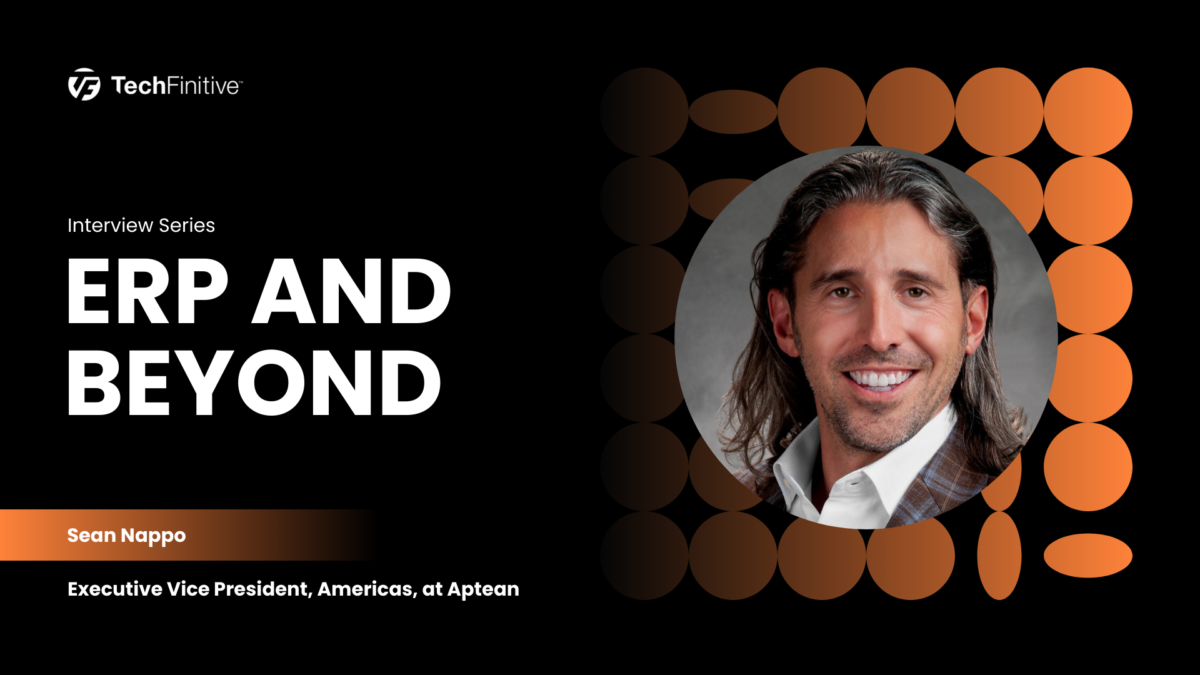
Sean Nappo, Executive Vice President, Americas, at Aptean: “Looking ahead five to ten years, an ERP will no longer be a back‑office system”

With over 15 years of experience providing and supporting ERP software, Sean Nappo is no stranger to change. Specifically, the change brought about by the full embrace of ERP systems into businesses. As Executive Vice President for the Americas at Aptean, Sean works closely with manufacturers and distributors who rely on ERP systems to keep their businesses running, all while getting to see firsthand how powerful ERP can be when aligned with the needs of the business.
At its best, Sean believes that ERP can deliver something increasingly hard to find as technology advances: clarity. A well-implemented system can give leaders “a single, trusted view of their business,” Sean explains. But ERP serves a greater function than simply piecing together real-time data from different departments; when AI is introduced to the equation, you can, in Sean’s words, “anticipate what is coming next”.
The ability to be proactive rather than reactive is what makes ERP such a powerful tool when it comes to agility and data-led decisions, Sean believes. When information is connected, ERP shifts from “something people consult after the fact” to “something that actively guides decisions in the moment”.
Of course, ERP is no magic wand, and Sean is quick to point out where it can fall short. “Most ERP failures generally don’t start out with bad software,” he explains, “they start with poor fit and poor preparation.” To avoid this, Sean recommends being careful to not let the teams get left behind. There needs to be proper training and alignment in the way work is being done, else risk undermining the investment.
With Sean’s clear view of both ERP’s potential and pitfalls, it felt natural to take a step back and ask where that perspective comes from. So that’s why we began by asking Sean to share more about his role and experience working with ERP systems over the years.
Can you tell us about your role and your experience with ERP systems?
I serve as Executive Vice President for the Americas at Aptean, where I am responsible for sales, services and product management across the region. My focus is simple. I want to make sure our ERP solutions deliver real, measurable outcomes for customers and that every engagement strengthens the long‑term value we provide. That mindset guides how I lead teams and how I think about the role ERP plays in day‑to‑day operations.
I started my career at Ellucian, where I led sales in the West and significantly grew SaaS revenue. That experience shaped how I think about enterprise software. It is not just a product; it directly impacts how organisations operate every day, how people work and how effectively a business can respond to change.
At Aptean, that impact is even more tangible. ERP is the backbone of our customers’ business. Many of them are family‑owned manufacturers and distributors who rely on these systems to run efficiently, stay compliant and grow without losing what makes them unique. When you walk onto a plant floor and see a business running smoothly, that is ERP doing its job, even if no one notices it. That is what motivates me and keeps me focused on delivering tangible results.
What first drew you to ERP solutions?
For me, it was the opportunity to see technology make a real, tangible impact. Early in my career at Ellucian, I saw how software could reshape institutions. But I wanted to get closer to the commercial world, where technology isn’t just about systems, but about livelihoods and the day-to-day realities of running a business.
When I joined Aptean in 2020, I quickly learned from customers that they needed partners who could help them transform their businesses. The right ERP becomes the backbone of a company, enabling it to operate more efficiently and critically, to thrive.
That clarity of purpose is what drew me in. As my role expanded into implementation, and product management, I got a front-row seat to how ERP supports businesses in practical, customer-focused ways. I got to see the impact not in abstract metrics, but in real operations.
What excites me most is seeing the results in the everyday. Walking into a grocery store knowing our solutions keep operations running smoothly, or seeing food trucks serving families nationwide, reminds me why this work matters. and feeling proud that Aptean is supporting this behind the scenes.
It’s in these moments I am reminded why our partnership and the right software solutions matter. Software isn’t just code. It’s the bridge between heritage and progress, and between family-owned pride and global scale. We are here to help businesses stay ahead and thrive.
What’s the biggest advantage a well implemented ERP system can bring to an organisation?
Clarity.
A well implemented ERP gives leaders a single, trusted view of their business. Instead of chasing reports across finance, operations and supply chain, they can see what is happening in real time and act with confidence. That level of visibility removes guesswork and allows teams to focus on what truly matters rather than piecing together fragmented information. That clarity drives better decisions. It reduces friction. And when you layer AI on top, it goes a step further. You no longer understand what happened. You anticipate what is coming next.
That clarity drives better decisions. It reduces friction across departments and creates a shared understanding of performance. And when you layer AI on top, it goes a step further. You are no longer just understanding what happened; you expect what is coming next. AI highlights risk earlier, identifies patterns teams may miss, and helps leaders respond before issues escalate.
The real advantage isn’t theoretical. It shows up in the everyday running of the business. It results in faster decisions, fewer surprises and a more predictable operation. Teams can collaborate more effectively because they are working from the same information. Leaders can move with greater confidence even when conditions change, because they have real‑time insight into what is happening and what may happen next.
Clarity becomes a competitive advantage, one that strengthens resilience and supports smarter, more agile growth.
How do ERP systems help businesses become more agile and data driven?
Agility is about speed, clarity and confidence. Without the right ERP, disruption – whether a supply chain delay or a sudden demand spike, results in teams scrambling to pull data from different and disconnected systems. By the time they understand the problem, they are already behind and the moment to act has passed. That lack of visibility slows everything down.
With the right ERP, the full picture is available instantly. Because the data is connected, consistent and reliable, teams can adjust production, shift inventory, or reallocate resources in real time. Decisions that once took hours or even days can now be made in minutes, allowing the business to respond with far greater precision.
Layer AI on top and the value compounds. Data stops being purely descriptive and becomes predictive. Instead of reacting to issues, businesses can anticipate them and act before they escalate. AI highlights risk earlier, identifies patterns that may not be obvious, and gives leaders the confidence to move quickly even in uncertain conditions.
That shift from reacting to anticipating is what truly makes an organisation agile and data driven.
Are there specific industries or business functions where ERP creates the most impact?
Manufacturing is where ERP creates some of the most significant impact because it’s an environment with countless moving parts. Take food manufacturing, for example. Think about a producer juggling recipes, tracking ingredients, meeting strict safety standards, and staying ahead of constantly evolving regulations. Without the right ERP, that becomes a maze of spreadsheets and disconnected systems. With a vertically focused AI platform such as Aptean’s AppCentral 2.0, which we purpose‑built from the ground up, everything comes together in one place. Suddenly the business has end‑to‑end traceability from farm to fork, and every team is working from the same reliable picture.
That same value extends across industries. ERP becomes the invisible infrastructure that keeps operations running smoothly. Finance teams get real‑time reporting. Operations teams spot bottlenecks before they happen. Supply chain leaders can trace every step of production with confidence, reducing risk and improving overall efficiency.
More broadly, a great ERP supports quality control, compliance and rapid recovery when disruptions occur. In apparel, it strengthens demand forecasting and inventory management, helping businesses keep pace with fast‑moving markets and shifting customer expectations. Across all these functions, ERP provides the structure, insight and consistency that allow businesses to operate with greater speed, accuracy and resilience.
What are the most common reasons ERP implementations fail or fall short?
Most ERP failures generally don’t start out with bad software; they start with poor fit and poor preparation. When the system isn’t designed for the specific industry, teams are forced into workarounds, heavy customization and manual processes. This slows adoption, increases risk and undermines the value of the investment.
People and processes matter just as much. If organisations fail to bring their teams along, explain the “why,” and align new ways of working, the ERP exposes existing problems instead of resolving them. The same is true for processes. If you take messy, inconsistent workflows and digitize them, the ERP doesn’t fix the issues; it shines a spotlight on them.
That’s why Aptean focuses so heavily on getting customers match‑fit before ERP implementation. We align processes to proven best practices, minimize unnecessary customization, and ensure teams understand the change ahead. When customization is used sparingly and intentionally, the system stays easier to maintain and upgrade.
Industry fit is another critical factor. A generic system cannot reflect the real‑world complexity of manufacturers and distributors. Aptean’s vertical approach ensures customers start with workflows built for their sector. When you get the people, the processes and the fit right, ERP becomes a true growth engine rather than just a system of record.
How are cloud-based ERP systems changing the landscape compared to on-premises deployments?
Cloud‑based ERP systems are transforming the enterprise landscape by removing much of the friction historically associated with on‑premises deployments. Businesses can deploy faster, scale more easily and stay current without worrying about infrastructure, upgrades, or downtime. This frees teams up to focus on value rather than maintaining systems.
The deeper transformation comes from what cloud enables. With a single, centralized, real‑time data model, businesses finally have the foundation required to operationalize AI and advanced analytics in a practical way. Leaders gain immediate visibility into performance; they can surface insights quickly, spot risks earlier, and act in the moment instead of relying on slow, retrospective reporting cycles. Cloud ERP becomes the engine for decision intelligence, enabling AI to guide actions as conditions change.
Security is another area where cloud ERP changes the equation. Modern cloud platforms deliver levels of monitoring, resilience and compliance that far exceed what most businesses can build or sustain internally. The result is a higher and more consistent security baseline across the entire operation.
There is also a cultural shift. Cloud ERP makes real‑time information accessible across teams, devices and geographies, enabling faster collaboration and better decision-making.
The business becomes more agile, more intelligent and more resilient. In a digital economy where speed, insight and adaptability matter, cloud ERP gives businesses the foundation they need to compete effectively.
Cloud ERP isn’t just a deployment model. It’s a better way to run a business.
What role do you see AI and machine learning playing in ERP in the future?
AI is transforming ERP from a traditional system of record into a true system of intelligence. Historically, ERP told businesses what had already happened. With AI and machine learning, it can now predict what will happen next and recommend the best actions to take. That shift – from reporting to anticipating – fundamentally changes how ERP supports day-to-day operations.
We are already seeing this in areas such as demand forecasting, anomaly detection and real-time decision support. AI also changes how people interact with ERP. Instead of digging through reports or navigating complex menus, users can ask questions in plain language and receive immediate, context-aware answers that reflect the data and the workflows inside the system.
At Aptean, we have built this capacity directly into AppCentral 2.0. Because the platform is industry-specific, intelligence is immediately relevant and actionable. It reflects real operational processes, making insights more precise and more useful than generic AI models.
AI is also reshaping how people interact with an ERP. Instead of navigating complex reports, employees can ask natural‑language questions like, “What’s our margin on product X this quarter?” and get immediate answers. This makes an ERP far more accessible and useful across the organisation.
Looking ahead, AI makes ERP proactive, predictive and significantly more valuable across the business. It shifts ERP from something people consult after the fact to something that actively guides decisions in the moment, helping businesses operate with greater speed, confidence and intelligence
AI makes ERP proactive, predictive and personal, and supports businesses move from reacting to anticipating, which in today’s environment, becomes a competitive advantage.
How do you think ERP systems will evolve over the next 5–10 years?
Looking ahead five to ten years, an ERP will no longer be a back‑office system. It will become the digital nervous system of a business – connecting data, predicting outcomes and guiding decisions in real-time.
The first major shift is connectivity. ERP will integrate seamlessly with everything around it, the CRM, supply chain, e‑commerce, finally giving business leaders one unified view of how their business is running. No more stitching data together or waiting for reports. Just a single, connected operational picture in one platform.
The second shift is intelligence. AI and machine learning will no longer sit on the edges as optional add-ons. They are built into the core, turning the ERP into a proactive partner that automates routine work, surfaces insights a team may have missed, and even making recommendations on the next course of action.
And the other shift is vertical specificity. Companies won’t settle for generic systems anymore. They’ll need partners like us, and solutions that understand the realities of their industry, whether it’s the domain itself, the workflows, the regulations, the pace, or the risks. That’s exactly where we’ve got to with AppCentral 2.0. It’s a vertically focused AI platform that brings together industry best practices, predictive analytics and connected solutions in one place.
For our AppCentral 2.0 customers today, their ERP actively runs their business. And when you consider my own story, and how I was motivated to join this industry by a desire to improve businesses performance, that’s exciting.
Other interviews
- Neil Gardner, Head of Cloud ERP at SAP: “Leaders should make their technology transformation a shared mission”
- Ciarán Quilty, Senior VP International, Intuit: “AI can be really used in a positive way to help SMEs focus on what they want to do”
- Darren Cran, CEO of AccountsIQ: “The biggest pitfall is assuming that bigger automatically equals better”
About The Author

Rowan Campbell
NEXT UP


