Trending Topics

 Trending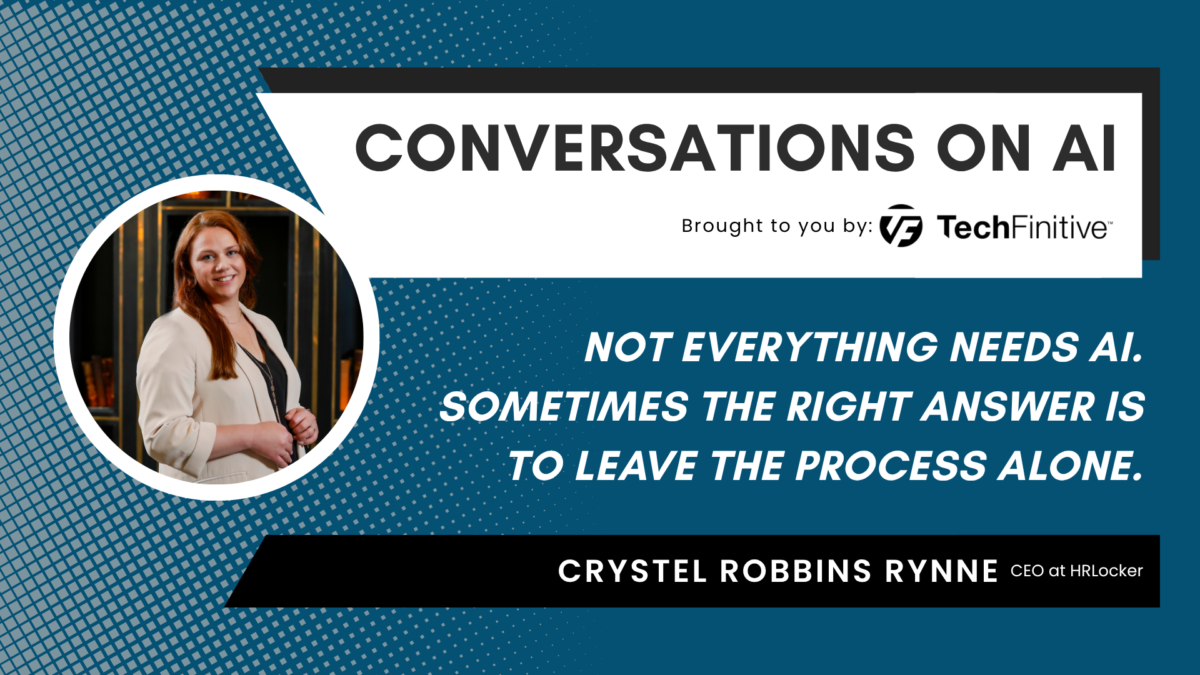
Crystel Robbins Rynne, CEO at HRLocker: “Not everything needs AI. Sometimes the right answer is to leave the process alone.”

For Crystel Robbins Rynne, AI has more depth than being simply technological. This is the big theme of our interview, the third in our “Conversations on AI” series.
As CEO of HRLocker, she sees its impact through the lens of the people, business processes and sensitive data that sits behind them. It’s this that gives her such a particularly grounded perspective on where AI can genuinely be useful, and where the industry may be using it as more of a crutch.
While Crystel is in no doubt of AI’s potential impact, she’s wary of the rush to apply it everywhere. The pressure to stake claim to the “AI-powered” label can lead companies to add complexity where it isn’t needed, especially when the existing process already works. In Crystel’s own words: “the industry gets carried away assuming that, because AI is transformative, every AI feature must also be valuable. But not everything needs to be AI’d.”
Crystel’s own approach to AI has evolved considerably as the technology has matured. Having initially been distracted by the possibilities AI can create, she now takes a more measured view. The biggest benefit she has seen is when it comes to prototyping, where an idea can now become something customers can test out “in a day”, rather than being weeks of work and development. AI has made the business not only significantly faster but also, as Crystel puts it, “it has made us more selective”.
In HR especially, Crystel warns that an AI-generated recommendation can have serious consequences. Simply saying that “there’s a human in the loop means very little if that person clicks accept on whatever comes back”. Those using the system must understand its limitations, challenge its conclusions and ultimately remain responsible for the output.
Crystel’s own journey with AI reflects much of what many businesses are now going through: moving from wanting to apply it everywhere to using it carefully where it actually makes a difference. So with that evolution in mind, we started by asking where she thinks the industry is overestimating its impact, and where they’re still missing the opportunity.
Everyone says AI is transforming software, but where do you believe the industry is still overestimating its impact and where is it underestimating it?
AI is as significant as the launch of the internet. It’s changing how companies are built, how people work and how software is created. We’re still very early in understanding the full impact.
Where I think the industry gets carried away is assuming that, because AI is transformative, every AI feature must also be valuable. But not everything needs to be AI’d.
There’s a lot of pressure on software companies to describe themselves as AI-powered or AI native, even when these features sometimes add very little. Sometimes the existing process is already simple and works well. Adding AI often makes it more complicated.
AI has definitely lowered the barrier to building and shipping software. That’s really exciting, but it also means the market is becoming cluttered with copycat products. They can look convincing in a demo because features are now much easier to reproduce. What’s harder to reproduce is everything around the product. Security. Positioning. Customer trust. Implementation. Support.
We also forget that AI isn’t just for tech. I use it every day in how I run the business. Each morning, I get my chief of staff agent ‘Claudia’ to give me my daily briefing on sales, meetings, accounts payable, accounts receivable and our SaaS metrics. I get an overview of the business in a few minutes – this used to take me a few hours.
How has AI changed your company’s product roadmap over the past 18 months? Were there projects you accelerated, delayed or abandoned altogether?
At the beginning, I viewed AI as this shiny new thing. I’m very easily distracted, so I probably drove our CTO mad because every second conversation became, “Can we put AI into that?” or, “Can we AI that?”, or “Can you give me access to the codebase because I think I can code now?”
My thinking has, thankfully, changed a lot since then! We shouldn’t be developing features simply to find somewhere to put AI. We should start with the actual problem and ask whether AI would genuinely help. If the answer is yes, include it. If the answer is no, leave it alone.
That sounds obvious, but the industry is so distracted with using AI in everything it loses sight of the end goal.
The biggest practical change for us has been prototyping. We can now take an idea and turn it into something people can see and test in a day. Before, a team could spend weeks discussing a specification before a customer saw anything. Now we can get a reaction much earlier. That doesn’t mean more ideas automatically make it onto the roadmap. In some cases, it means the opposite. We can find out quickly that an idea isn’t good enough and move on.
AI has also changed how we approach QA. More testing can be automated, which helps us move faster and catch issues earlier.
AI has made us faster, but it has also made us more selective.
Many SaaS vendors now describe themselves as “AI-powered”. What actually separates companies creating real customer value from those simply adding AI features?
The difference is whether the AI is solving a real problem or simply giving the marketing team something new to put on the website.
“AI-powered” is not a value proposition. It doesn’t tell the customer what the product will actually do for them. Will it save time? Reduce administration? Improve a decision? Find an issue earlier? Make reporting easier?
If nobody can answer that clearly, the feature probably exists because the company felt it needed to AI something.
Security is another major difference. In HR technology, we deal with some of the most sensitive information in a business. Salaries, absence records, performance information, disciplinary notes and personal documents all sit in an HR system. We need to be able to explain where that information goes, how it’s processed, whether it’s retained and whether it’s being used to train anything.
The customer side matters too. AI has made it much easier to create software. It has not made it easier to build trust, onboard a customer properly or support them when something goes wrong. A copycat product can be launched in weeks. A support team that understands your business cannot be.
Take the word AI off the website and see whether anyone can still tell you what the product does. If they can’t, AI is not creating the value. It is covering up the lack of it.
What is the biggest misconception enterprise customers still have about adopting AI within business-critical software?
I think the biggest misconception is that adopting AI means buying an AI tool or switching on an AI feature. Getting the tool is the easy part. The harder part is deciding what people are allowed to use it for, what information can be entered, who checks the output and who remains responsible when the answer is wrong.
A lot of companies are focused on formal AI projects, but I think the bigger risk is often informal use. The official project will usually have meetings, security reviews and some form of oversight. The real exposure is an employee copying sensitive information into a free tool because it saves them ten minutes.
We’ve authorised one AI platform internally. We just wanted people to have one clear place to go instead of finding their own.
Companies also tend to underestimate how different the level of AI adoption is across their own teams. Some people are pros and others have barely started. Buying the technology doesn’t close that gap. People need practical training using real work. They need to know what good use looks like, what bad use looks like and when not to rely on an answer. We are still working out how to do that properly ourselves, and it’s a challenge.
What has been the hardest challenge in bringing AI capabilities into your products? Technology, data quality, customer trust, regulation, pricing or something else?
The hardest part has been knowing when to say no.
The technology isn’t the main barrier anymore. It’s now possible to create anything very quickly. The harder question is whether that capability should exist in the first place.
“Adopting AI” is not a strategy. You need to know what problem you are solving, who the feature is for and what happens when it gets something wrong.
If your HRIS creates an employee summary that identifies a trend or suggests something about an employee, a manager may act on it. That could affect recruitment, performance, progression or employment. Saying there’s a human in the loop means very little if that person clicks accept on whatever comes back. They need to understand the limitations, question the result and remain responsible for the final decision.
There’s also a pricing issue that the SaaS industry hasn’t yet solved. We haven’t solved it either. Do you charge separately for AI? Customers won’t automatically pay more for something they increasingly see as part of how modern software should work.
We put an AI chatbot into support as a beta. It works really well and customers liked it. More than half of our support queries are now resolved without a human. What I had not planned for was the bill! There was no budget line for it, because when we started there was nothing to budget for. Predicting usage is a problem.
That’s the part I would flag to anyone modelling this. Software costs used to be broadly fixed. You built the feature once and the marginal cost of another customer using it was close to nothing. AI is not like that. The cost scales with usage, so success makes it more expensive, and most SaaS pricing was designed on the old assumption. That’s a gross margin question, not a pricing page question.
The part that concerns me longer term is dependency. AI has made the labour of producing software cheaper, and that’s the bit everyone talks about. What replaces it is a recurring cost that you don’t control. Once a tool is genuinely embedded, and I mean embedded to the point where the team cannot do the work without it, you have lost most of your leverage on price. This dependency is real exposure for companies.
I’m not saying do not use it. We use it heavily and I would make the same decisions again. But I would warn customers that we have taken on a dependency rather than pretend we have simply made things more efficient. Anyone modelling AI into their cost base should be asking what happens to that line in three years when they can’t walk away from it.
How do you balance innovation with responsible AI? Where do you draw the line between moving quickly and ensuring customers can trust the outputs?
Responsible AI starts with being able to explain what the system has done. That’s especially important in HR, where the output may relate to an employee’s performance, suitability for a role or progression. If a manager is using AI to support a decision, they need to understand what information it considered and where human judgement begins.
AI can help organise information, summarise records, identify a trend or prepare a report. It should not make a judgement about an employee. Internally, the training matters as much as the tooling. AI literacy is not sending everyone a generic course and asking them to tick a box. People need practical guidance on what information they can enter, what should never be entered, how to check an answer and when to ignore it. The EU AI Act has made this more concrete. Under Article 4, AI literacy is now an obligation, not simply good practice. Companies need to consider whether the people using these systems understand their limitations, the risks involved and the context in which the output is being used.
That matters particularly in HR. AI used in areas such as recruitment, employee selection, performance or progression can fall into the Act’s high-risk framework. So it’s not enough to buy a tool and assume the vendor has taken care of everything. The employer using it has responsibilities too.
Moving quickly is important, especially in software. But speed does not remove responsibility. Innovation and responsible AI are opposites. Trust is what lets you keep moving over the long term. Once customers stop believing the output, the feature isn’t worth much to them anyway.
If you could give one piece of advice to another SaaS executive planning their AI strategy today, what would it be?
Look at the gap inside your own team before you buy another tool. Most companies have a small group of people who are already very good at using AI. They’re testing it, finding practical uses and changing how they work. Then there’s another group who are much further behind.
That gap is a much bigger problem than most leadership teams realise.
The people who are best at AI are not always the engineers. They can be in operations, finance, customer support, product, sales or marketing. What they usually have in common is curiosity. They’re willing to try something, get a poor answer and try again.
Find those people and get them to teach everyone else.
Peer-to-peer learning is far more useful than another generic webinar. Show people how AI was used on real work. Show them the report that used to take a day. Show them the prototype that was created in an afternoon. Show them the bad output as well as the good output.
AI won’t simply replace everyone’s job. But someone who knows how to use AI well will have an advantage over someone doing the same role who does not. That’s the reality companies need to address.
The other advice is to define the purpose before choosing the technology. Don’t start with, “How do we adopt AI?” Start with, “What are we trying to improve?”
Not everything needs AI. Sometimes the right answer is to leave the process alone.
About The Author

Rowan Campbell
NEXT UP


