Trending Topics

 Trending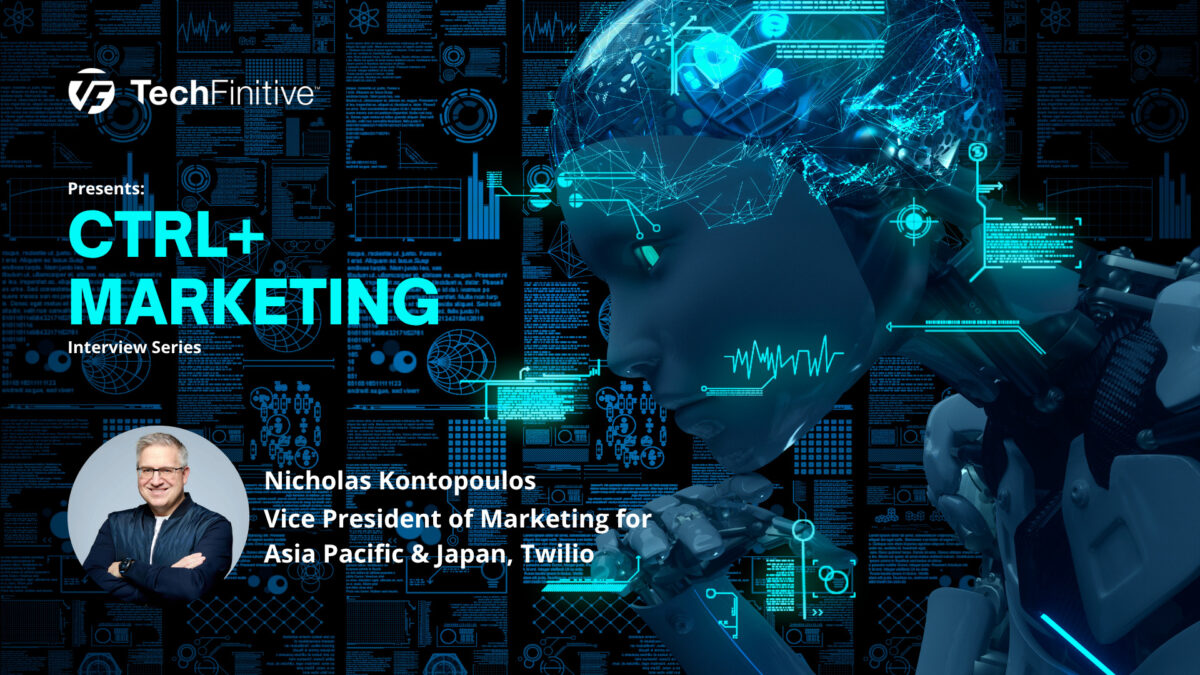
Nicholas Kontopoulos, VP of Marketing APJ at Twilio: “To unlock AI’s true potential, companies need to pair AI with customer data”

Table Of Contents−
- In your experience, how effective is AI at understanding and predicting customer behaviour compared to traditional methods?
- How can AI-enhanced marketing create a connection that feels authentic to the humans who receive the communications?
- Where do you think AI enhances brand trust, and where does it risk undermining it?
- How do you see the role of human marketers evolving alongside increasingly sophisticated AI systems?
- Data privacy and AI often come into tension. How do you balance personalisation with consumer privacy concerns?
- If you could give one piece of advice to marketing teams just starting to explore AI, what would it be?
- More interviews
“In 2024, AI will be like giving B2B marketing a sixth sense,” Nicholas Kontopoulos, VP of Marketing APJ at Twilio, told us last year. “Imagine ABM [Account-based marketing] with AI’s clairvoyance: hyper-personalised, almost intuitive customer dialogues, turning every interaction into a bespoke masterpiece.”
A year has passed and we edge closer to that vision, to the point that now Nicholas and his team are moving from the imagination stage to deployment. “AI-powered predictions allow businesses to target high-value users more effectively, optimise marketing strategies and improve customer retention and revenue growth,” he told us.
One website “reported a 10% improvement in click-through rates and over a 20% increase in open rates for campaigns built with Twilio’s AI Predictions”, he added.
So how do you take advantage in your job? Read on to discover the event that kickstarted Nicholas’ journey into this post-ChatGPT world, and his recommendations to any marketing professional who wants to enhance the way they work. Keep a pen and paper to hand, as there are action points to be noted!
And once you’ve digested this interview, we suggest you head read this article written by Nicholas on how to harness data to shape the brand experience in a post-cookie world.
In your experience, how effective is AI at understanding and predicting customer behaviour compared to traditional methods?
AI is an incredibly powerful tool, capable of processing vast amounts of data at a speed that simply isn’t impossible for us mortals. But it’s important to note that AI doesn’t negate the need for customer data – on the contrary, it demands much more of it. First and zero-party data remain the most reliable sources for understanding and predicting customer behaviour.
To unlock AI’s true potential, companies need to pair AI with customer data. More and more companies are relying on Customer Data Platforms (CDPs) in this context. CDPs help brands capture data from every customer interaction – be it the website, ads, emails, and other channels – and combine that with the data already in their system. It also cleans and governs that data, to ensure it is not only accurate but also respects consumer privacy. It is through these rich data points that brands can really get to know their customers on a whole new level, understanding customer preferences, behaviours, and context to create unified customer profiles.
When good data is combined with AI, the predictive capabilities are mind blowing and so is the ability to deliver meaningful business outcomes. AI-powered predictions allow businesses to target high-value users more effectively, optimise marketing strategies and improve customer retention and revenue growth. As an example, TradeMe, New Zealand’s largest online auction and classifieds website, reported a 10% improvement in click-through rates (CTR) and over a 20% increase in open rates for campaigns built with Twilio’s AI Predictions. The company also reported that audiences built with AI Predictions delivered 2-3x higher return on ad spend (ROAS).
How can AI-enhanced marketing create a connection that feels authentic to the humans who receive the communications?
We are seeing that consumers are becoming more comfortable interacting with AI as part of their engagement with brands, and even value its ability to help them interact and find the information they need faster. But what remains clear is that they still need human connection too – 54% of consumers globally want the option to interact with a human if their issue isn’t being resolved with AI.
Basic AI implementations, like traditional chatbots, often provide generic responses that consumers can spot a mile away. However newer AI-powered agents are very different, and can go beyond completing basic tasks to deliver personalised interactions. AI agents can now engage in natural, human-like conversations that understand nuance, context, and emotions. This kind of capability can then be combined with an off-ramp, or the ability to escalate to a human when needed. This approach reduces the strain on service agents, while freeing them up to deal with more complex issues that need a human touch.
Another important consideration is that – with or without AI – authenticity also comes down to the brand remaining true to its brand promise and identity, and keeping this consistent across channels. Consumers want to know what they are getting when they interact with your brand. They must receive the same level of service at every single engagement. If they get a different experience on the website vs the App, or quality differs from one product to the next, consumers are less likely to see your brand as authentic and reliable.
Where do you think AI enhances brand trust, and where does it risk undermining it?
Businesses are already starting to see very real operational benefits of AI-powered customer engagement. According to our recent 2025 State of Customer Engagement Report, 56% of brands globally now use AI to tailor experiences — from personalised content and recommendations to real-time support and dynamic offers — and 75% report increased customer spend. But whilst businesses are realising gains, consumers are still sceptical and lacking trust. And without consumer buy-in – any AI successes will be short lived.
AI can undermine consumer trust when brands are not transparent about how they are using the technology, or the customer data that fuels it. Our survey showed that more than half of consumers globally want to be informed when they are communicating with AI. Brands need to be upfront with AI use, and allow consumers autonomy over how they engage with AI.
If a consumer trusts your business enough to share their personal data, that should be repaid with a positive experience. This mutual exchange in itself builds trust. Positive consumer interactions will build loyalty. We are finding that most customers are receptive to AI that helps them find products and resolve issues faster, provide around the clock support and personalises their experience. When they aren’t seeing these benefits or when they don’t have the option of an off-ramp or to escalate to a human – trust and engagement start to wane.
How do you see the role of human marketers evolving alongside increasingly sophisticated AI systems?
No matter how much technology evolves, there will always be a critical role for human marketers. Technology alone cannot create good CX – instead it requires a blend of People, Process and Technology.
With increasingly sophisticated AI systems, customer service agents will not only be better equipped to do their jobs, but they will get more fulfillment from them too. In a number of industries, like utilities, you see service agents who genuinely want to help customers, but are hindered by legacy technologies. This leads to frustration and lack of trust for everyone involved. Giving customer service agents access to all the information that enables them to have meaningful conversations and be helpful to customers, will empower them and give them a sense of accomplishment.
Outside contact centre agents, the role of marketers more broadly will change with the empowerment that comes with intelligent AI systems. AI is already enabling hyper-personalised experiences and automating tasks, helping marketers build more targeted and ultimately successful campaigns. Equipped with deeper customer insights, marketers will be able to get more creative with campaigns and deliver levels of personalisation we never thought possible. For example, a consumer that is only interested in specific brand collaborations might receive tailored offers and content exclusively related to those partnerships. With so much real-time data at their fingertips, campaigns will be constantly fine-tuned and evolved, with so much room for improvement and growth. It’s a truly exciting time to be in this space.
Data privacy and AI often come into tension. How do you balance personalisation with consumer privacy concerns?
This will be one of the key factors that will define which businesses win or lose in the AI space. Data privacy remains of key importance to consumers – and most still don’t believe brands use their personal data in their best interest. It is possible to personalise without crossing privacy boundaries, but there are a number of layers of complexity to navigate.
Before even thinking about AI campaigns, marketers need to ask themselves if their businesses are truly AI-ready. Do you have a foundational data platform in place to ensure that you feed your AI clean, consented data? Do you have privacy policies in place, and is your team equipped to articulate these clearly to customers? Do you know how AI will be used, and if customers will be given autonomy over how they engage with the technology? How often are you reviewing data deletion processes to ensure compliance with retention policies?
Balancing personalisation with consumer privacy ultimately comes down to the means in which data is collected in the first place, how that data is used and how transparent companies are with consumers about both of these processes. Gen AI has made personalisation possible for more businesses than ever before – but the real winners will be those that build trust based on consent.
If you could give one piece of advice to marketing teams just starting to explore AI, what would it be?
My advice for marketing teams just starting to explore AI is simple: dive in and experiment with everyday tasks. I learned this firsthand. A few years ago, I struggled to condense my bio for an event to 50 words. Seemingly a very simple task, but it was taking more time and effort than I anticipated. After a few tries, I was still stuck at 53 words. I decided to try ChatGPT and in less than 10 seconds, it produced a better bio that fit the word count exactly. That experience opened my eyes, and I realised AI is a strong enabler in helping us do higher value work. I’ve been a strong AI advocate ever since.
I recommend teams to start by identifying those mundane, time-consuming tasks that bog down your team. Encourage everyone on the team, regardless of their technical background, to play around with readily available AI tools. The key is to foster a culture of curiosity and psychological safety, where team members feel comfortable trying new things and sharing their discoveries. By embedding AI into these routine workflows, your team will not only gain practical experience but also begin to understand AI’s potential to free up their time. This hands-on approach will build confidence and organically lead to more sophisticated AI applications down the line.
More interviews
- Rupert Bedell, Managing Director at Fasthosts: “IT teams will need to adopt a more customer-centric mindset”
- How Google’s Steven Nickel is revolutionizing device repairability
- James Harvey, CTO, EMEA, Rimini Street: “There is a temptation to follow the hype in IT, but we should not forget the basics”
About The Author

Rowan Campbell
NEXT UP


