Trending Topics

 Trending

How do you secure agents across the workflow? Lessons from ServiceNow’s World Forum 2026

Now that enterprises are starting to deploy AI agents at scale, they need to put guardrails in place. Fresh from the World Forum 2026, Sarah Kidner summarises the company’s key advice
The more you know, the more you realise you don’t know. It’s an adage, but one that increasingly applies to managing artificial intelligence across the enterprise. As attack surfaces expand and become less predictable, the tools designed to identify vulnerabilities can themselves create more work for already stretched security teams.
At ServiceNow’s World Forum 2026 in London this week, Maxime Chardome, Product Marketing Manager at ServiceNow, described how the traditional boundaries of IT security have become increasingly difficult to define.
“The IT scope was a well-known perimeter,” said Chardome, whilst acknowledging that IoT devices and more made things more complicated in recent years. But now we have AI agents roaming our networks.
“The new part, and the part that is sometimes worrying, is the adoption of non-human identities, AI agents and shadow AI. So, it’s no longer about an attack surface that is exploding, it’s just that it became very unpredictable.”
The pace of change is making those vulnerabilities harder to track.
“I used to say that your attack surface can change overnight, but now it can change every second if you don’t set the guardrails, if you don’t have the policies in place. AI-assisted coding introduces up to seventy-five percent more vulnerabilities, and in many cases, it takes more than hundreds of days before shadow AI is uncovered or discovered.”
A sobering picture of uncontained agentic security disruption
John Aisien, SVP, Central Product Management at ServiceNow, echoed the warning during the show’s keynote.
“Every workflow, every identity, and every fine-grained permission, and connected asset is part of an invisible but exponentially growing attack surface. And that’s just on-prem,” he said.
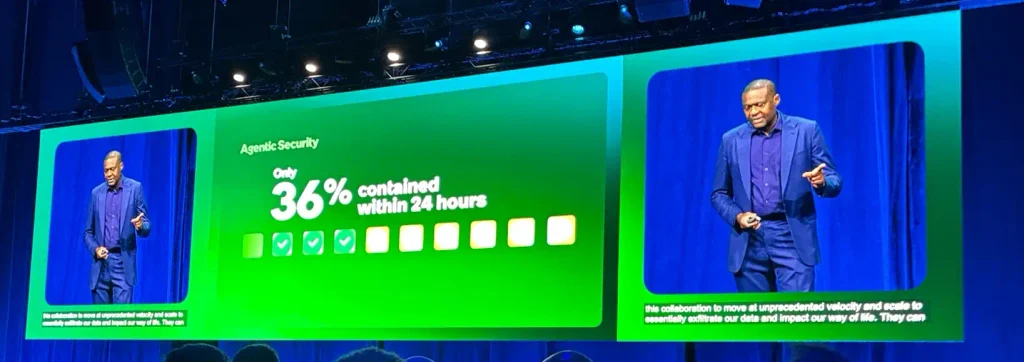
Aisien referenced a ServiceNow survey that revealed what he called “a sobering picture”.
The global survey of 3,700 security leaders identified a significant gap between the deployment and governance of AI agents.
Titled Deployed but ungoverned: The state of agentic security, the report found that:
- Only 34% of organisations automatically register new AI agents.
- 90% reported incidents last year, but just 36% contained them within 24 hours.
- 82% run AI agents in physical and operational technology systems.
“The challenge isn’t that organisations shouldn’t be using AI agents,” said Damian Stirrett, ServiceNow’s UK and Ireland Group Vice President and General Manager. “Far from it. There’s a huge opportunity here. But if you don’t know exactly what agents you’ve got running, what they’re accessing or who’s responsible for them, you’re leaving yourself exposed. And when something does go wrong, you need to be able to respond quickly.”
Too many vulnerabilities, not enough time
The problem isn’t necessarily a shortage of tools for identifying vulnerabilities. It’s what happens when those tools find more problems than security teams can realistically address.
“You hear about these frontier AI models, who can now uncover vulnerabilities that you didn’t even know you had. That will not be the solution,” said Chardome.
He referred to reports that Bank of America had recruited 1,000 additional contractors to address software vulnerabilities identified by Anthropic’s Mythos.
“It [Bank of America] had 3,000 full-time security employees, but they hired 1,000 contractors to deal with the new vulnerabilities. Instead of having more alerts, the solution must be to prioritise exposure reduction that factors in your business reality, the real attack paths that could touch your crown jewels, not static risk scoring.”
Shift Zero: a smarter approach to securing enterprise agents
ServiceNow argues that the answer isn’t simply to identify more vulnerabilities or respond to attacks faster. Its Shift Zero approach aims to prevent threats from becoming incidents in the first place.
“Attackers are collaborating on the deep dark web, and they’re using this collaboration to move at unprecedented velocity and scale to essentially exfiltrate our data and impact our workloads,” said Aisien.
“They can find weaknesses and write exploits literally in minutes and sometimes in seconds. So, we have literally a responsibility to react to it in real-time.”
He added that SecureNow’s “aspiration” was to reach zero alerts. “This is North Star. No more blind spots, no break-ins and spread, no agents running loose, no piles of alerts waiting for one person, waiting for the constantly catching up on that backlog.”
What does ServiceNow mean by Shift Zero?
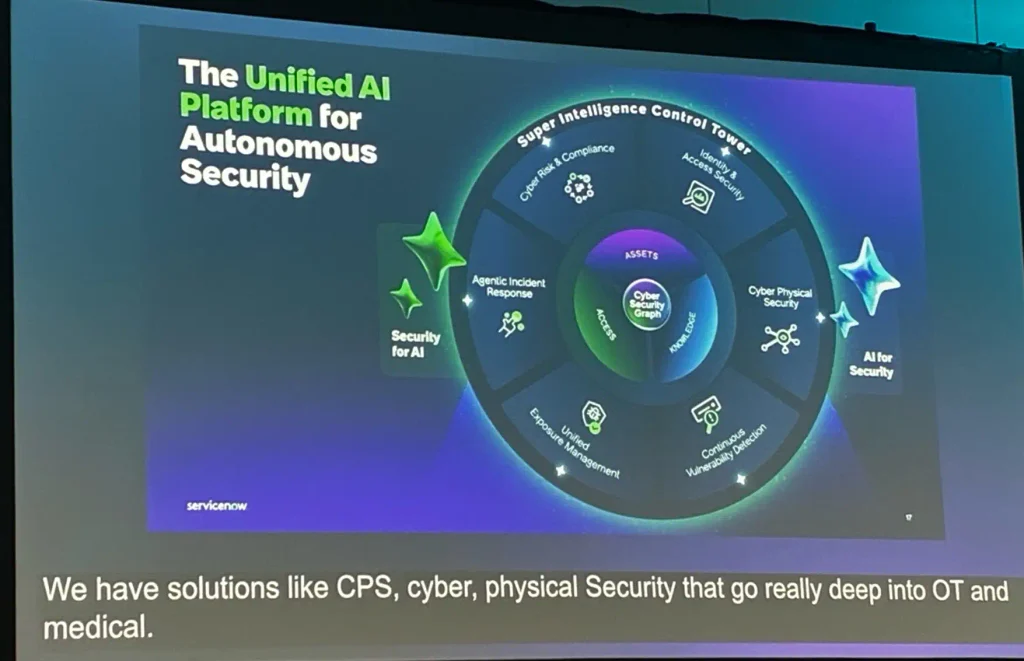
Earlier this year, the company launched its Autonomous Security Platform at Black Hat.
In a press release, it described Shift Zero as “the move from fragmented, reactive security to prevention embedded at every layer, where every system, identity, and agent is governed and secured in real-time as threats move at AI speed.”
The platform includes six solutions that integrate with ServiceNow’s AI Control Tower:
- Unified Exposure Management
- Continuous Vulnerability Detection
- Cyber-Physical Security
- Identity & Access Security
- Agentic Incident Response
- Cyber Risk and Compliance
Together, ServiceNow says these capabilities are designed to give security teams greater visibility of threats, prioritise vulnerabilities according to business risk and automate responses where appropriate.
Related articles
About The Author

Sarah Kidner
NEXT UP