Trending Topics

 Trending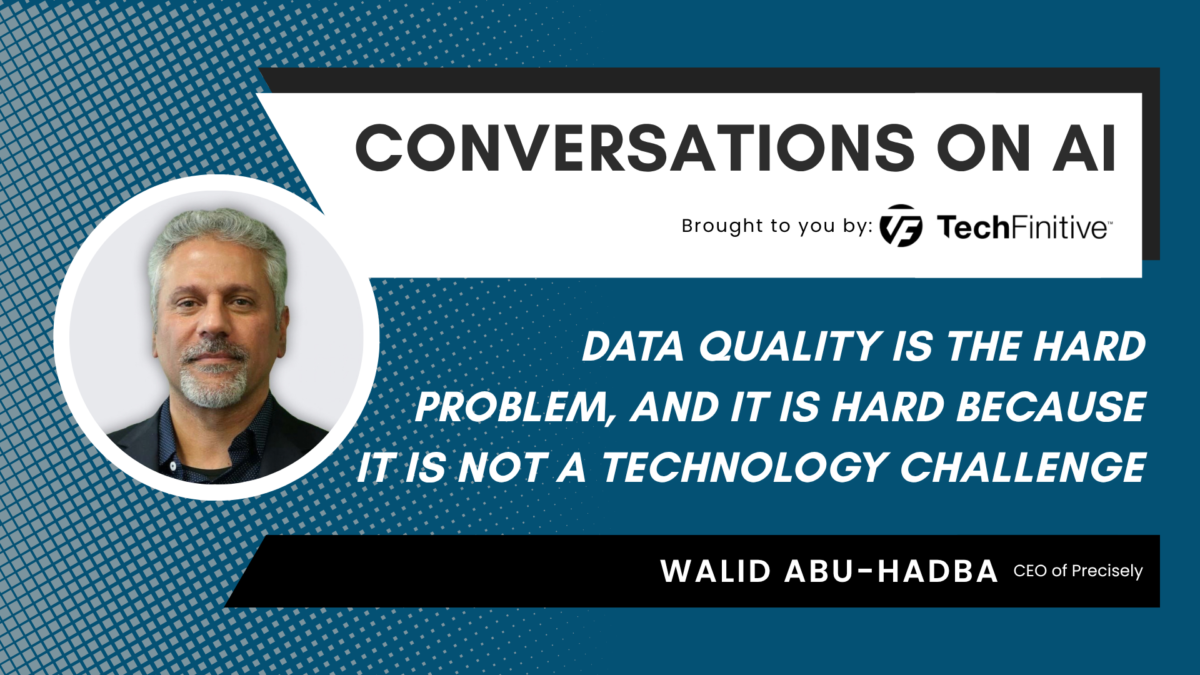
Walid Abu-Hadba, CEO of Precisely: “Data quality is the hard problem, and it is hard because it is not a technology challenge”

AI has become a fixture in software companies’ product roadmaps, but turning promising demonstrations into reliable business outcomes remains a challenge. For Walid Abu-Hadba, CEO of Precisely, the issue often comes down to something less glamorous than the latest model: the quality and integrity of the data behind it.
Precisely provides data integrity software, data and strategy consulting services to more than 12,000 organisations worldwide, including 95 of the Fortune 100. Abu-Hadba joined the company after serving as Chief Product Officer at Sage, having previously held senior roles at Oracle and ANSYS. He also spent more than 20 years at Microsoft, where he was Corporate Vice President responsible for the Developer and Platform Evangelism group.
Drawing on three decades in enterprise software, Abu-Hadba argues that the industry risks overestimating the capabilities of AI models while underestimating the work required to make them effective in production. Inconsistent records, missing context and poor governance can undermine even sophisticated systems, particularly as businesses begin to rely on AI agents to make decisions and take action.
His position challenges the idea that adding AI features is enough to differentiate a software product. The real test, he says, is whether customers achieve measurable results. That requires investment in data quality, traceability and governance, as well as a rethink of how enterprise applications are designed and used.
In this interview, Abu-Hadba discusses the gap between AI hype and enterprise adoption, why data readiness remains a major obstacle, and how agentic systems could reshape SaaS interfaces and workflows. He also explains why responsible AI should be a prerequisite for adoption rather than a constraint on innovation, and offers a clear message to software executives planning their AI strategies: start with the data, not the model.
Everyone says AI is transforming software, but where do you believe the industry is still overestimating its impact and where is it underestimating it?
The industry is still overestimating the model layer. There is enormous energy being invested in which model is smartest, which architecture is fastest, and which vendor is winning the benchmark race. Those things matter, but they can create a false sense of progress. AI often performs well in controlled testing environments because the data is clean, complete, and curated. The real challenge comes when those systems move into production and have to operate on enterprise data with all of its complexity, inconsistency, duplication, and missing context. That is where many AI initiatives break down.
The industry is also underestimating how much of AI will remain semi-autonomous for longer than the hype suggests. Fully autonomous AI is where the conversation is headed, but today only the most technically mature organizations are close to that reality. For most enterprises, the durable value will come from trusted, governed systems that can recommend, automate, and act within defined boundaries. That requires rethinking workflows, governance structures, data architecture, and how teams are organized. The companies that recognize AI is not something you bolt on, but something you build around, will move faster than those treating it as an incremental feature.
How has AI changed your company’s product roadmap over the past 18 months? Were there projects you accelerated, delayed or abandoned altogether?
AI has sharpened our product roadmap around one central priority: helping customers turn AI ambition into trusted business outcomes. We have accelerated capabilities that make data more accessible, more understandable, and more usable for AI-driven workflows. That includes Gio™, our generative AI assistant , which helps users find answers, navigate capabilities, and act on trusted data more easily. We are also applying what we are learning from our own AI transformation into product development, including capabilities that help customers operationalize AI responsibly and at scale.
What we have deprioritized is anything that feels like AI theater, features that let us claim the label without delivering substance. Customers are increasingly sophisticated enough to see through that. Our focus has been on capabilities that advance what we believe is the central challenge of this moment: helping enterprises build AI-ready data foundations, data that is visible, reliable, accountable, and complete so AI systems can act on it with confidence. We also see important work ahead as enterprises move from experimentation to broad adoption, including new capabilities planned for later this year and into early 2027.
That shift has also changed how we think about packaging knowledge into the product experience. The goal is not simply to add AI features, but to help customers embed trusted intelligence into how they work. That means building from the data foundation up, with the right governance, context, and controls in place from the start.
Many SaaS vendors now describe themselves as AI-powered. What actually separates companies creating real customer value from those simply adding AI features?
Outcomes. That is it. The test is not whether you have shipped an AI feature; it is whether your customers can point to a measurable business result that would not have been possible without it. Most AI-powered claims today survive a demo or a marketing headline. They do not always survive the move into production, where the system has to work with real data, real governance requirements, and real business consequences.
The companies creating real value are not treating AI as an add-on. They are building around it and, increasingly, running on it. That means AI is not isolated to one feature or one interface. It shapes the product architecture, the data foundation, the workflows, and the way customers make decisions. The differentiator is not the sophistication of a model alone. It is whether the company can help customers act on trusted, governed, context-rich data at scale.
At Precisely, we have made a deliberate choice to anchor our entire value proposition to that reality. We are not in the business of making AI feel exciting. We are in the business of making AI work, reliably, at scale, in the kinds of high-stakes enterprise environments where wrong answers have real consequences. That means lineage, quality scoring, governance, and enrichment. None of it is glamorous. All of it is essential.
What is the biggest misconception enterprise customers still have about adopting AI within business-critical software?
The biggest misconception is that AI readiness is a procurement decision. Organizations believe that if they buy the right platform, subscribe to the right cloud service, or partner with the right vendor, they will be AI-ready. But if everyone is using the same AI tools, differentiation does not come from the tools themselves. It comes from the trusted, governed, and context-rich data those tools can act on, and from the organization’s ability to manage risk, compliance, and accountability around how AI is used.
Without trusted data, AI does not work. That sounds simple, but the operational implications are significant. Before you invest in models, you need to invest in the integrity of your data. You need to know where it came from, whether it is accurate, whether it is consistent across systems, and whether it carries enough context for an autonomous or semi-autonomous system to act on it responsibly. Most enterprise data environments were not built with those requirements in mind.
What I tell customers is this: your AI strategy is only as strong as your data strategy, and your data strategy has to include governance from the beginning. That is not only about storage or pipelines. It is about trust, auditability, compliance, and risk management. The companies making durable progress on AI are treating the integrity of the data as a continuous strategic priority, not a one-time cleanup project. That shift in mindset is the real prerequisite for AI success, and it is the one that is still most commonly missed.
If you were launching your company today with AI available from day one, what would you build differently?
I would build the governance layer first. That probably sounds counterintuitive, given how much pressure there is to ship fast and move quickly. But having spent three decades building enterprise software, I have watched the same pattern repeat itself across every major platform shift: the teams that invest early in the infrastructure that makes things trustworthy are the ones that win long-term. The teams that defer governance until later spend the next several years paying down a debt that compounds faster than they can manage it.
Running on AI is not a future state. It shapes how you build products, how you market and sell them, how you operate internally, and how you support customers. If I were starting fresh today, I would make that assumption from line one of code. Every data pipeline would be designed with lineage built in. Every output would carry provenance. Every agent would operate within a governance framework that makes its decisions auditable. Not because regulators require it, but because customers making business-critical decisions on your outputs require it.
I would also build for trust explicitly, not retroactively. Trust is earned through transparency, and in the age of agentic AI, transparency means being able to answer the question: How did you get to that answer? Systems that cannot answer that question cleanly will not survive the scrutiny of enterprise deployment. The ones that can will become indispensable.
How is AI changing the role of your customers? Are you replacing repetitive work, augmenting decision-making, or fundamentally changing how people do their jobs?
All three, but not in equal measure across organizations. The honest answer is that the third one, fundamentally changing how people do their jobs, is still more aspiration than reality for most enterprises. What we are seeing in practice is a significant wave of repetitive task automation, and some meaningful augmentation of decision-making in areas where data quality is strong enough to support it. The fundamental transformation is coming, but it requires a level of data readiness that most organizations have not yet achieved.
What I find most interesting is how the nature of human contribution is shifting. As agents take on more of the operational workload, the execution, the synthesis, the routine decision-making, the premium on human judgment increases, not decreases. People are moving upstream. Their job is no longer to run the process; it is to set the direction, evaluate the outputs, and make the calls that require genuine contextual understanding and accountability. That is a more valuable role, not a diminished one.
We will apply AI in our own workflows and embed it into what we deliver to help customers move from experimentation to real outcomes, with data they can trust. The customers who are furthest along in this journey are the ones who have equipped their teams with the technology, budget, training, and resources to let agents handle appropriate execution while people focus on what actually requires human intelligence.
What has been the hardest challenge in bringing AI capabilities into your products?
Data quality, without question. Everything else, the model selection, the interface design, the integration architecture, is solvable. Data quality is the hard problem, and it is hard because it is not a technology challenge. It is an organizational one. Data quality is a function of how an enterprise has chosen to treat data over time: whether it invested in governance, whether it maintained lineage, whether it enforced consistency across systems. Most organizations did not, because for most of the past two decades, the consequences of inconsistent data were manageable. AI changes that calculus entirely.
AI has raised the stakes for every business. The ones that will win are the ones that get their data foundations right. That does not happen by accident; it requires discipline. In an agentic system, a data quality problem does not produce a bad dashboard; it produces a wrong action, at scale, before anyone catches it. That is a fundamentally different risk profile, and it forces a reckoning that many organizations are not prepared for.
The challenge we have taken on at Precisely is being the company that helps enterprises close that gap, not by telling them their data is a problem, but by giving them the tools, the frameworks, and the infrastructure to fix it systematically, and to keep it fixed as data continues to grow and move. That is genuinely hard work. It is also the most important work in enterprise AI right now.
Do you see the future as applications becoming collections of intelligent agents, or will conventional interfaces remain central?
The agent-first model will win, but it will take longer than the hype cycle suggests, and the transition will be messier than most people expect. The reason is simple: agents operate on trust, and trust has to be earned before enterprises are willing to let autonomous systems take consequential actions without human review. That trust is built one use case at a time, as organizations gain confidence that the data feeding the agents is reliable and the outputs are accountable.
Our sales team is already using AI agents in the field. We have a prototype of a Sales Quoting Agent, AskHR, and AI-powered tools that are changing how we operate day to day. These are early but real examples of what the agent-first model looks like in practice. Employees are not navigating menus or filling out forms; they are engaging with agents through natural language and getting work done.
That said, conventional interfaces will not disappear overnight. They will persist in domains where governance, compliance, or audit requirements create a preference for deterministic, traceable workflows. But over a three-to-five year horizon, the expectation that you need to log into a tool to get something done will feel as dated as the expectation that you need to call a bank branch to check your balance. The shift is directionally clear. The pace will be determined by how quickly enterprises can build the data foundations that make agent-first systems trustworthy.
How do you balance innovation with responsible AI? Where do you draw the line?
I do not think of it as a balance, because balance implies trade-off. The companies that are treating responsible AI as a constraint, something that slows them down, are misunderstanding the market they are operating in. Enterprise customers are not going to adopt AI systems they cannot explain to a board, a regulator, or a customer. Responsible AI is not the brake. It is the condition for adoption.
We will apply AI in our own workflows and embed it into what we deliver to help customers move from experimentation to real outcomes, with data they can trust. That phrase, data they can trust, is doing a lot of work. It means lineage. It means quality scoring. It means governance that is operational, not theoretical. It also means putting guardrails in place so people cannot push systems beyond appropriate boundaries, intentionally or unintentionally, without the right controls.
The line I draw is auditability. If a system cannot explain how it arrived at an output, it should not be making autonomous decisions in a business-critical context. Companies also have to assume that people will test boundaries, so responsible AI requires clear policies, access controls, monitoring, and escalation paths. That is not a conservative position; it is a practical one. The value of AI in the enterprise is its ability to act reliably and at scale. The moment an output cannot be traced or controlled, the reliability claim collapses. Speed without guardrails is not innovation. It is risk accumulation.
Beyond productivity gains, what business outcome are your customers most excited about when they invest in AI?
Confidence. That is the outcome I hear most consistently, and it is the one that does not get talked about enough in the AI conversation. Productivity is quantifiable and easy to put in a business case. Confidence is harder to measure, but it is what actually changes decision-making behavior at the leadership level.
When a customer knows their data is accurate, governed, and contextually rich, when they can trust the output of an AI system without having to second-guess it, they make faster decisions, they take more considered risks, and they act with more conviction. That is not a productivity gain. It is a capability gain. And it compounds over time in ways that productivity metrics do not fully capture.
AI has raised the stakes for every business. The ones that will win are the ones that get their data foundations right. What I see in our best customers is an organization that has made that investment and is now operating with a fundamentally different level of confidence in their AI outputs. They are not hedging their decisions against the possibility that the data is wrong. They are acting on it. That shift, from hedging to acting, is the outcome that changes the trajectory of a business.
Looking ahead three to five years, what part of today’s SaaS experience do you think will disappear because AI makes it obsolete?
The login. The dashboard. The static report. The workflow that requires a human to initiate every step. All of it will be displaced, not because it is technically possible to displace it today, but because the economics of agentic workflows will eventually make the manual alternative indefensible. Why would a finance team spend hours pulling data into a report that an agent could generate, validate, and distribute in minutes with higher accuracy?
What will survive is judgment. The interface of the future is not a dashboard; it is a conversation, a review, a decision. Humans will remain in the loop, but the loop will be much shorter, and the questions humans are asked to answer will be much more consequential. The operational overhead that consumes so much of knowledge worker time today, the data gathering, the formatting, the routine analysis, will be handled by agents. The output will land in front of a human who has the context and the accountability to decide what to do with it.
Running on AI is not a future state. It is happening now. The organizations that internalize that and restructure accordingly will be operating in a fundamentally different way three to five years from now. The ones that treat AI as an incremental feature will still be logging into dashboards and wondering why their competitors are moving faster.
If you could give one piece of advice to another SaaS executive planning their AI strategy today, what would it be?
Start with the data, not the model. I know that is not the exciting answer. The exciting answer involves model selection and agent orchestration and all the things that make for a compelling board presentation. But the companies I have seen make durable progress on AI, the ones where the technology is actually changing outcomes and not just appearing in demos, are universally the ones that started by asking hard questions about their data.
AI has raised the stakes for every business, and the ones that will win are the ones that get their data foundations right. That does not happen by accident; it requires discipline. It requires a commitment to data quality, lineage, governance, and enrichment that feels unglamorous until the moment your AI system produces a trusted, auditable output at scale and your competitor’s does not.
The model is a commodity. The data is your moat. Invest accordingly.
Recommended reading
About The Author

Ricardo Oliveira
NEXT UP