Trending Topics

 Trending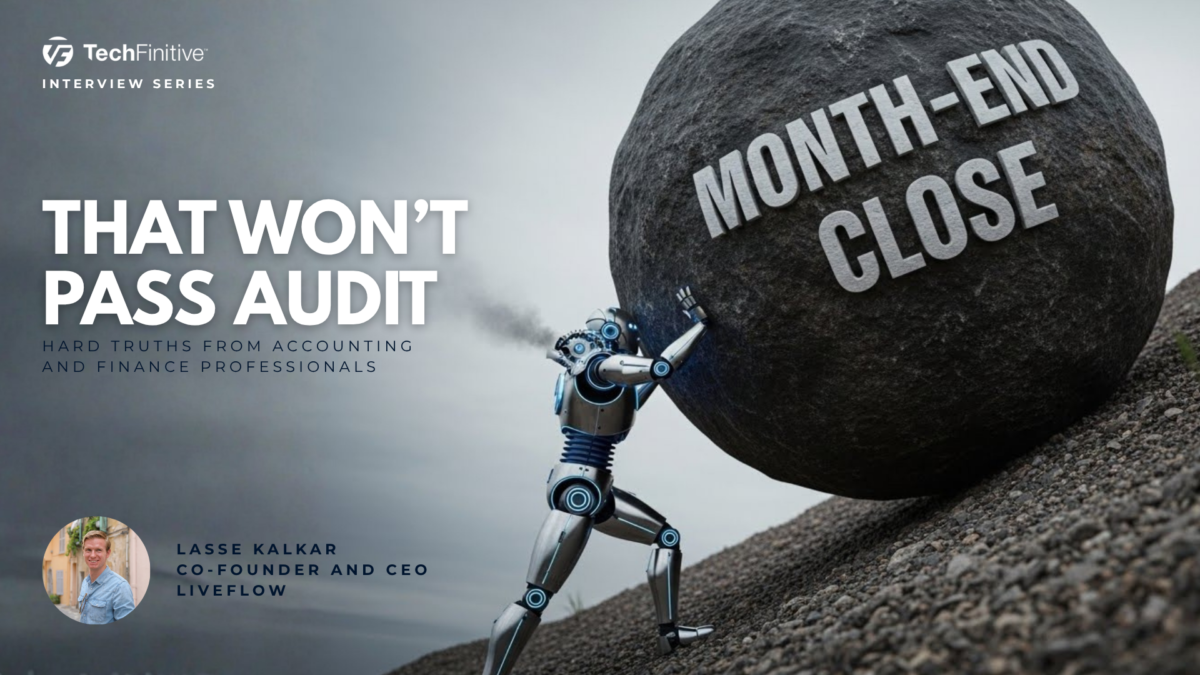
Lasse Kalkar, Co-Founder and CEO of LiveFlow: “AI adoption across finance will only accelerate”

With his background working as Head of Growth, Nordics at Revolut, Lasse Kalkar is used to navigating rapid expansion! As Founder and CEO of LiveFlow, he’s now rethinking how finance teams can operate in an AI-first world. For instance, helping businesses move beyond systems that have become outdated as the role of financial teams becomes more pivotal to the decision-making process.
In Kalkar’s view, that role has shifted faster than most organisations can keep up with. The move towards real-time data was already underway, but AI has been “such a disruption” that it has accelerated those changes significantly. Finance roles are now expected to operate as a “central operating hub” for the business, yet many still find themselves reliant on spreadsheets rather than adapting to new technologies.
These challenges tend to show up most clearly in day-to-day work. Processes like accruals and reconciliation remain heavily manual despite, as Kalkar points out, being “repetitive, rules-based and well-suited to automation”. The blocker in leaning into automation, he says, often comes down to trust. Spreadsheets still feel safer than newer systems that aren’t perceived as fully reliable, but that overreliance comes at a cost, introducing operational risk and limiting scale. As AI tools mature, the expectation is that confidence will follow, gradually reducing this reliance on manual work.
For finance leaders, Kalkar’s advice is simple: waiting is the bigger risk. As AI adoption accelerates, delaying the investment only leaves you a further step behind. Instead, he encourages teams to focus on automation at the core processes and build confidence from there. AI technology is set to continue to improve, but only those who are used to working with it and understand how it functions will see the greatest advantage.
So with a future in automation on the horizon, we wanted to know more about what changes we’re already seeing, and what that might yet mean for the future.
How has the role of the finance function changed in the last three to five years, and what do you think most organisations still underestimate about that shift?
We think of the finance function pre- and post- launch of ChatGPT in 2022 (although 2022 is the official launch date, we did not see formalized adoption of AI for finance teams till around early-mid 2024, based on our customer base). AI has been such a disruption that it’s hard to think about the trends that were well underway before AI, namely the shift to cloud, and overall digitization of the finance function.
Finance teams have actively started moving to shared workspaces and generally repositioning themselves from a largely siloed, backward-looking role to a central operating hub for the business. The work-from-home movement we saw during COVID pushed adoption further. This led to much more emphasis on real-time data and integrations, even in smaller businesses. As operators in this industry at the time, we saw a huge number of requests for forecasting software, budgeting tools that connect different parts of an organisation, and real time consolidation across countries.
This move to the cloud by finance teams had ripple effects. Desktop-based tools and file storage are being phased out in favor of cloud-native systems that support collaboration, scalability, and remote work. The planned wind-down of QuickBooks Desktop and the fact that nearly all modern ERPs are now cloud-first (e.g. NetSuite, Workday, Sage Intacct) reflect this shift.
Post-AI adoption, however, this move to the cloud seems obvious in hindsight, although it did not seem so at the time. Now, AI has accelerated the reason those trends were appearing in the first place. Finance teams are increasingly using AI for forecasting, anomaly detection, scenario modeling, and automation of routine workflows, among other things.
What many organisations still underestimate is the cybersecurity and governance implications of this evolution, both in the cloud era and in the AI era. As finance becomes more connected, cloud-based, and AI-enabled, it also becomes a prime target for cyberattacks, ironically by hackers using AI deepfakes. Companies that don’t have official AI governance policies and subscriptions in place will risk their employees using free, public AI tools to summarize, analyze, or draft financial documents without company approval, which can result in significant data leakage. The lack of transparency in AI systems makes it difficult to trace how data is used or if it has been exposed, greatly increasing risk.
Which accounting or finance processes are still far more manual than they should be, and what’s stopping teams from automating them?
All the accrual schedules. There is little justification today for updating accruals (eg: prepaid amortizations, depreciation, leases) in spreadsheets, yet many teams still rely on Excel for work that is repetitive, rules-based, and well-suited to automation. Another one we see in spreadsheets a lot is reconciliation. This is an activity that is very easy for an AI to do, but is usually outsourced or just delegated to someone junior instead of automating.
One major blocker is inertia. Finance teams tend to default to tools they trust, and if an automation product isn’t perceived as “100% there,” Excel feels safer and more controllable. Spreadsheets offer flexibility and familiarity, even though they introduce operational risk and don’t scale well.
Accuracy concerns also slow adoption, particularly with newer AI-powered tools. Finance teams are rightly cautious: AI systems have been shown to hallucinate or produce confident but incorrect outputs, and it can be hard to review. That said, this is a transitional phase. The problem will likely get worse before it gets better as AI adoption accelerates unevenly. Over time, however, operators will learn how to better train and constrain models, vendors will mature their products, and buyers will become more sophisticated, asking sharper questions about accuracy, controls, and accountability.
What are the biggest integration challenges between finance systems (ERP, payroll, billing, reporting), and how do they affect accuracy and agility?
The biggest challenge is definitely the workarounds that teams implement to deal with the lack of integrations altogether. Finance tech stacks are often highly fragmented. Teams use separate tools for A/P, A/R, payroll, and a different ERP. Other systems, like Salesforce, influence financial decisions but are managed separately. Niche industry tools for bookings or inventory add another layer of complexity. Many of these tools do not sync back to the ERP because they are too small or too customized to support integrations. As a result, finance teams rely on spreadsheets and manual copy-pasting. These workflows are time-consuming and prone to error, and add unnecessary risk to the process.
When integrations do exist, they create new problems. Connections can be brittle and require constant maintenance. Data sync issues are common. Many teams disable integrations because they were not working as expected or caused accounting errors, such as incorrect sales tax bookings. These issues delay close cycles and reduce trust in the numbers. The integrated data often diverges from what teams expect to see. Differences in payment logic and settlement timing can go unnoticed for months. In some cases, providers underpay without teams realizing it. Irregular sync schedules, especially over weekends, add more friction. Almost every team we work with has someone dedicated to reconciling between two systems that are supposedly integrated. This creates trust gaps across the ecosystem.
This model may begin to shift. Model-centric platforms and MCP-style architectures suggest a different approach. Instead of tightly coupling applications, systems can connect through a shared AI layer. Tools like ChatGPT show how users can query multiple data sources in an app-agnostic way. This could simplify how finance teams access and reason about data.
Accuracy, however, remains a risk. If AI is embedded only in the ERP and disconnected from systems like A/P or billing, it lacks context. Missing approvals, discussions, and audit trails can lead to misleading outputs. AI quality depends on complete information. Without strong connectivity or shared intelligence, both accuracy and agility suffer.
How do you balance speed and automation with control, auditability, and regulatory compliance?
Control within automation is less about slowing down and more about being deliberate with its applications. Responsible automation starts by breaking down problems into smaller workflows, and clearly separating the low-risk and high-risk areas. Those should remain tightly controlled. Automation should be applied to the truly manual, repeatable tasks, while preserving full visibility and override rights for anything that impacts compliance or financial statements.
Internally developed automation should be designed to align with existing SOX and internal control frameworks, and subject to rigorous stress testing before rollout. The capabilities and failures of the automation should be documented and staff should be trained accordingly.
If partnering with third-party vendors who offer automation, due diligence is critical. If an automated process fails, who is accountable? If responsibility sits with the vendor, it’s essential to understand how their models are trained, validated, monitored, and updated. If responsibility ultimately sits with the business (as it usually does) then systems must be stress-tested, auditable, and designed so that AI outputs are never made final or irreversible without proper review.
On review, another approach could be separation of duties within AI itself. Rather than relying on a single model to both execute and validate work, organisations could consider AI agents that perform tasks and separate agents (or rules-based controls) that review, flag, and challenge outputs. This mirrors traditional internal controls and makes automation far more defensible.
What’s one finance or accounting technology investment that delivered unexpected value, and why?
I’ll be completely biased here, but it’s the spreadsheet integration in LiveFlow. Let me explain – We’re a startup, and we decided to take our accounting in-house. We wanted to build Flow, a new ERP, so the first step was to learn what it takes to close the books in QuickBooks, something that our external bookkeepers were doing till that point. When we actually started using QuickBooks, we very quickly realized just how many times we had to copy paste data in a spreadsheet. We knew about the problem from our customers, and we’d built so many models to help FP&A functions, but experiencing a month end close from a bookkeeper’s point of view was a whole different experience. Suddenly, the simple, humble spreadsheet extension we had first built became invaluable. Unless you’ve built models yourself, the joy of having live data in a spreadsheet cannot be expressed. The convenience was incredible. We’ve built a lot of products on top of our basic product of course – budgeting and consolidation and other heavy hitters, but it’s the humble spreadsheet integration that unexpectedly was the tool that actually made the month end close experience much easier.
Outside of LiveFlow, using Claude for Excel has actually helped us build forecasting models faster. It still has a long way to go, but we’re seeing some very encouraging early signs already. Having this has helped us reduce the need for making complex or very dynamic formulas, because it’s now much faster to build adhoc models from scratch.
What advice would you give to finance leaders who are under pressure to ‘digitise’ but lack internal buy-in or technical resources?
Companies need to recognize that it’s actually riskier to wait. AI adoption across finance will only accelerate, and the cost of starting later, both financial and operational, will be meaningfully higher than starting now.
At this point, there’s no real excuse not to automate foundational finance processes. Many tools are purpose-built, cloud-based, and require far less technical lift than legacy transformations did. The bigger risk is doing nothing. If leadership doesn’t invest proactively and set guardrails, employees will inevitably start using free or unapproved AI tools on their own. That creates far greater exposure around data security, accuracy, and compliance than a controlled rollout ever would.
Finance professionals aren’t blind to the adoption change, and are increasingly looking to upskill themselves. If your company is not able to provide an environment where employees can learn and grow, you’ll lose talent to competitors. The upskilling argument also applies to finance leaders within the firm. They don’t need to become engineers, but they do need enough fluency to ask the right questions, evaluate vendors, and understand where automation and AI are appropriate. Teams that invest in education build confidence and reduce resistance.Finally, make the case internally by tying digitisation to concrete outcomes: risk reduction, faster closes, better visibility, and scalability. Where internal resources are limited, partnering with trusted vendors in the finance can dramatically reduce execution risk and accelerate impact.
Great stories from our newsroom
- Tanium appoints new Chief People Officer as it earns industry recognition
- Campari Group goes live with SAP cloud ERP system
- R-ai aims to disrupt paid media planning and buying with first purpose-built enterprise AI platform
- New research highlights dramatic shift in the type of tech skills required by companies… and you won’t need to guess what’s driving it
About The Author

Rowan Campbell
NEXT UP


