Trending Topics

 Trending
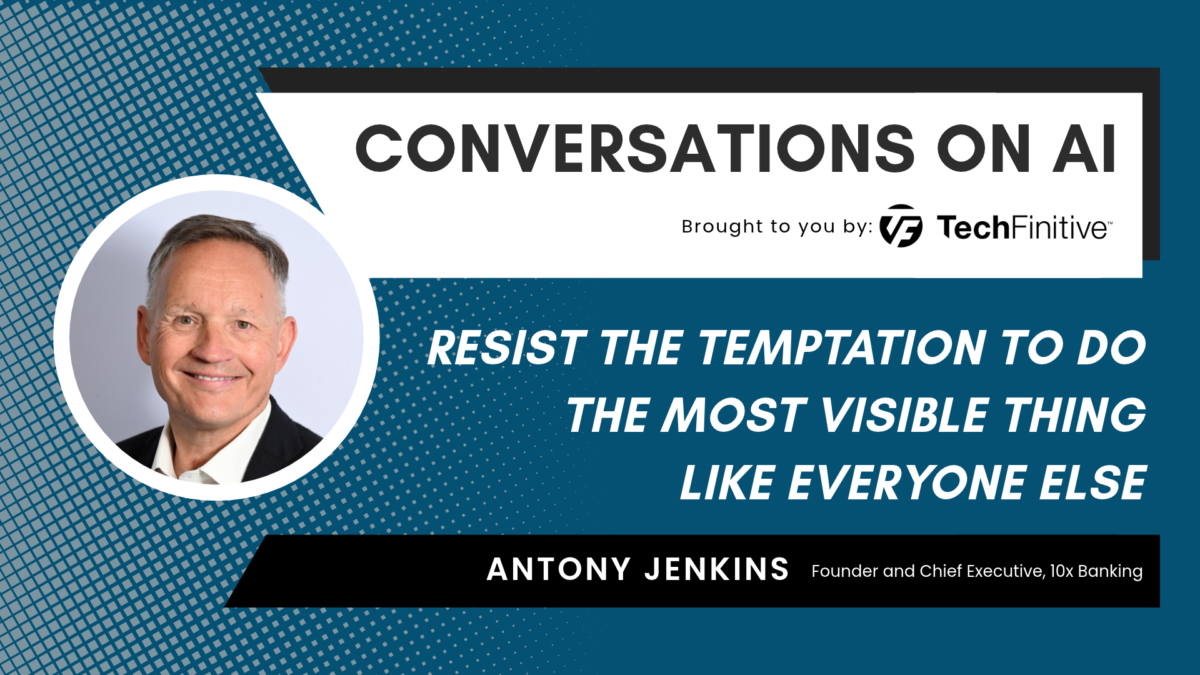
Antony Jenkins, Founder and Chief Executive, 10x Banking: “Resist the temptation to do the most visible thing like everyone else”

Much of what we see from AI is “theatre”, said Antony Jenkins CBE, the founder, chair and CEO of 10x Banking. “Most pilots won’t reach full production, and a new senior hire doesn’t equate to a business strategy. You can’t simply add AI to an existing product and call it transformation.”
As the man behind the fourth-generation core banking platform powering some of the world’s largest financial institutions, including Westpac and Chase UK, it should come as no surprise that his focus is on the strategic, business uses of AI – or applied AI. Or, as he said, “You can’t simply add AI to an existing product and call it transformation.” Rather, we should be “putting AI to work in the places where we’re already strong,” and, of course, that includes banking.
Back to basics: A focus on the fundamentals of business banking
The businesses that are adding value are, said Antony, the ones that have paid attention to the fundamentals first: “The businesses that are creating value have usually done a lot of the unglamorous building work first, as opposed to adding AI as a new layer on top of existing infrastructure.”
For businesses, there are a couple of simple ways to tell whether they are taking a strategic approach. “The quickest way to tell the difference is to ask what a customer can do now versus what they could achieve before – the difference between those things being the value added,” said Antony. And the second? “Whether you can say what your AI is doing and why.”
A focus on data is one of the fundamentals banks need to get right, said Antony, who served as CEO of Barclays, which he led from 2012 as part of his forty-year career. “Enterprises are being sold the idea that you procure a model, point it at the business, and wait for the results to roll in. It doesn’t work that way with business-critical software; there the return is determined by the quality of your data, processes and governance,” he said.
Antony has sympathy for people trying to implement AI in legacy systems. “When I was running a bank, we could see the possibilities of digital technology clearly but could not move at the speed we wanted because our underlying systems were built for another era of computing. Still today, in many institutions, the core systems are older than the people running them,” he said.
However, AI can help banks to accelerate change. “Building or changing a banking product used to take months of specialist effort. The foundations we’ve put in place mean we have brought that down to minutes. Once we show customers this, they naturally don’t want to go back to the old way,” said Antony, who founded 10x Banking in 2016.
Some things won’t change, and given he works in one of the world’s most regulated industries, it should come as little surprise that he says, “trust and control,” will have staying power.
Everyone says AI is transforming software, but where do you believe the industry is still overestimating its impact, and where is it underestimating it?
I always say that the impact of new technologies like AI is overestimated in the short-term and under-estimated in the long-term. Like any other technology, AI is a tool, not a magic wand. Right now, we’re in the phase where learning and execution are the most important factors in long-term success.
Much of what we see announced to date with regards to AI amounts to theatre.
Most pilots won’t reach full production, and a new senior hire doesn’t equate to a business strategy. You can’t simply add AI to an existing product and call it transformation.
The policy conversation around AI has a similar challenge, in that it assumes that owning the big models is the main objective. As an example, you can look to the conversations around tech sovereignty – in response to stories such as the US temporarily shutting off access to Anthropic’s model. The UK isn’t going to build its own ChatGPT, but it doesn’t need to.
Foundational models are a scale game that the US and China will win, which is why we must focus on applied AI and how quickly we can put AI to work in the places where we’re already strong.
This is obvious in banking.
Every bank wants to be an AI bank, but you can’t be that on a core built forty years ago, because the data AI needs is held in systems designed for overnight batch processing, and AI needs it in real time.
Many SaaS vendors now describe themselves as “AI-powered”. What separates companies creating real customer value from those simply adding AI features?
You’re right that most companies describing themselves as AI-powered have added new features rather than anything fundamental. The businesses that are creating value have usually done a lot of the unglamorous building work first, as opposed to adding AI as a new layer on top of existing infrastructure.
The quickest way to tell the difference is to ask what a customer can do now versus what they could achieve before – the difference between those things being the value added.
You need to build infrastructure that lets AI operate from real-time, clean data. For us that means a real-time, event-driven core banking platform. Without that, you are asking AI to operate on information that is out of date or out of shape, and that’s ultimately going to lead to poor performance.
There is a second test that separates those adding value from those adding features, which is whether you can say what your AI is doing and why. That’s not going to be optional in regulated industries, so if you can’t explain how a decision was reached, the feature will become a liability rather than a value-add. Capability like this has to be baked in to how the product works and how it uses and relies on data. Building in such a way is hard and unglamorous work, but it separates the winners from the ones left behind.
What is the biggest misconception enterprise customers still have about adopting AI within business-critical software?
That AI is something you buy rather than something you have to be ready for. Enterprises are being sold the idea that you procure a model, point it at the business, and wait for the results to roll in. It doesn’t work that way with business-critical software; there the return is determined by the quality of your data, processes and governance. Most large businesses aren’t in a position yet to earn much of a return.
I do have sympathy with this because I’ve seen it from the other side. When I was running a bank, we could see the possibilities of digital technology clearly but could not move at the speed we wanted because our underlying systems were built for another era of computing. Still today, in many institutions, the core systems are older than the people running them.
The second misconception follows from the first, which is that this can be done quietly at the edge without touching anything important.
Getting real value from AI in critical systems means modernising the foundation, with the right data, processes and governance underneath. Boards don’t like to hear that, but paying attention to it will decide whether your AI delivers or disappoints.
Looking ahead three to five years, what part of today’s SaaS experience do you think will disappear because AI makes it obsolete?
Firstly, the amount of manual configuration and navigation we currently look at as normal. Today’s SaaS experience revolves around learning, memorising and completing screens, menus and forms in order to make software do what you already know you want. What I suspect is that much of that will disappear in the next three to five years as we move to a situation in which you describe your desired outcome and the software configures itself to deliver it.
We see early versions of this in our own work at 10x Banking. Building or changing a banking product used to take months of specialist effort. The foundations we’ve put in place mean we have brought that down to minutes. Once we show customers this, they naturally don’t want to go back to the old way.
However, not everything will change. There are two things I would identify as having staying power. The first is the need for trust and control. An interface can become much simpler only if the platform beneath it is real-time, auditable and safe. In regulated industries, that requirement will only get stricter.
Secondly: people. Done properly, AI takes the drudgery and leaves the judgement, the creativity and the relationships, which is where the people in any business will always deliver the most.
Beyond productivity gains, what business outcome are your customers most excited about when they invest in AI?
Productivity is the first. But our customers are also excited about speed and the potential for growth it offers. Say you’re a bank which has previously been able to launch or change key products in months. Once you can do that in days, you no longer have to follow or react to the market. You can lead it.
The second outcome being talked about a lot right now is personalisation that holds up in practice. Personalisation has been a buzzword for over a decade, but now, with a real-time foundation feeding AI, you can actually respond to individual customers in way that’s relevant. That’s going to change the relationship between a bank and its customers and unlock revenue that was previously unreachable.
Underneath both is confidence, something that senior people care about a lot. The ability to adopt AI without betting the institution on it, because the data can be trusted and the platform is proven, live and in-market. No one I speak to is short of ideas as to what they can use AI for; they’re just short of the assurance that they can execute on those ideas safely.
If you could give one piece of advice to another SaaS executive planning their AI strategy today, what would it be?
Going back to my earlier answer: get AI-ready, not AI-powered. Resist the temptation to do the most visible thing like everyone else. You will be successful in five years if you use this period of disruption now to get your data and architecture in order, so that AI can be applied to the problems that matter and create value for your customers.
It’s hard work to do this because the results arrive a long time after the effort, but we have learned the lesson of this before, with the arrival of digital. Appointing a Chief Digital Officer never made a company digital, and hiring a head of AI will not make you an AI company.
So, I would say be realistic about whether you can earn a return and invest in readiness over headlines. Pick a real problem where AI can make a difference to your customers and execute properly.
The reason I would not wait is that the gap between the businesses that get AI-ready quickly and those that do not will be hard to close as time goes by.
Compounding advantages work that way.
Luckily the tools you need to get started are available now, and you don’t need to wait for the next budget round to begin.
You might also be interested
- The ten risks of adopting AI in HR systems…and the five you can solve yourself
- Saravana Sivanandham, Chief Product and Marketing Officer at Absorb Software: “In enterprise software, trust is not the speed brake. It is the precondition for it.”
- Eric Vaughan, CEO of IgniteTech, GFI Software and Khoros: “The traditional enterprise software model will not survive in its current form”
About The Author