Trending Topics

 Trending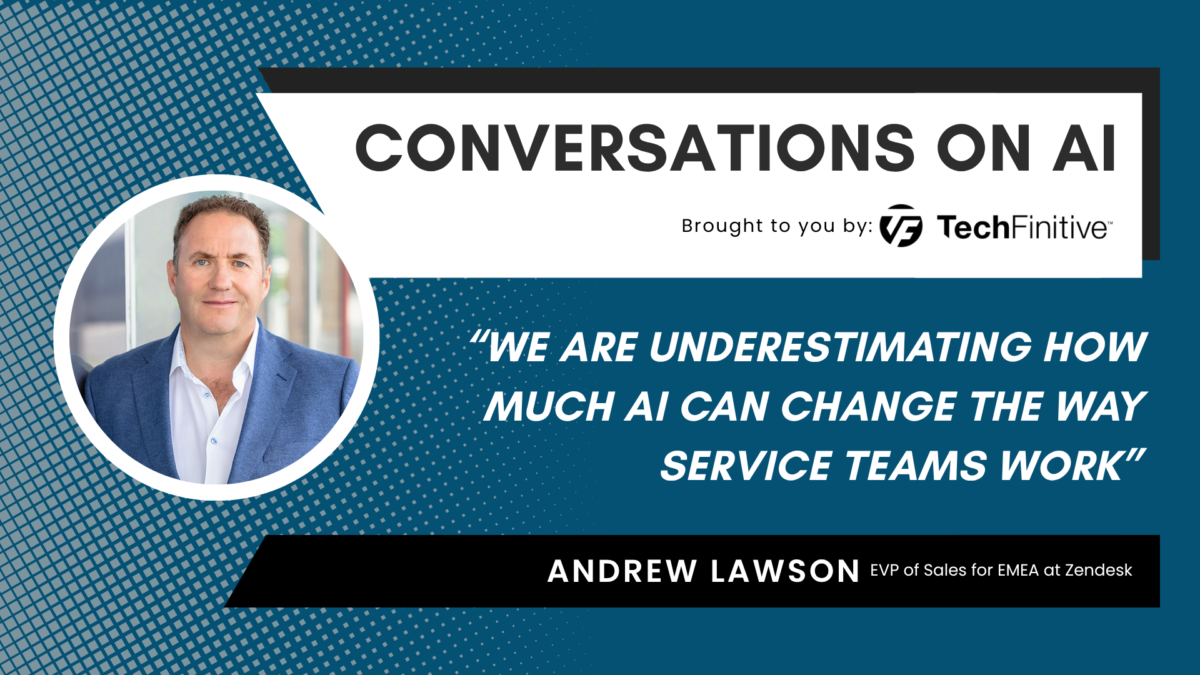
Andrew Lawson, EVP of Sales for EMEA at Zendesk: “We are underestimating how much AI can change the way service teams work”

Having enjoyed senior roles at both Oracle and Salesforce, Andrew Lawson has seen the impact great technology can have on companies first hand. Now Executive Vice President of Sales for EMEA at Zendesk, that’s truer than ever: he’s in prime position to help as organisations navigate the latest wave of AI-powered software.
That means Andrew also sees their common mistakes. “Adding an AI feature to an existing product does not necessarily improve the customer experience,” he explains, particularly in situations when poor data or fragmented systems are still slowing the underlying processes. Without proper foundations in place, moving beyond simple automation becomes an impossible task.
The real test of AI, Andrew argues, comes down to whether it solves a real customer problem. “Customers are not impressed by an AI label on its own,” says Andrew. They need to understand what the technology will improve, and how they will quantify it. When it comes to customer support, that means focusing on whether an issue was truly resolved, whether the customer was satisfied and whether the overall process was tangibly improved.
When it comes to customer support, he explains, “it helps to begin with the business problem”. That could mean reducing response times or extending support beyond regular hours. From there, organisations can narrow their testing, measure their outcomes and expand gradually. Starting small allows for businesses to learn from real interactions, prove their value and build the foundations for AI to scale across the business.
With AI adoption accelerating across the software industry, understanding where it can create the most value becomes quite the daunting task. That’s why we began by asking Andrew where he believes the industry is overestimating AI’s impact, and where yet it may still be underused.
Before we get into the interview itself, the first in our Conversations On AI series, here are a couple of things to know about Andrew Lawson the man. First, he’s a keen champion of diversity and inclusion, being recognised for two years in a row in Management Today’s Agents of Change power list. And despite being based in London, he’s a competitive sailor, loves skiing and is a Trustee of the activity-focused Andrew Simpson Foundation.
But back to business and those mistakes. We began our interview by asking Andrew where he believes the industry is overestimating AI’s impact, and where yet it may still be underused.
Everyone says AI is transforming software, but where do you believe the industry is still overestimating its impact and where is it underestimating it?
I think the industry sometimes overestimates what AI can do on its own. Adding an AI feature to an existing product does not necessarily improve the customer experience. If the data is poor or the process is confusing, AI may simply make the existing problem more complex.
Knowledge is a good example – if information sits in separate systems, AI may give different answers to the same question, which creates confusion for customers and agents. In fact, 86% of UK CX leaders say failing to connect siloed knowledge will cause AI to deliver inconsistent answers that erode customer trust.
At the same time, I think we are underestimating how much AI can change the way service teams work. This is not only about writing a response or summarising a conversation, AI can help understand what a customer needs, find the right information, take action across systems and involve a person when that makes sense. The opportunity is to move from managing a queue of tickets to solving customer problems. That requires good knowledge, clear processes and a way to measure whether the customer reached the right outcome.
As per Zendesk AI readiness checklist, companies need to prepare their wider CX operation rather than treat AI as a standalone technology project. The systems behind the scenes also need to connect AI with the right business tools and customer data. This allows AI to support tasks such as processing returns, verifying users and providing more relevant support. As AI handles more routine interactions, human teams have more time to focus on building stronger customer relationships.
Many SaaS vendors now describe themselves as “AI-powered.” What actually separates companies creating real customer value from those simply adding AI features?
The difference comes down to the resolution. Customers are not impressed by an AI label on its own, they want to understand what will improve and how they will know it is working. It needs to be backed by context to understand the customer and the situation, use the company’s own information and policies to take useful action, rather than simply producing an answer. A generic response has limited value in a service environment, customers need answers that reflect their issue.
The final test is measurement. A reduction in ticket volume does not necessarily mean a customer received a good answer, we need to look at whether the issue was resolved, whether the customer was satisfied and whether the process improved. That is why resolution matters: 91% of CX leaders in the UK agree that resolution is the new currency, and one unsolved issue now costs brands a customer for life.
The exact measure will vary by business, but the principle is clear: companies should focus on solving the customer’s problem, not simply moving the interaction somewhere else. At Zendesk, we are focused on verified, outcome-based pricing. Customers pay for resolutions that the AI agent completes and an independent evaluation confirms, routine exchanges and spam do not count. That gives customers a clearer connection between the technology and the value it delivers.
What is the biggest misconception enterprise customers still have about adopting AI within business-critical software?
Many businesses see AI as a technology decision. In practice, it touches much more than technology. It affects data, processes, people, security and the way a company measures success.
Some organisations start by asking which model they should choose, which may not be the best starting point. It helps to begin with the business problem. Are response times too slow? Are agents spending too much time searching for information? Does the business want to offer support outside normal working hours? The answer will shape the right use case.
Customers sometimes assume that AI adoption requires a large transformation all at once. It does not have to – many businesses start with a focused area where they can identify a problem and see the potential benefit, and they then measure the result. They can then learn from real customer interactions before expanding.
Readiness also needs to involve the wider business operation. Businesses need connected knowledge, clear processes, reliable data and people who understand how to manage the change. Zendesk’s AI readiness checklist puts strategic planning, operational preparation and continuous improvement at the centre of adoption.
How is AI changing the role of your customers? Are you replacing repetitive work, augmenting decision-making, or fundamentally changing how people do their jobs?
It can do all three, depending on the task.
Customer service teams deal with many repetitive requests. Agents may need to answer common questions, search for information, summarise conversations or follow a standard process. AI can help with much of that work, giving agents more time to focus on situations that need judgement, empathy or problem-solving.
Zendesk research shows that 88% of agents say AI allows them to focus more on creative problem-solving. It also shows that AI can improve confidence and help agents handle more complex customer interactions.
AI can support decision-making as well. It can bring together customer history, relevant information and suggested next steps, helping agents make a more informed decision. It can also help managers understand the issues customers raise and identify gaps in knowledge or process.
The role itself may change over time. Agents may spend less time handling every request from start to finish and more time overseeing AI, improving the knowledge behind it and stepping in when a situation needs human judgement. Zendesk research also found that 93% of admins say AI has allowed them to shift their focus from routine management tasks to more strategic planning and decision-making.
So it is not simply about replacement, it is about redesigning work. AI handles more predictable activity, while people focus on complex problems, relationships, product expertise and service improvement. The best outcomes will come from combining the two.
How do you balance innovation with responsible AI? Where do you draw the line between moving quickly and ensuring customers can trust the outputs?
I do not see innovation and responsibility as opposing ideas. When AI supports a customer-facing experience, trust is a part of the product.
Transparency: customers should know when they are interacting with AI. They should understand what information the system uses and what it can do. Most importantly, they should have a clear route to a person for escalations, when the issue is sensitive or the system does not have enough confidence.
Knowledge: AI tends to work better when it can use the company’s own knowledge, policies and procedures. When knowledge remains disconnected, the system may produce inconsistent answers. That helps explain why 86% of UK CX leaders are concerned that siloed knowledge will damage trust.
Zendesk’s AI principles focus on privacy, security, accuracy, transparency and customer control. Those principles help guide how the technology is developed and deployed.
In the end, moving quickly remains important. But so does being open about the risks – customers respond well when companies explain what the technology can do, where it has limits and how they plan to improve it.
Beyond productivity gains, what business outcome are your customers most excited about when they invest in AI?
Beyond productivity, customers are looking for better service at a sustainable cost. They want faster answers, but they also want those answers to feel relevant and useful. 88% of UK CX leaders agree that customers expect fast, seamless service across every channel. Another 88% say that instant response is now the baseline, anything slower feels broken.
Speed alone is not enough, though. Customers want their issue resolved without repeating themselves or being passed between teams. That is why first-contact resolution matters: 90% of CX leaders in the UK say customers will drop brands that cannot resolve issues on first contact, regardless of the channel.
AI can help businesses meet that expectation. It can understand the request, find the right information, take action and bring in a human when the situation needs judgement or empathy. The best experiences should feel simple to the customer, even when several systems are working behind the scenes.
That helps explain why 90% of UK CX leaders expect their investment in AI for customer service to increase over the next year. The focus should not be on adding AI for its own sake – start with the customer problem, define the outcome you want and build trust into the experience from the beginning. Then measure whether the customer actually reached a satisfying resolution.
About The Author