Trending Topics

 Trending
View from the Valley: Don’t call it a war

Our man in San Francisco explains that the “military operation” in Iran continues to have an outsized impact on tech firms… but at least their CEOs get to guide US science and technology policy
Last month’s missive about the use of AI in combat turned out to be unfortunately prescient: the day after filing, the US launched its military “operation” against Iran.
Amazon was one of the first tech companies this caused problems for. On 1 March, the cloud giant reported that three of its data centre sites had been damaged by Iranian drones, and it didn’t stop there. By the end of the month Iranian state media reported that the regime will be targeting Western companies that operate in the Gulf, including Apple, Google, Meta and Microsoft.
And it’s not only data centres that are under attack. Turns out the cable data links in the Gulf are also vulnerable to something as simple as a ship’s anchor.
Let me tell you, the mood in Silicon Valley is not good. The promised speedy victory shows no sign of being delivered and people are pissed off, with eight million folks taking to the streets for another No Kings demonstration last weekend.
Unless the Trump administration can wrap this up quickly, the populace, and the tech folks who funded Trump’s campaign, are going to be asking serious questions. As for physically invading Iran… allow me to point out that it’s five times the size of Vietnam and just as prickly.
San Francisco’s security week: part one, RSAC
Speaking of poorly managed security, the annual RSAC conference took place in San Francisco this month, and showed a similar level of organisation to the current US military campaign.
On the show’s busiest day, the queue to sign in was literally a mile long (a mate measured it on his Fitbit) as thousands of attendees were faced with only 21 laptops to input their details. They then needed to join another line to pick up a badge. That all happened on the Tuesday, a day we veterans know to avoid. But even on the Sunday and Monday, the lines were far worse than usual.
Queues aside, the 40,000 attendees enjoyed some excellent talks. This despite the fact that, remarkably for an RSAC event, the US Government sent no speakers. In fact, it pulled out of several sessions after the former Head of the Cybersecurity and Infrastructure Security Agency, Jen Easterly, was appointed as CEO of RSAC.
Easterly is a well-respected member of the cyber security community but someone the current administration has problems with. After all, she had the temerity to investigate foreign powers trying to influence American voters with misinformation.
While serving government members stayed away, four former heads of the NSA and Cyber Command took part in a panel on incoming threats. And it was quite a line-up. General Keith Alexander (2005 to 2014); General Mike Rogers (2014 to 2018); General Paul Nakasone (2018 to 2023); and finally his successor Air Force General Timothy Haugh (2023 to 2025).
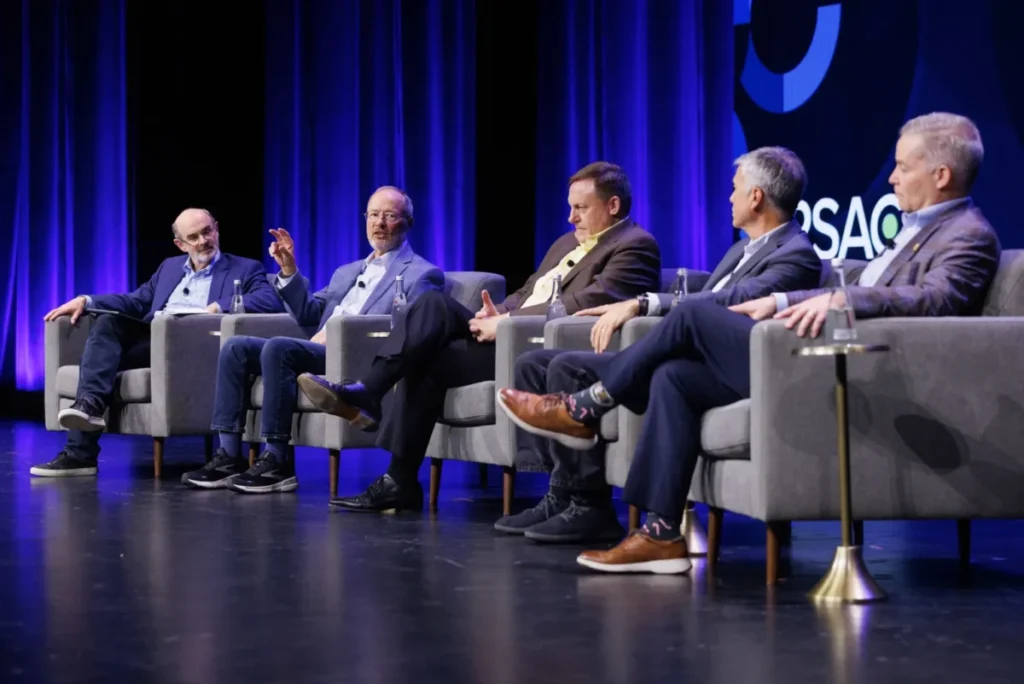
All four explained how the role of cyber actions have influenced America’s online warfare. The message was blunt: the agency will act and any future war won’t just be about rockets and bombs, but IT as well.
They pointed out that any military action is now a combined operation and it’s the job of cyber warriors to shut down systems before the aircraft start flying and boots go on the ground. Whether politicians will understand this remains to be seen, they warned. What a shame there weren’t any Trump administration politicians there to take heed.
San Francisco’s security week: part two, BSidesSF
There was also a lot of talk about how nice the city was. If you believe some of the media, then visitors to San Francisco should expect to be attacked by crack-addicted, AIDS-infested rabid pit bulls smeared in excrement. Not so: the city remains very normal.
RSAC wasn’t the only show in town. BSidesSF is the cool younger brother of RSAC and one speaker, bug-bounty legend Katie Moussouris, got the first standing ovation in recent memory by urging security workers to keep control of AI and keep a human hand on the steering wheel.
Moussouris has form. In 2013 she convinced Microsoft to stop prosecuting flaw finders and pay them instead, then did the same with the Pentagon three years later. But with AI automating many features she argued it’s time to put the brakes on.
One section of her talk really struck a nerve. The UN World Food Programme has forecast it could end world hunger in a decade for $40bn a year. This year alone, five tech companies committed $660 to $690bn to AI infrastructure. Something to ponder.
Science, we’ve heard of it
Last week the current administration announced the 13 members of the President’s Council of Advisors on Science and Technology. These esteemed individuals will guide American policy on science and technology, and include one professional scientist and a heck of a lot of tech CEOs.
VC uberlord Marc Andreessen, Google Co-Founder Sergey Brin, Oracle’s Safra Catz, Michael Dell, Mark Zuckerberg, Larry Ellison, Jensen Huang and AMD’s Lisa Su are all on the list. The sole scientist on the panel, John Martinis, is a professor at UC Santa Barbara with a speciality in quantum computing.
The council, set up but executive order in January, will have a large say in how technology policy is formulated going forward. Given its makeup, it seems the tech barbarians have stormed the gates and are making themselves quite comfortable in power.
Is this a good point to remind everyone that tech moguls funded the current Trump regime?
Yet more tech layoffs
Layoffs haven’t stopped in the Valley, with Meta dropping a few hundred staff and Oracle reportedly giving thousands their marching orders. The old days of a tech job being for life are well and truly gone.
The biggest tech firms, who went on a hiring spree during lockdown, are frantically shedding staff to meet financial targets and fund AI infrastructure spending, bombed or not. I haven’t seen this level of gloom over the job market since 2008, and there are no signs it’s getting better.
As we saw with Block’s announcement that it was laying off 40% of staff last month, tech firms are more than willing to wield the axe if they think it’s necessary. The problem, as one now-ex Oracle employee explained, is that businesses have been convinced that AI can do a “good enough” job with minimal human supervision.
“It’s like when Microsoft launched Office,” she said. “It wasn’t on a par with Lotus or WordPerfect, but it was cheap and got the job done in an OK manner. AI’s doing that to tech workers right now. But it made Bill Gates rich at least. God help the rest of us.”
More by Iain Thomson
- View from the Valley: Rise of the robots, job threat from AI, and why it’s time to show us the money
- View from the Valley: The AI wars have begun, but keep ChatGPT’s fingers off the red button
- The death of fragmented data: A guide for portfolio managers
- Letter from America: How Trump’s first year has transformed the US technology scene
About The Author

Iain Thomson
NEXT UP


