Trending Topics

 Trending
View from the Valley: The AI wars have begun, but keep ChatGPT’s fingers off the red button

All is not peace and love in the US Department of War. We hear that US Defense Secretary Pete Hegseth ripped a strip off of Claude’s Co-Founder Dario Amodei over the use of AI by the government in the Land of the Free.
The fight started after Anthropic refused to remove the guide rails from its machine learning systems to suit the Pentagon’s requirements.
Amodei said the department had threatened to block it from government contracts and place it on an embargo list if the company didn’t allow the engine behind Claude to be used for “fully autonomous weapons” and “mass domestic surveillance”.
“We cannot in good conscience accede to their request,” Amodei said in a public statement.
Staffers at Google’s AI division and OpenAI have joined in, with over 200 backing Anthropic’s position. And who knows, maybe this could save all our lives…
AI wargames
This month, a paper on using AI in wargames showed that when GPT-5.2, Claude Sonnet 4 and Gemini 3 Flash were put charge, the LLMs fired off tactical nuclear weapons in 95% of scenarios .
“The nuclear taboo is no impediment to nuclear escalation,” the boffins found. Someone should teach LLMs about the effects of electromagnetic pulses on servers to build in some survival instinct.
Meanwhile, American chip companies AMD and Nvidia have reportedly been locked out of testing for China’s latest v4 build of the domestic DeepSeek engine.
Chinese companies like Huawei got early access to the model for testing but not American firms. Is this a bamboo curtain in the making? That’s the concern for AI developers in the US, who believe China may not be as open with American competitors as it has been.
Unlikely bedfellows
On the domestic front, AI is making Silicon Valley techies worried about their jobs. And these concerns are spreading to unusual places further afield, as we shall discover.
Let’s start with the US tech industry, which has shed hundreds of thousands of staff in the past two years. AI efficiencies was cited as the cause in many cases. There’s no sign of this abating, with Twitter Co-Founder Jack Dorsey shocking the Valley this month by laying off 40% of his Block payments company workforce. He said he was just getting ahead of the AI situation. Block’s stock price shot up by up over 20% after the announcement.
The same was not true for IBM, which saw its stock plummet in value this week thanks to a release from Anthropic saying it had developed Claude code that could potentially replace COBOL programmers.
The ancient programming language has been a cash cow for Big Blue for many years, and the thought of replacing venerable and very expensive programming know-how with AI wasn’t good news for IBM accountants.
We’ll see. As one IBM and COBOL veteran told me: “Writing it is one thing, getting it to run smoothly is quite another.”
Others are equally sceptical about AI’s supposed productivity gains. As The Economist points out, claimed productivity gains haven’t yet materialised in the US and show little sign of being the big boost some are claiming.

Leaving aside techies, there’s been an unusual case at Sheri’s Ranch in Nevada, one of the state’s oldest brothels. Its ladies of negotiable affection have been issued new contracts signing over their images, videos and writing for use in AI agents controlled by their employers. The staff went on strike, and then unionised with the Communications Workers of America as the United Brothel Workers, campaigning under the slogan “Bust Nuts, Not Unions!”
It might sound inconsequential but such identity rights are going to be much more important in the years ahead. Denmark has become the first nation I’m aware of to promise a guarantee consent before using someone’s digital likeness, and more laws are likely.
President Trump breaks another record
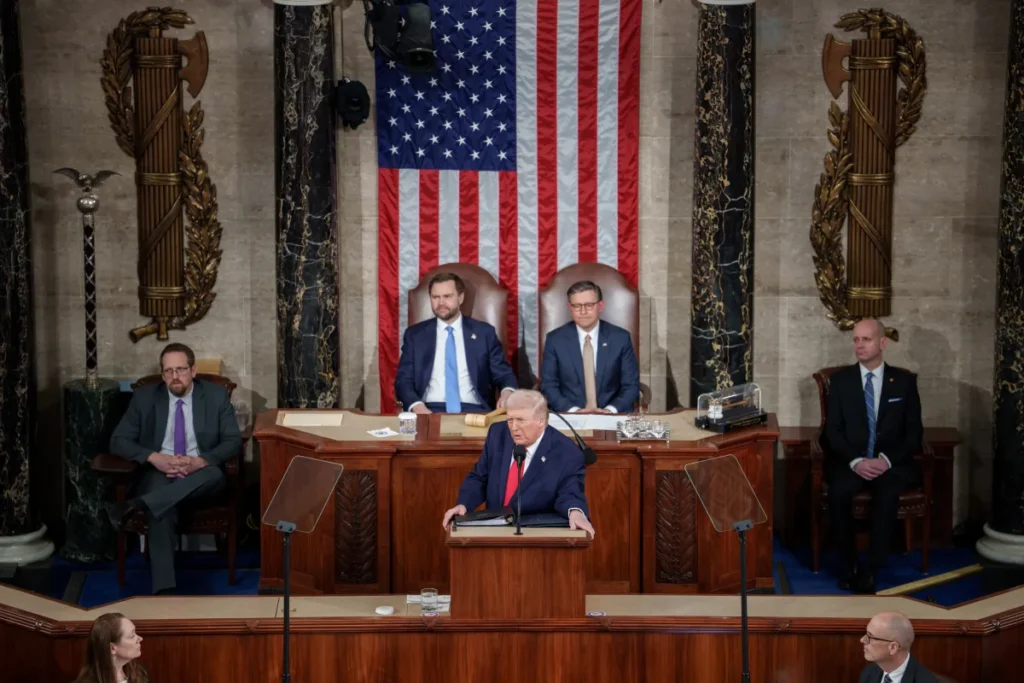
To cap the month off, President Trump issued his State of the Union address, the longest in US history at one hour and 48 minutes. It felt like longer for those of us watching so you don’t have to.
Tariffs are still on the table. Despite the Supreme Court striking down around half of those announced by the president, he’s doubled down with a global 15% rate, so prices for IT equipment – and many other things – won’t be falling. If money from tariffs that were ruled illegal is returned it’ll go to businesses, so don’t expect a personal rebate for your inflated costs.
The only other announcement of note was that AI data centres will agree to generate their own power onsite at some point in the future and bring down power costs, it’s claimed. Quite how this will be achieved is another matter. Trump might get some hyperscalers to sign up, and is very keen on nuclear power, but even the most advanced of such systems are a year or two away from prototype stage.
Without more evidence, treat this with the same respect you’d give an Elon prediction.
Related articles
About The Author

Iain Thomson
NEXT UP


