Trending Topics

 Trending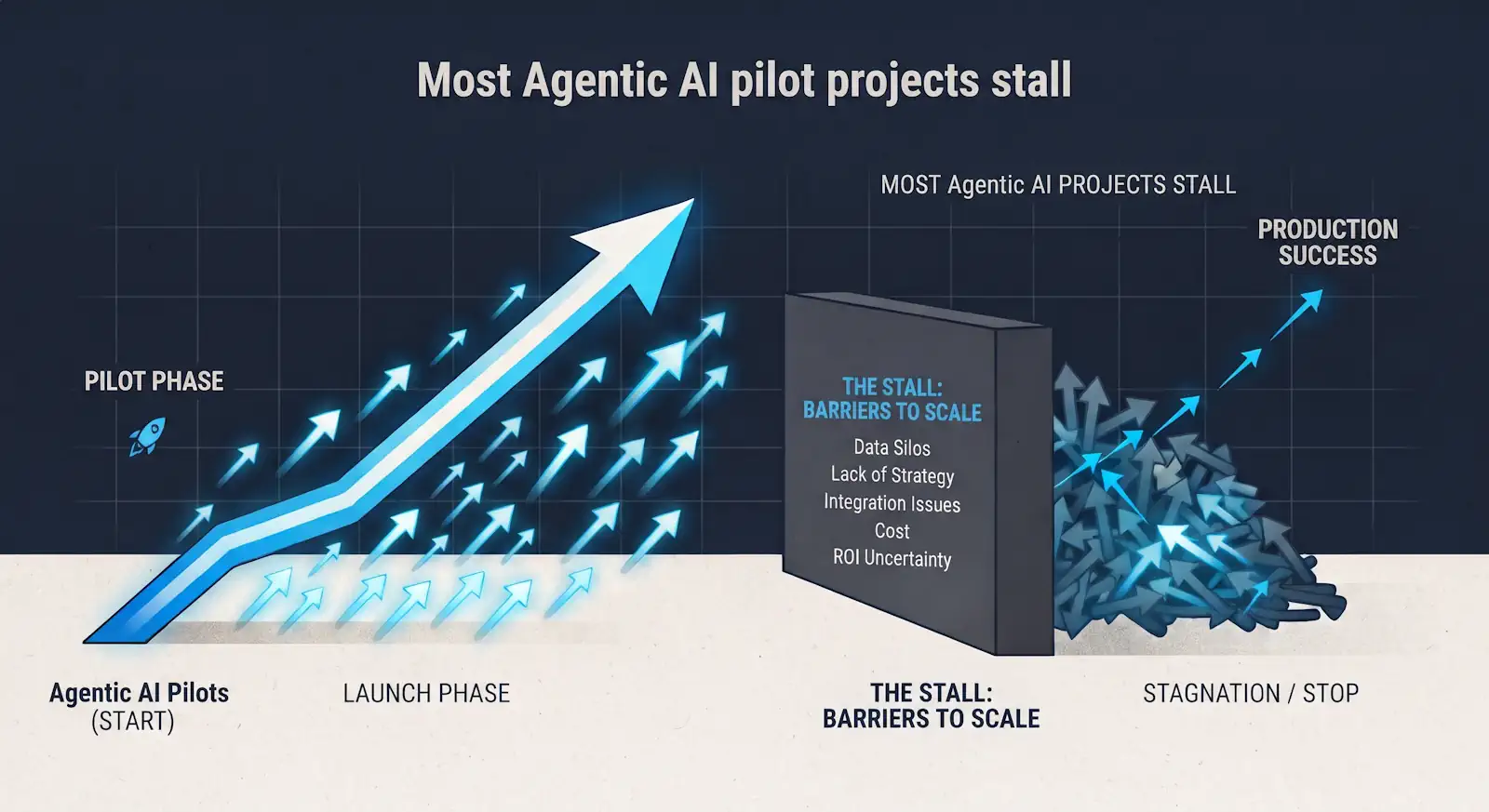
From pilot to production: Why most agentic AI projects stall before scale

This article is part of our Opinions section, where we invite industry professionals to share their views on the most pressing technology questions of our time.
The modern enterprise is currently caught in a fascinating, albeit expensive, illusion. Over the last eighteen months, the narrative surrounding agentic artificial intelligence (AI) has been dominated by triumphant press releases and internal celebration. On paper, pilots are flying. Agents are summarising complex contracts, drafting compliance briefs, and auto-approving low-tier procurement requests with astonishing speed. Business unit leaders are declaring victory, pointing to successful initial runs where autonomous workflows completed their assigned tasks without a single system-level crash.
Yet, if you look under the hood at actual enterprise-wide deployments, a glaring gap emerges. Gartner’s 2026 CIO Survey revealed a stark disconnect: While roughly 75% of technology leaders claim some form of agentic AI adoption, only about 11% are running truly production-ready systems, and just 17% have deployed agents at scale.
Enterprise AI strategy is stalling because there is a massive gap between how much AI companies claim to use and what actually works in daily operations. The uncomfortable truth leadership teams face today is that a successful pilot is not proof of production readiness; it is merely proof that an autonomous model can function under engineered, highly artificial conditions.
Agents don’t just execute steps; they make decisions
The primary reason teams struggle to bridge this gap stems from a fundamental misunderstanding of what scaling an agent actually entails. Traditional software scales by solving technical bottlenecks: you add server power, speed up database queries, and expand system limits to handle more users. With standard deterministic automation, if a system executes a step for ten invoices, it can execute that exact same step for ten thousand.
Agentic AI operates under an entirely different paradigm. Agents do not merely execute pre-written sequences; they interpret contextual inputs, synthesise unstructured data, and make autonomous decisions.
In a pilot environment, agents appear flawless because human supervision is hyper-vigilant and the initial scope is deliberately sanitised. The agent is fed pristine sample documents, edge cases are filtered out by engineers before reaching the model, and subject matter experts are hovering over the interface to catch anomalies.
Production, however, is where enterprise messiness lives. When you deploy an agent into live contracts, vendor compliance checks, or cross-border regulatory approvals at volume, the agent is immediately bombarded with ambiguous documents, conflicting clause hierarchies, and subtle judgment calls that never surfaced in the lab. Scaling an agent is not a matter of giving it a longer leash. It’s a matter of ensuring your enterprise architecture and governance models can withstand the volume of autonomous judgments being made simultaneously.
Think about the scenario where you are letting agents review documents for verbiage or clauses that don’t align with your corporate standards. During testing, your samples are tightly controlled, and the documents are created to align with the agent’s recommendation. Whilst in production, you have no control over what a customer could include/edit/update in that document that can throw off your agent’s intent completely. The cost of this could amount to millions in lost revenue or expose your company to liabilities.
Four signs an agentic AI project is stalling before scale
When an agentic initiative begins to crumble under the weight of production requirements, the underlying failure points are rarely found in the model’s weights or context window limits. Forrester’s 2026 Enterprise Research confirmed this reality, showing that 88% of agent pilots never successfully graduate to production. The primary blockers cited were evaluation gaps, governance friction, and model reliability.
Governance friction, not the raw AI technology itself, is doing the vast majority of the damage. In reviewing stall points across high-stakes enterprise environments, four warning signs consistently emerge:
- Missing or Incomplete Audit Trails: The moment an agent makes a decision, the organisation must be able to deterministically reconstruct why that choice was made. If a regulatory body or internal auditor asks why a specific contract clause was flagged as compliant while another was bypassed, citing an LLM prompt response is completely disqualifying in a regulated environment.
- Governance Architectures Built Solely for Humans: Traditional enterprise permissioning, approval chains, and separation-of-duties matrices were designed under the implicit assumption that a human being with implicit liability is acting inside the loop. They simply cannot accommodate an autonomous system acting inside those same pathways at scale.
- Resurfaced Document and Data Fragmentation: The agent inherits the exact same fragmented, siloed, and inconsistent source-of-truth issues that crippled previous digital transformation attempts. The dangerous difference now is that the agent is actively making high-stakes decisions on top of that bad data—invisibly, autonomously, and at machine speed. This is of utmost importance, as when you get the data wrong in any external-facing document(s), the average cost per incident is $95K according to S-Doc’s 2026 The Regulated Workflow Divide Research Study. Incorrect data with no audit of the “why, what, and where” is going to put your business at risk, or even worse, liable to legal action.
- Ambiguous Operational Ownership: No one has explicitly stated who bears final accountability when an agent misinterprets a document or takes a faulty action. Does the risk sit with IT for deploying the stack, Legal for vetting the rules, Compliance for setting the boundaries, or the Business Unit leader who owns the business outcome?
Document operations is where agentic AI quietly breaks down
During the last decade of cloud and digital transformation, enterprises learned a costly lesson: operational risk rarely lives in the application layer. It lives in document operations. Unstructured documents, such as agreements, technical specifications, regulatory filings, invoices, and policy artefacts, remain the true operational substrate of modern business.
Agentic AI dramatically elevates the stakes of this lesson. An agent is not merely storing, indexing, or routing a PDF across a pipeline. It is actively reading, contextualising, synthesising, and taking downstream operational actions based on the text inside that PDF.
If the underlying document ecosystem is plagued by outdated templates, conflicting versions scattered across legacy repositories, or inconsistent metadata, the agent will not fix the problem. Instead, it will actively automate and multiply your operational risk at a velocity no human workforce could ever match. A bad prompt creates a single error; bad document governance coupled with an autonomous agent creates thousands of systemic compliance risks in seconds. Document governance cannot be treated as a parallel or secondary workstream to AI adoption. Document governance, instead, is the non-negotiable prerequisite.
Scaling requires governance built in, not bolted on
The handful of enterprise organisations successfully running agentic AI in production treat governance as an upfront architecture and design requirement, rather than an afterthought to be retrofitted following a pilot victory or an operational incident.
Achieving true production readiness requires a fundamental shift in how we design these systems:
- Explicit Escalation Architectures: Systems must feature hardcoded, deterministic guardrails defining the precise boundary where an agent’s autonomous authority ends and a human expert’s manual intervention is legally and operationally required.
- Deterministic Auditability: Every step of an agent’s reasoning chain, from source document citations to data retrieval timestamps to policy versioning, must be permanently logged in a human-readable, audit-ready format.
- Upstream Document Integrity: Content pipelines must guarantee version control, structural hygiene, and metadata accuracy before an agent is ever granted read access.
A governance problem wearing a technology costume
Agentic AI does not fail at scale because the underlying intelligence engines suddenly stop working. It stalls because the organisational structures, audit controls, and document operations surrounding those engines were never designed to support an autonomous decision-maker operating at enterprise volume.
Just as digital transformation frequently failed not during initial rollout, but in the operational years that followed, agentic AI will not fail in the pilot phase. It will fail the exact moment an enterprise asks it to make real decisions in the real world without the structural governance to back them up.
Related articles
About The Author