Trending Topics

 Trending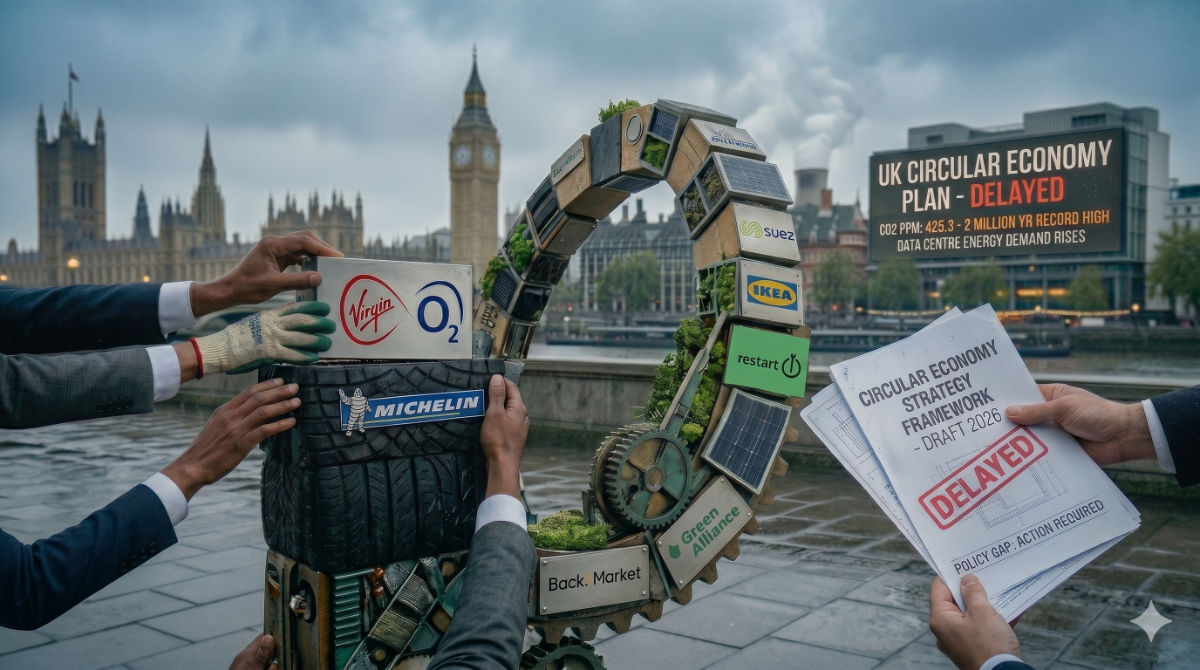
The dangerous reality of England’s stalled Circular Economy Growth Plan

Global brands such as Virgin Media 02, IKEA, Michelin have written to the UK’s Prime Minister, demanding the release of the government’s much-delayed Circular Economy Growth Plan.
Their letter joins another written by Back Market, SUEZ, The Restart Project and Green Alliance, which also pushed for the publication of this important government report.
Business leaders say the delay is harming momentum and economic growth, whilst the lack of clarity from government stymies innovation against competitors in other countries.
As renewed conflict highlights the fragility of global supply chains, business leaders and experts are, once again, voicing concerns over energy sovereignty and raw materials acquisition. Experts believe that the key to mitigating these issues in the future is to transition away from a linear to a circular economy.
As other nations build regulatory walls to protect their resources, big business is losing patience with the UK government’s lack of a plan.
What is the Circular Economy Growth Plan?
When the current UK government came to power in 2024, its creation of the Circular Economy Taskforce sparked a surge of optimism. This body comprises strategists, academics and experts, all tasked with delivering the Circular Economy Strategy for England.
This strategy should facilitate economic growth, create skilled green jobs, reduce the cost of living whilst reducing emissions to hit net zero targets. The plan was also to consider how to keep resources in use for longer, to bolster supply chains and increase economic resilience. The Green Alliance estimates that an expanded circular economy could create over 450,000 decentralised jobs throughout the UK and help drive GDP by 1% (around $25 billion) by 2035.
It is undeniably a complex brief. While many members of the Circular Economy Taskforce cite progress, the government’s delay squanders the opportunity for businesses to lead globally as green spending accelerates.
The global gap: UK vs the world
So how does England stack up against other countries? Scotland launched its Circular Economy Act in 2024 and claims circular activity already contributes over £4 billion to its economy. Wales’ multiple frameworks have led to some of the highest recycling rates in the world, whilst Northern Ireland’s are planning to enhance existing legislation with a Resources and Waste Management Strategy, currently under consultation.
Later this year, the European Union plans to introduce the Circular Economy Act to create a single market for secondary raw materials, making recycled goods as easy to trade as virgin ones.
Although Denmark and the Netherlands lead the EU in circularity, many other member states still follow linear economic models. The EU’s circular economy act should force its transition.
In China, the existing Circular Economy Promotion Law has been folded into the new Ecological Environment Code. This indicates that resource efficiency is no longer a goal, but a legal mandate alongside pollution control and climate change.
In the USA, the EPA published a Circular Economy strategy in 2022 when Joe Biden was president. During Donald Trump’s watch, the focus has pivoted towards controversial recycling techniques with a 54% decrease in EPA funding.
Mexico, South Korea, Brazil, Australia and several other nations are currently debating their own circular strategies. The economic and competitive need for a circular economy is undeniable, yet while legislators stall in debate, the environmental stakes grow more dangerous.
Planet Earth breaks a two million year old record
Indicators show that the amount of CO2 in the atmosphere rose to 425.3 ppm, the highest level ever in the last two million years. Methane (CH4), a greenhouse gas with a warming potential over 80 times that of CO2, is also at a record high.
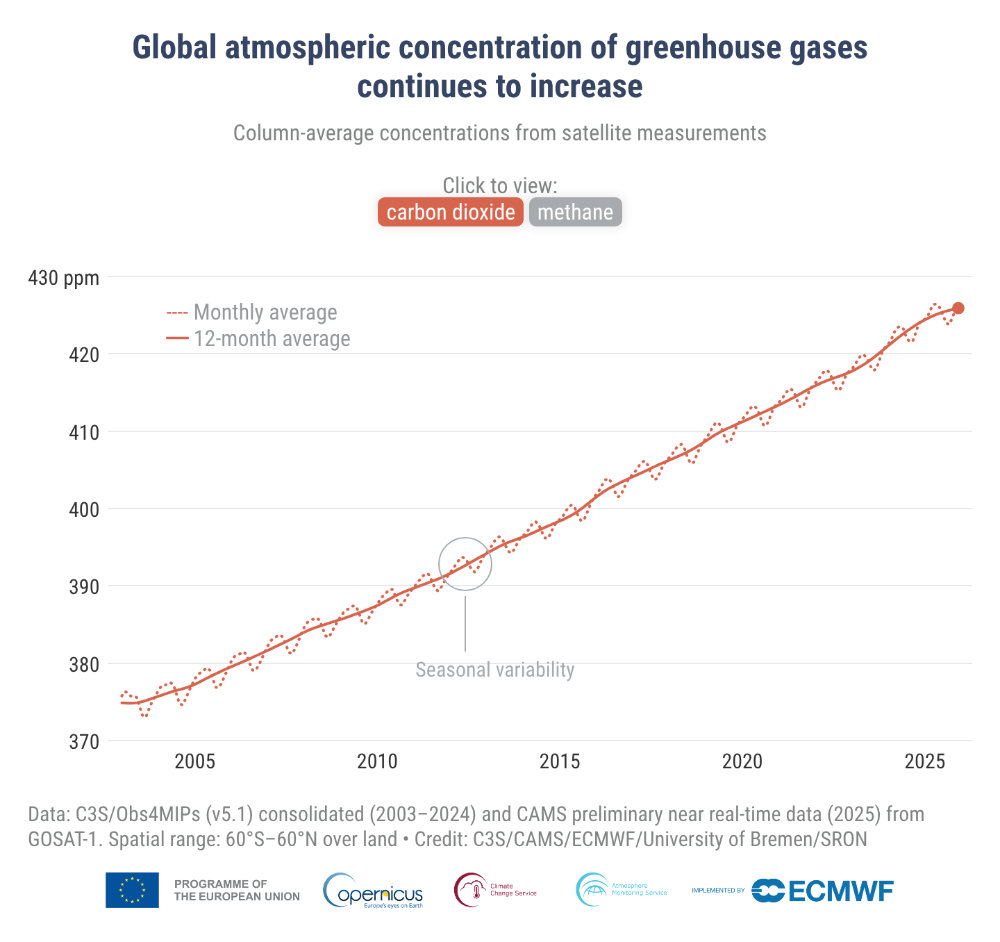
Obviously, these figures are utterly at odds with the reduction agreed in Paris. They highlight that whatever ‘we’ are doing is making less than zero difference in terms of catastrophic climate change.
A report analysing the CO2 reduction measures in the business sector finds little evidence of large or immediate reductions in emissions. Nor any broad shifts in climate policy:
For investors, policy-makers, standard-setters and other stakeholders, headline net zero commitments should therefore be interpreted cautiously as indicators of near-term performance, with greater emphasis placed on interim targets, capex/investment disclosure, and transition planning, which can strengthen the link between long-term commitments and near-term action.
There has been particular criticism for the use of cheap carbon offsets, the Emperor’s New Clothes of corporate carbon accounting, to mitigate Scope 3 emissions.
Circularity is required in the UK’s data sector. Driven by the AI arms race, the UK power grid is facing a connection queue to hook up around 140 data centres. The demand for power in 2025 rose from 41 GW to 125, which is around three times the UK’s peak energy demand of 45 GW.
Whilst government ministers push AI into everyone’s futures, the fear is that without legislated circularity adaptations for things like waste-heat recovery or modular hardware reuse, the UK’s data centres will become environmental black holes.
Energy Transition Investment continues to rise.
Despite legislative delays, there is positive news. In January, BloombergNEF reported that investments in the clean energy transition hit $2.3 trillion in 2025, which is 8% higher than in 2024. Critically, it was the second consecutive year that investments in clean energy outpaced fossil fuels, with the gap between them increasing.
This data shows that despite global conflicts and political resistance, the transition to green energy is resilient and happening at pace.
However, to achieve the climate efficiencies required, simply generating green energy isn’t enough.
Investors must repair, recover and reuse the material infrastructure they purchase with these funds. By feeding these materials into the next investment, we keep recycling and waste to an absolute minimum.
Without circular strategies, England remains linear in its consumption and will blithely swap one environmental crisis for another.
More by Lee Grant
- Beyond greenwashing: A tech leader’s guide to decoding ESG reports
- The AI-carbon paradox: Inside Microsoft’s 78-million-tonne hedge against climate failure
- Big Tech vs Brussels: Why US states are demanding Google, Meta and Microsoft reject EU sustainability directives
- Is Google’s nuclear deal a green energy gamechanger or risky gamble?
About The Author

Lee Grant
NEXT UP


