Trending Topics

 Trending
Is Google’s nuclear deal a green energy gamechanger or risky gamble?

Google recently announced a landmark agreement to utilise nuclear power in order to power its data centres in Tennessee and Alabama. The triumvirate of Google, Kairos Power and the Tennessee Valley Authority (TVA) has collaborated to bolster the US’s growing demand for energy by investing in a ‘homegrown’ solution.
It marks the first time a US utility will purchase power from a GEN IV nuclear facility. While this deal centres on Hermes 2, a 50 megawatts (MW) plant in Oak Ridge, Tennessee, it’s just the beginning: Kairos and Google plan to bring 500MW of nuclear power on-stream by 2035.
As the energy demands of Google’s business soar, its wager on nuclear power could reshape not just its future, but the entire landscape of low-carbon tech infrastructure.
Why has Google gone gaga for nuclear?
AI. As the demand for AI increases, there is a need to power the data centres and connected infrastructure. The problem for Google (and all AI providers) is that turning on an additional 10MW of electric capacity to power another data centre at short notice is almost impossible to do. Especially using low-carbon generation.
Back in 2020, Google’s white paper 24/7 by 2030: Realizing a Carbon-free Future was brimming with ambitious decarbonisation plans to help mitigate climate change. Over 13 million people have watched Google’s CEO Sundar Pichai’s video. He revealed a connection to the flooding in Chennai, near to where he grew up, and the devastating Californian wildfires. He said:
The science is clear. We have until 2030 to chart a sustainable course for our planet or face the worst consequences of climate change.
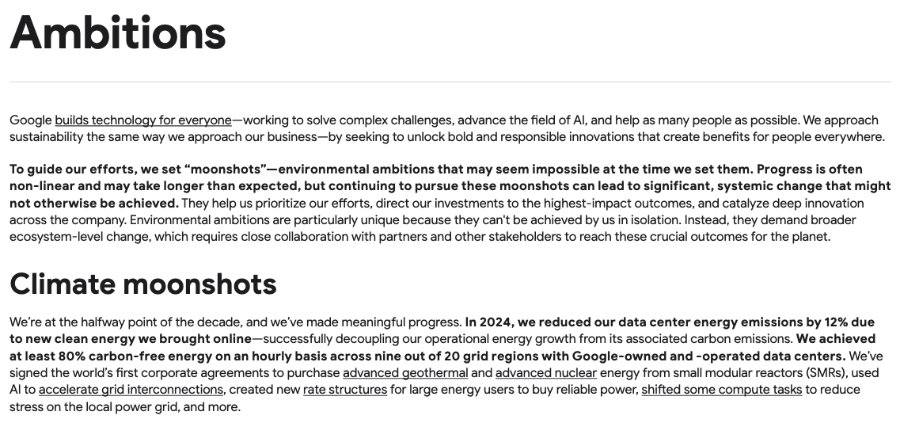
Then AI arrived and the tech execs discarded their climate pledges in the scramble to milk the biggest golden cash cow ever seen. Google’s Net Zero pledge is now a ‘Climate moonshot’. It’s a small footnote under the ironically unambitious sounding subheading as ‘Ambitions’. Behind the scenes, officials have signed contracts for coal-power to fuel the AI machine.
Nuclear power is convenient for tech companies like Google. They can claim their data-centres are running on carbon-free power, so we can all go out and buy their AI services. That way, we keep our consciences as clean as the electricity they generate.
What’s not to love?
Is Google’s nuclear deal ‘green’?
Before I answer, let’s dig a little deeper into this deal. Google’s investment is part of a Power Purchasing Agreement (PPA). PPAs can act as insurance against market uncertainty in the energy sector and this works particularly favourably with nuclear.
Google can claim to its investors and shareholders that it has secured 24/7 carbon-free energy by investing in the upfront capital costs of building a facility. It can then make a further claim in terms of ‘additionality’ (a usual greenwashing tell). This means that Google is bringing additional power to the grid which wouldn’t exist without its investment.
So far, so green…
The flip side is that nuclear projects are prone to delays and cost overruns. Despite the PR fanfare, developers have yet to build Hermes 2, which is only a demonstration project. Construction isn’t due for completion until late 2027.
Hermes 2 is a Small Modular Reactor (SMR), the current poster child of the nuclear power industry, which promotes it as the silver bullet for high-output, carbon-free energy.
Regulators claim that SMRs are based upon the technology within nuclear-powered vessels and are safer than ‘traditional’ nukes because of the inherent design safety.
The (current) elephant in the room is that there are only a handful of SMRs in operation, possibly fewer than three, worldwide. Construction of some SMRs, such as CAREM-25 in Argentina, have been halted, usually because of financial uncertainties.
Is Google gambling with nuclear power?
Yes, but then again, large corporates are increasingly the only entities that can afford to play at the table. 30 or 40 years ago, funding for large infrastructure projects was provided by governments; today, the pockets of many electorates are significantly shallower. Private enterprise, for various commercial reasons, is throwing in huge amounts of cash for a slice of the pie.
Google desperately needs carbon-free power, but there is no certainty that it will get a single volt. Kairos Power, launched in 2016, has built nothing so far. Only time will tell if Google’s investment pays off. It will need to be quick though. Hermes 2 has a planned operating lifespan of 11 years, which is only 12 months longer than Google gives on a Chromebook.
However, Google is far from the only big-tech firm throwing gazillions at carbon-reduction technologies hoping something sticks. Microsoft and OpenAI are among the names who have invested over $1 billion with Helion, an energy startup planning to use nuclear fusion – rather than nuclear fission – to create carbon-free energy by 2028 (in the case of Microsoft). Although fusion has been used to successfully generate electricity, it remains a laboratory project with commercial prospects not expected until the 2040s.
Perhaps Helion, with big tech and big money behind it, can succeed, but we don’t have the time to wait reduce CO2 emissions.
The benefits of nuclear power
Despite Google’s investment, the Tennessee Valley Authority is spending heavily on Hermes 2 and promoting it aggressively.
USP phrases such as bedrock of future energy security and low-cost electricity are potential vote winners at a politically uncertain time for US green issues. The Kairos website features this quote from US Energy Secretary (and former oil executive), Chris Wright:
“The deployment of advanced nuclear reactors is essential to U.S. AI dominance and energy leadership. The Department of Energy has assisted Kairos Power with overcoming technical, operational, and regulatory challenges as a participant in the Advanced Reactor Demonstration Program, and DOE will continue to help accelerate the next American nuclear renaissance.”
One presumes he finished the quote, cackled evilly and then vanished in a puff of smoke.
Kairos is dangling the usual carrots before Tennessee residents: promises of better jobs and a stronger tax base. Supporters claim these benefits will bring more funding for schools and infrastructure.
Why does Google need so much energy?
Let’s look at some numbers.
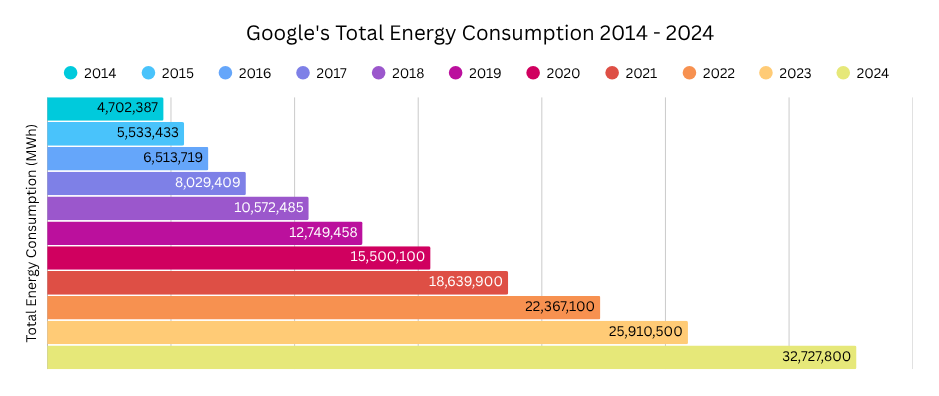
Google’s own data shows that its energy consumption usage for 2024 was 23% higher than 2023, the largest YOY increase it has ever declared. Their figures also reveal that 94% of their 2024 consumption was purely for data centres.
Google’s energy consumption has risen 149.7% in the last decade, so if we extraopolate their data on this average (ignoring the 2024 spike), then their consumption for 2035 would be around 81,000,000 MWh.
Assuming that Hermes 2 achieves its targets and is capable of delivering 500MW, 24/7 by 2035 – and also assuming that Google get access to 100% of this output – then that’s an additional 4,380,000 MWh in 2035. That’s around 13% of 2024’s requirement and only 5% of my estimate for 2035.
In the real world, Hermes 2 will only fuel a tiny part of Google’s infrastructure, but these numbers give some clarity on how much energy Google is consuming and how much energy it will need in the future.
Google is currently pulling a lot of energy from other renewable sources, but it’s nowhere near enough. Nuclear is still regarded at the carbon-free energy source capable of delivering the megawatts that Google needs. And even that is nowhere near enough.
There is another consideration with ‘carbon-free’ nuclear power that needs to be mentioned.
Google’s nuclear deal: just one more thing
Whilst Google throws cash at one end of the problem to ensure that plenty of cash rolls in at the other, we need to take a step back and consider the long-term effects of nuclear power.
Nuclear waste is a problem that no government has yet resolved how to manage safely. Currently, only Finland has a repository for spent nuclear fuel, with Sweden and France ‘under construction’. To illustrate the complexity of storing nuclear waste, the UK has been looking for a permanent waste site since 1976 and still hasn’t found one. The UK stores waste at Sellafield, but that is filling up, and one of the oldest storage silos is leaking radioactive liquid into the ground.
If you think this all sounds utterly preposterous and that something as critically important as nuclear waste storage should be considered before attempting to strap an AI data centre to a new plant, then you’re not alone. There is a reason Matt Groening satirised the US nuclear industry by making bumbling Homer Simpson the safety inspector at the Springfield Nuclear Power Plant.
Whether Google’s nuclear moonshot marks a step towards energy decarbonisation won’t be known for many years, but gambling on untested, and unbuilt, technologies against the rising CO2 levels is dangerous. Google once believed in reducing its CO2 emissions, but it seems that corporate greed has won out.
As the climate crisis tightens its grip and the clock ticks relentlessly toward 2030 and beyond, the race to power AI responsibly is no longer just a business imperative but a critical test of our ability to safeguard our environment.
More by Lee Grant
About The Author

Lee Grant
NEXT UP


