Trending Topics

 Trending
The AI-carbon paradox: Inside Microsoft’s 78-million-tonne hedge against climate failure

Microsoft’s “carbon negative by 2030” pledge, made in 2020, is a moonshot that is drifting further away. Although the tech giant’s latest sustainability reports still present treacly climate-friendly images of bucolic cornfields, beyond the marketing gloss lies a grittier business reality.
The key problem: Microsoft faces an AI-carbon paradox. If it continues to build its AI dreams, the carbon debt required to power them risks bankrupting the company’s 2030 climate goals.
Its latest strategy is to stop buying green promises and become an environmental venture capitalist. Microsoft has built a 78 million-tonne hedge against the very emissions its AI growth is generating.
The collision of two curves
Microsoft made a lot of eco-promises six years ago. Its ambition was to become carbon negative, water positive and zero waste by 2030. Chief Sustainability Officer Melanie Nakagawa has re-iterated Microsoft’s determination that its sustainable initiatives, particularly its Climate Innovation Fund (CIF), would increase the supply of scalable solutions that address the climate crisis.
And there are positive signs. Microsoft’s latest Carbon Removal Portfolio update reveals that it has contracted to purchase from over 60 projects worldwide, utilising ten distinct types of Carbon Dioxide Removal (CDR). Combined, these initiatives could remove around 78 million metric tonnes of CO2 from the atmosphere.
For Microsoft, these investments can be seen as advance market commitments. Guaranteeing a future market for types of CDR that are not fully developed.
Microsoft’s paradox is that whilst the CIF opens nascent markets to recapture CO2, its AI division continues to generate record-breaking levels of emissions.
Microsoft’s emissions problem
If we take 2020 as a baseline, Microsoft’s latest figures show that direct emissions (Scope 1) have increased by 21%. Of significantly more concern is that Microsoft’s Scope 2 emissions (based on the average emissions intensity of the local grid where energy is consumed) have skyrocketed by almost 130%. In terms of pure CO2 (rather than CO2 equivalent, or CO2e), Microsoft continues to emit more than it currently plans to capture.
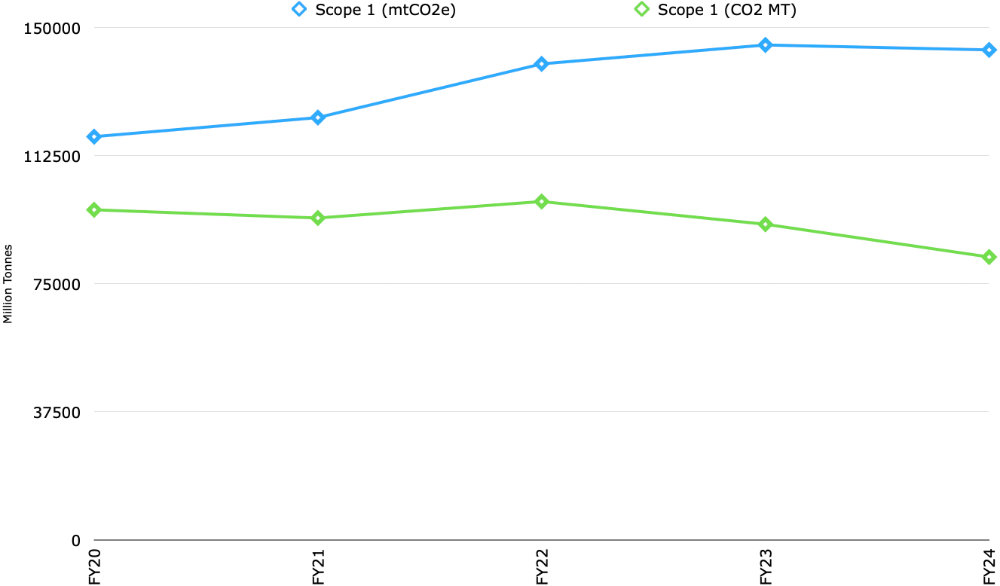
A deeper dive shows that despite this rise, its CO2 output has reduced in some areas. This good news is offset by a worrying increase in Hydrofluorocarbons (HFC) emissions, which are present in refrigeration systems and air-conditioning systems such as those used in cloud and AI data centres. HFCs are potent greenhouse gases that have global warming potentials ranging from hundreds to thousands of times that of CO2.
Despite Microsoft’s carbon removal investments, it needs to rapidly reduce CO2 output and its increasingly potent hydrofluorocarbon footprint.
Engineering the portfolio: low vs high durability
There’s no doubt that Microsoft’s investment portfolio is diverse, with varying levels of durability across the ten CDR types.
It’s a financial hedge. Microsoft can’t rely on one carbon removal method, so it has spread bets over several areas, each with its own risk/reward probabilities.
In 2025, Microsoft invested mainly in IFM (Improved Forestry Management) and ARR (afforestation, reforestation and restoration). Microsoft categorises these as low durability, meaning that most projects will sequester carbon for less than 100 years. Woodlands also carry a higher risk of reversal because fire or timber harvesting can re-release captured CO2 into the atmosphere.
Conversely, Microsoft began 2026 with headline investments in high durability projects such as Gais BECCS and Beaver Lakes BECCS. BECCS (Bioenergy with carbon capture and storage) promises long-term carbon storage for thousands of years but it’s controversial and experimental technology. Although Microsoft’s investment might push the facilities toward completion, the long-term environmental benefit remains theoretical.
The positive is that high durability projects, should they become reality, will be more resilient to fire and flood, making CO2 reversal unlikely.
The venture capitalist of the sky
Microsoft has pivoted from a buyer of sustainability initiatives to becoming a lead investor. Melanie Nakagawa stated that Microsoft will “identify the sustainable innovations with the highest climate impact potential at the edge of commercial adoption and we match the right type of capital and partnership to bring those solutions to market at scale”.
Another positive attribute of Microsoft’s approach is to apply rigorous third-party verification, ensuring every tonne delivered exists. This may lead to a shift away from the junk credits that have plagued the voluntary carbon market.
The scale problem: A drop in the atmosphere
Whether you see Microsoft as an eco-warrior or a venture capitalist, the emission numbers are inescapable. A chasm remains between corporate action and global necessity. Microsoft’s 78 million-tonne removal plan is just a start but it’s pocket change against the 7–9 billion tonnes needed annually to reach the 1.5°C Paris target.
The silicon-carbon trade-off
So here’s the big question: Can a company be truly sustainable while leading a power hungry, climate-damaging tech revolution?
Microsoft is betting that unproven engineered removal can scale as fast as generative silicon. If these technologies succeed, it will have built a new global utility.
If the technologies fail, the carbon debt of the AI era may become unpayable.
Related articles
About The Author

Lee Grant
NEXT UP


