Trending Topics

 Trending
Beyond bandwidth: Beware the rising price of fighting DDoS attacks

This article is part of our Opinions section, where we invite industry professionals to share their views on the most pressing technology questions of our time.
For decades, we have measured how effectively attackers can amplify traffic. Perhaps it is time we also measured how effectively they can amplify costs.
When we think about distributed denial-of-service (DDoS) attacks, we tend to think in terms of volume. Gigabits per second, millions of packets, overwhelmed servers and congested networks are familiar measures of an attack’s intensity. The objective is equally familiar: consume enough resources to degrade or deny access to a service. Yet beneath these technical mechanisms lies a more fundamental principle. DDoS attacks exploit an imbalance between the resources attackers can mobilise and those defenders must expend to maintain availability.
One significant development in DDoS history was the emergence of reflection and amplification attacks. Rather than relying exclusively on traffic they could generate directly, attackers discovered that certain protocols could multiply their effective attack capacity. DNS amplification is a familiar example: a relatively small query, sent with a spoofed source address, can induce a DNS server to direct a substantially larger response toward the victim. The amplification factor compares response size with request size; a 100-byte query generating a 10,000-byte response represents 100-fold amplification. The significance lies not merely in the additional traffic, but in the asymmetry: a small input can impose a disproportionately larger burden.
While this imbalance has traditionally been understood in terms of bandwidth, processing capacity and network connections, consumption-based infrastructure introduces another dimension. Attackers may not need to overwhelm technical resources to cause damage. Instead, they could exploit the economics of operating those resources.
When availability is no longer the only target
Traditionally, successful DDoS attacks have been associated with service disruption. Networks become congested, servers exhaust capacity, and legitimate users experience degraded performance or unavailability. Consumption-based cloud services, however, introduce another consequence of malicious traffic.
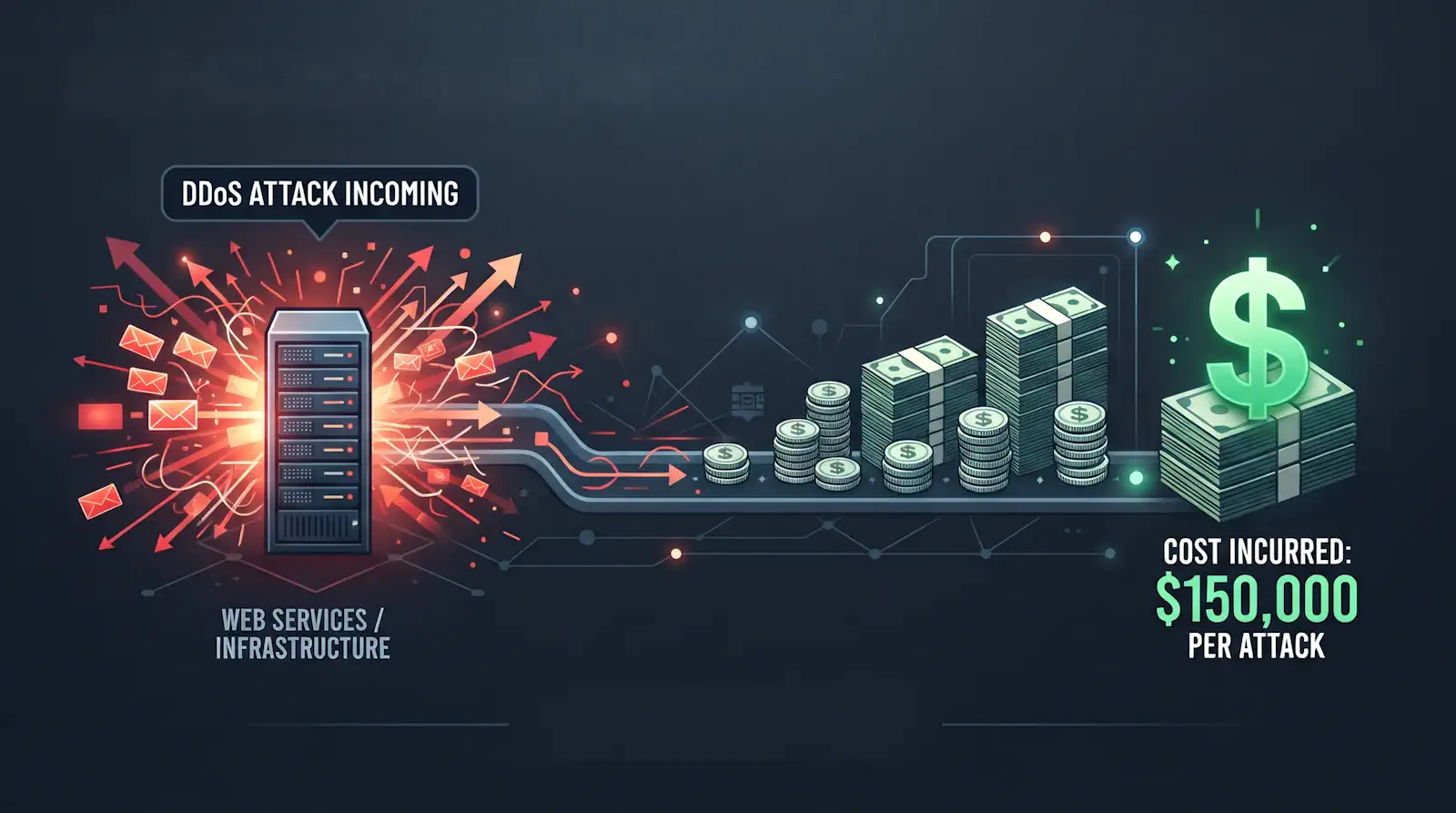
Consider an organisation using a content delivery network (CDN) that charges according to bandwidth or requests processed, or a managed DNS service with usage-based billing. Malicious traffic could potentially increase operating expenses even when the infrastructure accommodates the demand. The website remains accessible, and the services continue functioning, yet the organisation may face unexpected charges. Actual exposure depends on provider billing arrangements, including whether attack traffic is excluded.
This is not a new phenomenon. Research into Financial Denial of Service and Denial of Wallet has examined the financial risks of malicious consumption of metered cloud resources. Still, a question remains: if an organisation withstands an attack technically but suffers significant financial losses, has its defence truly succeeded? Financial exhaustion can also lead to the very outcome traditional DDoS attacks seek: denial of service.
When the wallet becomes the bottleneck
In conventional DDoS attacks, availability is compromised when technical resources become insufficient for legitimate demand. Consumption-based services introduce another point of failure through spending ceilings, usage quotas and prepaid credit balances.
Consider an AI-powered application operating with a fixed consumption allowance or prepaid inference credits. Malicious requests might steadily consume those resources until a spending ceiling or credit balance is exhausted. Where hard limits are enforced, further requests may be rejected until credits are replenished or limits adjusted. Such behaviour is configuration- and provider-dependent; not every billing threshold automatically stops service.
The distinction is that the underlying infrastructure may remain healthy. The AI provider may have ample compute capacity, the network may be uncongested, and the application servers may be functioning normally. Yet legitimate users cannot access the service because the organisation has exhausted its permitted or funded consumption. The bottleneck has shifted from technical capacity to financial capacity: the service is denied not because the infrastructure cannot process the next request, but because its consumption controls no longer permit it.
AI and the changing economics of resource exhaustion
Generative AI and agentic applications make this problem timely. Unlike many conventional requests, AI interactions can initiate workloads that vary substantially in complexity and cost. A prompt might trigger extensive reasoning, document retrieval, multiple model invocations and external tools. Agentic systems can extend that activity into multi-step workflows, sometimes retaining information that is processed again on subsequent calls.
Research suggests these characteristics can be exploited. The 2025 study OverThink: Slowdown Attacks on Reasoning LLMs examined adversarial content that induced excessive reasoning. The 2026 preprint Beyond Max Tokens studied manipulation of agent tool interactions and reported experimental per-query cost increases of up to 658 times relative to baseline execution. Another 2026 preprint, Persistent Billable State, investigated how retained agent context can repeatedly incur processing costs. These are controlled research results, not evidence that the same magnitudes occur in production, and the 658-fold per-query cost increase is not an Economic Amplification Factor.
Unlike DNS amplification, which exploits protocol behaviour to multiply traffic, these attacks can exploit an application’s own reasoning, memory and tool execution to multiply computational work. A small input may trigger prolonged processing, with charges borne by the application operator. The result might be rising expenditure while availability is maintained, or service interruption if malicious consumption exhausts an enforced allowance.
Revisiting the economic amplification factor
Cybersecurity researchers have already considered how to measure such financial asymmetry. In their 2016 paper Abusing Public Third-Party Services for EDoS Attacks, Wang and colleagues introduced the Economic Amplification Factor (EAF) in the context of traffic-related cloud costs. Their formulation compared the economic burden imposed on a victim with the corresponding expenditure of the attacker.
That concept deserves renewed attention as billable resources expand beyond bandwidth to inference tokens, model calls, tool execution and other downstream AI workloads. For an AI-oriented discussion, the underlying relationship can be expressed conceptually as:
Economic Amplification Factor (EAF) = Additional Economic Cost to Defender ÷ Economic Cost to Attacker
Suppose, hypothetically, an attacker spends $5 submitting malicious requests that cause an AI application to incur $2,500 in additional inference charges. The resulting EAF would be 500×: every dollar spent by the attacker generates $500 in additional defender costs. The figure is illustrative, not a measurement of a documented incident.
Applying EAF to AI workloads raises methodological questions. Attacker expenditure can be difficult to estimate, while defender costs may span multiple pricing models. Exhausting prepaid credits or a hard quota can interrupt service without producing an equivalent new cash charge. EAF also measures amplification efficiency, not severity: a very high ratio can coexist with a small absolute loss. The opportunity is therefore not to claim a new metric, but to revisit an existing one and invite researchers and practitioners to test whether its accounting can be adapted to agentic AI.
Rethinking cybersecurity resilience
Traditional DDoS defences remain essential. Network capacity, traffic filtering, behavioural analysis and application-layer protection still help maintain availability. Consumption-based AI applications, however, may also need inference budgets, workload limits, monitoring of downstream costs and controls on agentic execution. Counting incoming requests alone may reveal little about the amount of work each request can initiate.
As digital services become increasingly consumption-based, resilience must account for both the technical capacity to withstand malicious demand and the economic capacity to absorb its consequences. A service can remain online while costs escalate, or become unavailable after exhausting a financial allowance despite healthy infrastructure.
The new economics of denial
DDoS has evolved from brute-force resource exhaustion to attacks that exploit amplification and asymmetry. AI inference and agentic applications introduce new ways for a modest input to trigger substantial downstream work. Economic Amplification Factor offers one useful lens through which to examine that relationship, provided its limitations are understood and its historical origins acknowledged.
For decades, we have asked how much traffic an attacker can generate and how effectively that traffic can be amplified. As the economics of digital infrastructure evolve, perhaps we should also ask: how many dollars of damage can an attacker generate for every dollar they spend?
More from our Opinions section
About The Author

Donny Chong
NEXT UP