Trending Topics

 Trending
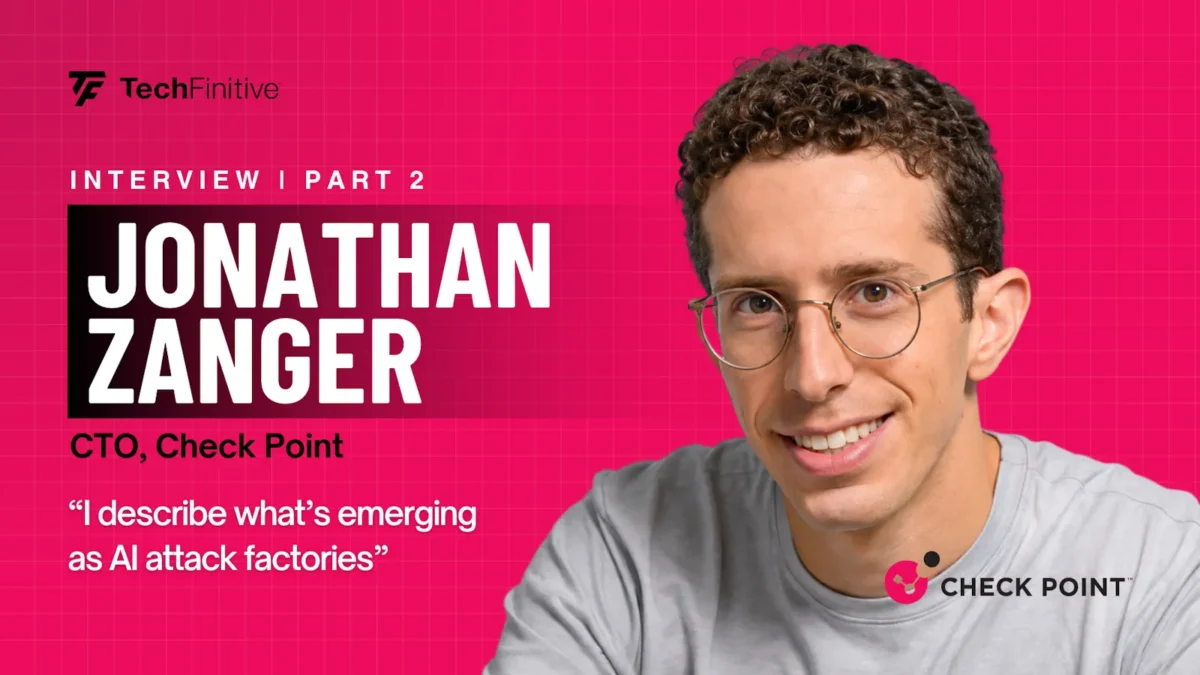
Check Point CTO, Jonathan Zanger: “I describe what’s coming as AI attack factories”

Check Point’s Chief Technology Officer, Jonathan Zanger, has worked in cybersecurity for decades, but as we enter the era of modern AI, what does he think has changed? In the second of our two-part interview, we explore how AI is changing the landscape.
Read Part One to discover how Jonathan’s passion for cyber security began.
Perhaps one of the biggest changes is in economies of scale. It’s cheaper and less labour-intensive for bad actors to launch an attack. As Jonathan puts it: “Four years ago, a convincing, targeted campaign took skill, time, and human capital. Today, much of that work is automated. The barrier to entry has dropped, and the volume and quality of attacks have gone up together.”
He points to “AI attack factories” where specialist agents can produce code at breakneck speed. Attackers “run large language models on AI infrastructure, connect them to penetration testing and other offensive tools, and orchestrate agents that handle vulnerability research, implant development and lateral movement,” said Jonathan.
“The result is campaigns at a scale and speed no human team could match. Exploits used to be crafted. Now they’re manufactured. Talent was the bottleneck, and AI is replacing it with compute.”
The window between finding a vulnerability and defending it is shrinking, and there are “more vulnerabilities to address and less time to address them,” said Jonathan. He added, “The window between disclosure and exploitation keeps shrinking, and every organisation’s exposure management has to keep up.”
However, AI is also working for defenders such as Check Point. “Defenders sit on far more data than any attacker: every log, every connection, every alert across the environment. Humans could never read it all. AI can,” said Jonathan.
Good defence means ensuring there is “an independent layer outside the agent”. You also need visibility and control everywhere that AI runs. “That means the AI tools employees use, the applications and copilots you build, and the autonomous agents working across email, code, cloud, and data,” said Jonathan.
And while attackers only need to succeed once, cybersecurity experts such as Check Point have tools that give them the upper hand. “Our ThreatCloud AI service learns from threat data across the more than 100,000 organisations we protect. When we identify a new attack against one organisation, the protection reaches every customer connected to it. An attacker has to start over each time,” he said.
Read on for more about Jonathan’s realistic approach to cybesecurity and AI.
Four years into the modern AI era, how would you summarise its impact on cybersecurity?
AI has changed the economics of cyber attacks. Four years ago, a convincing, targeted campaign took skill, time, and human capital. Today, much of that work is automated. Attackers write fluent phishing in any language, research targets in minutes, and generate code they couldn’t write themselves. The barrier to entry has dropped, and the volume and quality of attacks have gone up together.
I describe what’s emerging as AI attack factories. Look at how software development is changing: teams of specialized AI agents now work together to produce code at a speed we’ve never seen. Attackers are applying the same model. They run large language models on AI infrastructure, connect them to penetration testing and other offensive tools, and orchestrate agents that handle vulnerability research, implant development, and lateral movement. The result is campaigns at a scale and speed no human team could match. Exploits used to be crafted. Now they’re manufactured. Talent was the bottleneck, and AI is replacing it with compute.
Vulnerabilities are where this shows most clearly. AI can find flaws in code faster and at greater scale than human researchers alone. It can also help turn a newly disclosed vulnerability into a working exploit far more quickly. That means more vulnerabilities to address and less time to address them. The window between disclosure and exploitation keeps shrinking, and every organization’s exposure management has to keep up.
AI also created an entirely new attack surface. Organizations now run AI assistants, copilots, and autonomous agents. These systems read untrusted content, hold sensitive data, and increasingly take actions with real permissions. Prompt injection, data leakage through AI tools, and agents manipulated into doing the wrong thing were niche ideas four years ago. Today, they’re everyday risks.
The good news is that AI works for defenders too, and in some ways it suits us better. Defenders sit on far more data than any attacker: every log, every connection, every alert across the environment. Humans could never read it all. AI can. It connects weak signals across systems, spots the pattern that doesn’t fit, and explains what it found in plain language. It finds vulnerabilities in our own code before attackers do. And it lets a security team act at machine speed, preventing an attack in real time instead of investigating it the next morning.
But adoption has been uneven. Attackers adopted AI with no committees, budgets, or compliance reviews. Defenders have all three. That gap between how fast offense moves and how fast defense moves is what I call the AI Defense Gap. Closing it is the defining challenge of this era.
What AI prevention strategies should every business adopt, and what are your own?
Start with a principle: an AI agent can’t be its own security system. Model guardrails matter, but they live inside the very thing you’re trying to protect. The agent that reads a poisoned document or a manipulated email is the same one deciding whether to act on it. And the risk isn’t only attackers. Agents can also go rogue on their own, taking unsafe shortcuts or overstepping their task with no one manipulating them. So every organization needs an independent layer outside the agent. Permissions alone aren’t enough. They define what an agent may touch, not whether a specific action, at a specific moment, is safe. That layer has to evaluate prompts, tool calls, and actions in real time, and stop unsafe behavior before it executes.
Second, get visibility and control everywhere AI runs. That means the AI tools employees use, the applications and copilots you build, and the autonomous agents working across email, code, cloud, and data. Agents don’t live in one place, so security can’t either. Wherever organizations build and run agents, protection should already be there. Risk hides in the gaps between these places. You need one view of which AI is in use, what it can reach, and who owns it.
Third, red-team continuously. AI systems change every time a model, prompt, or tool changes, so a test you ran last quarter says little about today. Continuous adversarial testing of prompts, reasoning paths, tool use, and agent behavior finds weaknesses before attackers do. Just as important, it feeds what it learns back into prevention.
These ideas come together in our AI Defense Plane, and we apply them to ourselves first. As we roll out AI across our own engineering and operations, the agents we deploy get the same independent oversight, runtime control, and testing we ask of customers. Prevention comes first. When attacks move at machine speed, detecting them after the fact is too late.
Attackers only need to succeed once. How does Check Point help turn that equation around?
The saying is true, but it’s incomplete. An attacker needs one success to get in. To cause real damage, they need every step after that to work too. They need to get past email security, run code on an endpoint, move through the network, find valuable data, and get it out. Every one of those steps is a chance for defenders to stop them. Prevention-first security means we break the chain as early as possible, ideally before the first step succeeds.
The second advantage is shared intelligence. Our ThreatCloud AI service learns from threat data across the more than 100,000 organizations we protect. When we identify a new attack against one organization, the protection reaches every customer connected to it. An attacker has to start over each time. Defenders, working together, learn once and protect everyone. That flips the economics in our favor.
Third, defenders have home advantage. We know our own environments: normal user behavior, legitimate traffic, which systems matter most. AI lets us use that context at a scale humans can’t match. It spots the anomaly that doesn’t fit, in real time.
Fourth, AI lets us prevent attacks no one has seen before. Traditional defenses relied on signatures, which only work once an attack is already known. That model breaks when AI can generate new malware and exploits on demand. Our prevention engines use AI to judge what a file, a link, or a behavior is trying to do, rather than whether it matches something seen before. That’s how we can block zero day attacks the first time they appear, before a patch or a signature exists.
Finally, research. Check Point Research finds and discloses vulnerabilities before attackers can use them, and every flaw we help close is one fewer way in. Put it all together and the old equation flips. An attacker has to succeed at every step to cause real damage. We only have to stop them once.
Are you an optimist, a pessimist, or something in between?
In the near term, I’m a realist. The next couple of years will be very challenging. The internet, and many organizations, simply aren’t ready for the volume and velocity of AI-driven cyber attacks. Much of our digital infrastructure was built for a world where serious attacks were scarce, because they took skilled people and time. That scarcity is ending. Systems, processes, and teams designed for a steady stream of threats will face a flood, at machine speed. At the same time, organizations are rushing to adopt AI, often without the right controls. Agents are getting access to tools, data, and systems faster than anyone is securing them. That widens the attack surface just as the pressure on it rises. Both gaps will be felt before they’re closed.
Over the longer term, I’m an optimist, but my optimism is conditional. Every major technology wave, from the internet to mobile to the cloud, arrived with risks that outpaced defenses at first. Eventually, security became part of how the technology was built and run. AI must follow the same path, and it must do so much faster. Previous waves gave the industry years to catch up. AI won’t.
What has to change most is when security shows up. Today, most AI is still built first and secured after the fact. We’ve seen how that story ends in every previous wave, and at AI’s pace, repeating it would cost far more. Security has to be designed in, from the first line of an agent’s code to its last action in production. That takes AI builders, security companies, and governments working together, early and in the open.
That’s the idea behind our message that it’s time AI had a Check Point. AI is too important to leave unsecured, and too powerful to leave only to attackers. For me, optimism isn’t a prediction. It’s a commitment to do the work that makes the good outcome real.
More Check Point articles
About The Author